
![[:]](/data/avatars/m/58/58936.jpg?1707488068)
I grow several Ipomoea species including the plant formerly known as Rivea corymbosa, now considered by many to be in the genus Ipomoea.
It just so happens that many Ipomoea with Periglandula fungi have visible mycelia on the adaxial surface of their leaves.
One might note that some of the early ethnobotanical literature noted that in some cases individual plants were used, as opposed to the plants in general, and that in some cases the parts used were leaves, rather than seeds.
The Periglandula fungus is the producer of ergot alkaloids in the Ipomoea species that have the symbiotic fungus. In those species, for alkaloids to be made in significant amounts requires significant amounts of fungal mycelia. Plants in the genus that bear minute hair like trichomes upon their adaxial surface are largely unable to provide the adaxial environment that the fungus thrives in and consequentially such species, like Ipomoea nil, do not accumulate significant amounts of ergot alkaloids. However plants with smooth adaxial leaf surfaces are able to sustain signifigant amounts of mycelia, which thrives in the folded leaves.
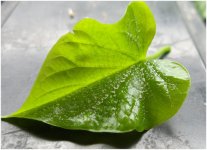
In the image I am sharing here I took a folded leaf of Ipomoea corymbosa and opened it, exposing the colony of Periglandula mycelia.
I should like to add that some studies indicate that Ipomoea species with the appropriate fungal colonies can accumulate significant amounts of alkaloids in their tender young leaves.
I am posting this material somewhat casually, rather than going through the literature and scientific papers and providing exact references for the claims.
Please forgive me for not providing a bibliography for this subject at this time.
For more scientific information about this topic please check out this thread.
It just so happens that many Ipomoea with Periglandula fungi have visible mycelia on the adaxial surface of their leaves.
One might note that some of the early ethnobotanical literature noted that in some cases individual plants were used, as opposed to the plants in general, and that in some cases the parts used were leaves, rather than seeds.
The Periglandula fungus is the producer of ergot alkaloids in the Ipomoea species that have the symbiotic fungus. In those species, for alkaloids to be made in significant amounts requires significant amounts of fungal mycelia. Plants in the genus that bear minute hair like trichomes upon their adaxial surface are largely unable to provide the adaxial environment that the fungus thrives in and consequentially such species, like Ipomoea nil, do not accumulate significant amounts of ergot alkaloids. However plants with smooth adaxial leaf surfaces are able to sustain signifigant amounts of mycelia, which thrives in the folded leaves.
In the image I am sharing here I took a folded leaf of Ipomoea corymbosa and opened it, exposing the colony of Periglandula mycelia.
I should like to add that some studies indicate that Ipomoea species with the appropriate fungal colonies can accumulate significant amounts of alkaloids in their tender young leaves.
I am posting this material somewhat casually, rather than going through the literature and scientific papers and providing exact references for the claims.
Please forgive me for not providing a bibliography for this subject at this time.
For more scientific information about this topic please check out this thread.
Last edited:


