• Members of the previous forum can retrieve their temporary password here, (login and check your PM).

Hybrid-Hybrid Tek

Migrated topic.
Simply_Me said:
Why the edit and the change to cold Nap in warm Solution?

The result of my first pull (warm N in warm S) wasn't that clean as I was looking for, but cold N in warm S did the job for me.

Happy extracting, tseuq

 

The result of my first pull (warm N in warm S) wasn't that clean as I was looking for, but cold N in warm S did the job for me.

Happy extracting, tseuq[/quote]

Hey, Tseuq, glad to be of any inspiration here. Happy you had success, as well. Here is my "take" on the Temp. thing.... SO any fats will dissolve easier Warm or HOT. So, if you want the least amount of fatty, yellow gunk, then cool solvent in warm solution seems to be the better option. I've never done cold into cold just to test it, but the standing wisdom was the warmer the solvent, the more D would transfer across, BUT, it will definitely bring some fats with the heat. I dry it, chop it up and mix it back in UNLESS it looks "dirty" to me. Then, I re-x... Otherwise, I'm of the assumption that some beta carbolines come with those fats and I like the effect better than the pure white, white.

Love & Light
A-K
 
Alev-Kev said:
JefFlux said:
Hi Alex-Kev,

First attempt at an STB (Cyb's hybrid salt tek) yielded exactly %3. Have been looking to see if it is possible to improve on this, as using 'max ion' bore no discernible increase.

As one more familiar with A-B on acacia, I have often wondered if the acidic heat bath stage of Cyb's teks could be improved by simmering the acidic bark-solution in a pot over an element on low heat (60 degrees Celsius) avoiding evaporation ..rather than the standard heat bath method?

Or even just 3 acidic boils and then discarding the bark as one would do for ACRB.

FLux

Hey, Flux
Thx for taking the time... I do, almost boil the whole time, simmering for reduction with water,and then white vinegar. I did strain a cal times, but I noticed that by removing/straining bark that my yields went down. When I leave it in, yields increase. So, I guess moving to the basing of the solution, some alkaloids are still trapped in the bar. I, also, go under the 1:1 ratio for lye, but I don't have a pH meter. The trial n error method produced a seeming 'sweet spot' for enough to keep emulsions to next to nothing, while releasing & binding all the D effectively. I should probably get a tester just for accuracy sake, but all $ has been put into good glass for my experiments, at this point. Thanks again for stopping thru...
A-K
I would definitely keep the bark, my rationale now that that one long simmer (even sub simmer at say 80 degrees) for a few hours would be more effective than 8 hour heat bath soak. I use citric acid as it has no discernible smell and takes one teaspoon per litre to get a pH of 2.5-3. A digital pH metre was the best thing I invested in for extractions in the early day and it made me realise how unreliable pH strips were! Also emulsions in my experience result from the solution not being aqueous enough combined with too much agitation.

And thanks for doing the warm Naptha vs Cold solution test as I've often wondered about this. Also on the subject of temperature, can anyone explain the rationale behind Cybs advocating of cycling the heat bath..i.e. arming then letting cool, then warming again the cooling again. I see many people just putting the solution oin a constant heat bath
 
I would really like anyone to try this and report results. I am still killing the numbers with this one.

A-K
 
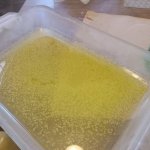
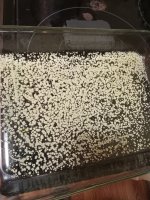
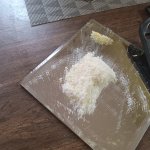
Ohhhhhh... FAMILY, I've done it again! Doin a step by step, with pics, for those intonthe details!!
HYBRID-HYBRID TEK
1. chop bark in NINJA
2. Pour into pot with simmering water, 1:1 ratio bark to H²O mL.
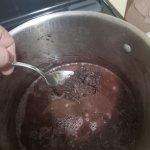
3. Simmer until water reduces and pot looks like sloppy brown oatmeal.
4. Remove from heat and allow to cool to close to room temp.
5. Put pot into freezer (mine is at 4° F)
6. Freeze overnight.
7. Put onto low burner in the morning after freezing and bring it back to slow simmer.
8. Add white vinegar, 1:1 ratio of bark and liquid added. Add ½ as much purified water and bring to rolling simmer for an hr while stirring periodically.
9. Add measured salt at the end of vinegar cook. 25-30g per 100g bark. Stir semi vigorously and you'll see it turn from dark brown to purplish red liquid. Turn off heat. Allow to cool for a time before decanting into pulling receptacle.
9. Put Pyrex mixing bowl into freezer along with a jug of purified water, to get extra cold before mixing your measured NaOH. (lye). Mix slowly while stirring the entire time or it will cake to the bottom of the bowl. This, also, gives off a fuck ton of heat, so the cold bowl and cold water help to cool it a bit before pouring it into the pulling receptacle with the bark soup.
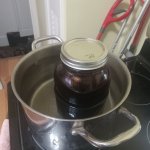
10. After capping and gently mixing the pulling receptacle, place the jar in a pot of warm but not hot or cold water. The lye will continue to heat for 20-30 mins after adding, so the Luke warm bath helps to cool it down, so you can safely add solvent for pulling.
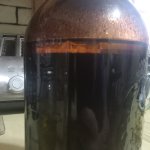
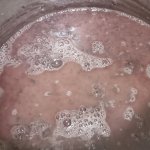
11. Wait for pulling jar to be warm to the touch, but not hot when you gently shake or mix it. When it is, add measured solvent, cap it and mix. If you see a bubble layer forming on top, that is an emulsion. Just add 25g-30g more salt directly, cap it and mix well. The salt will break that down.
12. After several mixes waiting for solvent and soup to separate, you can now pull your solvent layer with a glass turkey baster. If any soup comes with it, don't panic, we can clean that up in a step called CLARIFYING.
13. Add more solvent and mix again and wait for separation a few times before pulling into the same pull jar... repeat steps 12-13 one more time.
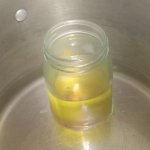
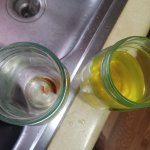
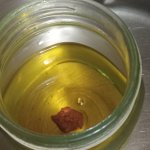
14. Take pull jar to a small pot of water on a burner. Place jar in hot water, lightly swirling jar around. All the black soup will coagulate in the middle together. Then, you can gently pour the clean solvent into another jar, leaving the black mess in the first.
15. WAIT UNTIL SOLVENT IS COOL BEFORE PANNING!
Warm solvent will cause the D to crashout into the solution instead of adhering to the pan, making the Pour Off very difficult or needing a coffee filter to catch all the spice. Scraping that is A PAIN...
16. Cover glass pan with plastic wrap and place in freezer. If you have a cold freezer that isn't opened a lot by people in the house, that is ideal. 4-6 hrs in the cold, then gently pour off solvent, taking care not to pour your spice with it.
17. Set pan on its side, propped in front of a small fan in a well ventilated area until the solvent left evaporates and the pan is dry.
18. SCRAPE UP THE MAGIC AND MEASURE... 20251001_090610.jpg20251001_090544.jpg20250822_125934.jpg20250822_125857.jpg20250822_130115.jpg20250822_121451.jpg20250822_122416.jpg20250822_171840.jpg20250228_213506.jpg20250909_174252.jpg
 
lovely tek will give it a try, quick question how do you deal with condensation after you remove the solvent from your glass dish after freezing. I noticed at times a water droplets are formed on the side of the wall and they tend to drip in to the drying magic. I have practiced flipping the dish upside down but that reduces the airflow and slows the drying process.
 
Back
Top Bottom