• Members of the previous forum can retrieve their temporary password here, (login and check your PM).

Improving Information on Caesalpinia spp.

Migrated topic.

wearepeople

Rising Star
Senior Member
OG Pioneer
Hello all,

I've done a little reading but haven't found anything substantial or scientific on the plant mentioned above. Light references to ayahuasca, Chinese medicine, seeing spirits.


Here is a running list of species:

pulcherrima
mexicana
cacalaco
paraguariensis
gilliesii
ferrea
bonducella
echinata
coriaria
sepiaria

I have direct access to gilliesii, pulcherrima, mexicana, cacalaco (var. smooth), & cacalaco (var. thorny).

Will be learning how to do appropriate testing.

If anyone would like to help find/test these species please do!


Thank Ya Kindly,
Wearepeople
 
Unpublished tlc of Caesalpinia gillesii and C. pulcherrima [The latter is a plant held to be especially sacred to Shiva.] showed the suspected presence of DMT and/or 5-MeO-DMT in flowers, flower-buds, stem and roots. Inflorescences were particularly heavy with assorted Xanthydrol reactive materials. tlc by Johnny Appleseed. [Seed grown or commercial plants. Co-tlc with known standards/ color with Xanthydrol spray.]

Schultes & Hofmann 1980 li. 327, mentions that the first Chinese herbal, the Pen-ts'ao ching, says of Caesalpinia separia: the flowers "could enable one to see spirits and, when taken in excess, cause one to stagger madly. If taken over a prolonged period, they produce somatic levitation and effect communication with spirits." Seeds said to be burned similar to henbane for summoning spirits. They cited Li 1977.]

from:

 
Caesalpinia spp.

Caesalpinia gilliesii

In stem-bark (with 1 other band) 1996 assays.
In roots. (Nice band with two others present) June

1995, also 1996. tlc by J. Appleseed (Xanthydrol) (Ref. Trout's Notes)

Caesalpinia pulcherrima

In flowers and buds. (26 August 1995) tlc by J.

Appleseed 1995. [August 1994 of a small sample of dead flower petals did not detect this alkaloid but did show a faint indolic band at a lower Rf.] In roots (nice band) June 1995, also 1996. tlc by J. Appleseed 1995 (Xanthydrol) Desmodium sp. (Wild species, not yet positively iden- tified; Austin, Tx.) Trace amounts in aerial portions (co-occurring with suspected DMT). tlc with Xanthydro1 spray, 24 June 1995. (Ref. Trout's Notes)

From the Nexus:
 
Guess it's time to start getting into this TLC ordeal. 😁


And, if a mod sees this, do you think it could be moved to the Collaborative Research section?

Thank Ya Kindly,
wearepeople
 
Caesalpinia sepiaria - Yun Shih - {hsu-kram-po}
..known in Africa to have purgative properties and is used to treat snake-bites..
• Burkill reports that in southern India the bark is used for tanning. Crevost and Petelot consider the roots as purgative. Kirtikar and Basu state that in Chamba the bruised leaves are applied to burns. According to Stuart the seeds are said to have astringent, anthelmintic, antipyretic, and antimalarial properties. They are said to be used for the most part in the treatment of ague. http://www.bpi.da.gov.ph/Publications/mp/pdf/p/puto.pdf
[Medicinal Plants of Myanmar]
For centuries this plant has been rumored to possess magical properties. In China, Yun-Shih has been used as a medicine to treat many different ailments. It was also written about in ancient Chinese herbal medicine books that claimed that the flowers “contain occult powers” and that they allowed “one to see spirits but make one idiotic if consumed in excess.” The medicinal books also claimed that the flowers “produce levitation of the body and promote communication with the spirits.”

TRADITIONAL USE: The historical evidence detailing this plant’s usage is scant, although there are several sources that allude to its psychoactive properties. Research conducted my renowned Chinese Botanist, Hui-Lin Li, in the 1970’s has shown a strong probability that Yun-Shih was used throughout antiquity for its psychoactive and hallucinogenic effects. Recent research into this plant’s psychoactive properties has shown that there are compounds produced in the flowers, stems and roots that should be considered for further in-depth phytochemical analysis.

TRADITIONAL PREPARATION: Very little is known about the traditional preparation of this magical plant. The few records that still exist mention two distinct preparation methods. The first method employed by the ancient Chinese dried, crushed and powdered the seeds of Yun-Shih and combined them with the seeds of Lang-Tang (Hyoscyamus Niger) to make an incense that possessed psychoactive properties when burned. The second method explains that the flowers were added to water to make a tea that could be used to communicate with the spirits and dispel evil forces. There are only anecdotal accounts of modern preparations, so there still needs to be a lot more research conducted on this little known plant.

MEDICINAL USES: Chinese herbal medicine books list several uses for this plant. The most common use was to use the flowers to make a tea that would be consumed to treat intestinal worms. There are also accounts of this plant being used to treat malaria and skin infections.

TRADITIONAL EFFECTS: There are no firsthand accounts of Yun-Shih’s effects, although there are many historical and alleged effects. The ancient Chinese medical /herbal books describe the effects of consuming large quantities as being levitation, lunacy, visual hallucinations, communication with spirits and staggering madness.
[Entheology.org - Preserving Ancient Knowledge]
 

Attachments

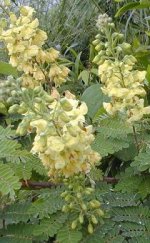
  • 33-Caesalpinia_Sepiaria.jpg
    33-Caesalpinia_Sepiaria.jpg
    28.6 KB · Views: 0
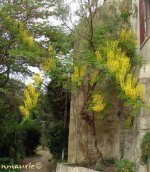
  • caesalpinia_sepiaria1.jpg
    caesalpinia_sepiaria1.jpg
    23.5 KB · Views: 0
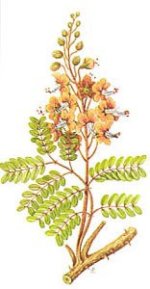
  • 33-caesalpinia_sepiaria-300.jpg
    33-caesalpinia_sepiaria-300.jpg
    18.7 KB · Views: 0
Hi all,

I did an A/B followed by FASA on C. pulcherrima leaves and flowers.

Unfortunately, I didn't take many notes.

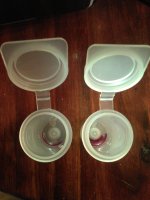
But I did yield something. I just tested a little bit of the yield with the Bunk Polices Ehrlich reagent kit. The reagent kit tests for DMT, 5MEO DMT, and other indoles. I did the test side by side to Freebase DMT (left vial). The C. pulcherrima test (right vial) had the exact same color change characteristics as the free base DMT.

2 drops of reagent were added to the C. pulcherrima whereas only one drop was added to the Free Base. This was not by choice, just by accident.
 

Attachments

  • 0820131051.jpg
    0820131051.jpg
    1.4 MB · Views: 3
Fantastic work wearepeople!!!! I never even looked at this species, untill now.
I'd be very interested to see home chromatography, and the results of testing.

It is a pea you say.. or is in the family? Yeah the Peas should have some magic.
Next up: magic beans! Come on jack, where do you think that story came from?
 
Keeper Trout said:
At least one Ecuadorian ayahuascero operating in the US uses a Calliandra he calls bobinsana instead of chacruna.

Keeper Trout, I did a little digging and bobinsana is a reference to Calliandra angustifolia.

Unfortunately, I haven't seen this Calliandra.

I have seen many, many Calliandra californica and Calliandra eriophylla in my part of the world.

Maybe we should start a Calliandra research thread as one species has a tentative confirmation.
 
Thought I might tack on a little picture of Calliandra californica I got the other day for interest/reference purposes. I'd like to do some testing on it soon. Very cool little plant.
 

Attachments

  • ccali.jpg
    ccali.jpg
    337 KB · Views: 0
This one gave me a chuckle at the mental image
Caesalpinia jamesii (Torr. & Gray) Fisher
James' Holdback; Fabaceae
Zuni Drug (Veterinary Aid)
Infusion of plant given to sheep to make them "prolific."
Stevenson, Matilda Coxe 1915 Ethnobotany of the Zuni Indians. SI-BAE Annual Report #30 (p. 54)
I wonder if it would make people "prolific" too :lol:
The Comanche use that species' roots as food.
 
Li, Hui-Lin. 1977. Hallucinogenic plants in ancient Chinese herbals. Botanical Museum Leaflets Harvard University 25(6):161-181.
Yun-shih — Caesalpinia sepiaria Roxb. — Plate 25

This is a drug plant in the Chinese pharmacopeia from early times. It is a shrubby vine of the Legume family widely distributed in China among the provinces south of the Yangtse River and in other warmer countries of Asia. The stem is hollow and densely beset with backwardly hooked spines. The leaves are doubly pinnate-compound with 6-16 pinnae each with 12-14 elliptical pinnules. The flowers are yellow and arranged in racemes. The flat pods are about 3 inches long, each containing 5 or 6 dark seeds, with a somewhat unpleasant odor.

The root, flowers, and seeds are all used in medicine. According to Li Shih-chen (22), the root is used to assist removal of a bone in the throat. The seeds are attributed to have astringent, anthelmintic, antipyretic and antimalarial properties. The flowers are attributed in the early herbals as having certain occult properties, and in at least one instance, the seed is similarly attributed. The first herbal, Pen-ts'ao ching (1) thus says, "[The flowers] could enable one to see spirits, and when taken in excess, cause one to stagger madly. If taken over a prolonged period, they produce somatic levitation and effect communication with spirits." Tao Hung-ching (7) states that "[The flowers] will drive away evil spirits. When put in water and burned, spirits can be summoned." The same author, in another instance, says that "The seeds are like Lang-tang (Hyoscyamus niger), if burned, spirits can be summoned; but this [sorcery] method has not been observed."

Li Shih-chen (22) admits the occult properties attributed to the flowers of these early records but expresses doubts about their beneficial effect on prolonged use. Remarking on the statement given above by the Pen-ts'ao ching, he says that "As the flowers of Yu'n-shih enable one to see spirits and drive one to madness, how can it be possible to gain somatic levitation by taking it over a long time? This shows that this is an error in these old works."

Caesalpinia sepiaria has not been noted as a hallucinogenic plant in modern works. In fact, as far as I am aware, it has not been investigated medicinally or chemically.

The International Legume Database and Information Service indicates that Caesalpinia decapetala (Roth) Alston. is the accepted botanical name of which C. sepiaria is a synonym. A quick search turns up some studies on the chemical constituents of this plant:

Li M, Zhang C, Chong L. 2002. [Studies on chemical constituents of Caesalpinia decapetala (Roth) Alston]. Zhong Yao Cai 25(11): 794-795. [Link] [Article in Chinese]
RESULTS: Seven compounds were isolated and elucidated as lupeol acetate(I), lupeol(II), oleanoic acid(III), pentacosanoic acid 2,3-dihydroxypropyl ester(IV), 1-(26-hydroxyhexacosanoyl)-glycerol(V), stigmasterol(VI), beta-sitosterol(VII).

Wei XH, Yang SJ, Liang N, Hu DY, Jin LH, Xue W, Yang S. 2013. Chemical constituents of Caesalpinia decapetala (Roth) Alston. Molecules 18(1):1325-1336. doi: 10.3390/molecules18011325. [Link]
Abstract

The current study targets the chemical constituents of Caesalpinia decapetala (Roth) Alston and investigates the bioactivities of the isolated compounds. Fourteen known compounds were isolated using column chromatography, and structural identification was performed by physical and spectral analyses. The biological activities of the compounds were also evaluated by 3-(4,5-dimethythiazol-2-yl)-2,5-diphenyl tetrazolium bromide (MTT) and 2,2-diphenlyl-1-picrylhydrazyl (DPPH) assays. Emodin (6), baicalein (9), and apigenin (12) displayed antitumor activities against the MGC-803 cell line, while quercetin (2), rutin (5), baicalein (9), and epicatechin (13) showed stronger DPPH scavenging activities compared with ascorbic acid. Andrographolide (1), quercetin (2), bergenin (4), rutin (5), emodin (6), betulin (7), baicalein (9), polydatin (10), salicin (11), and apigenin (12), were obtained from C. decapetala (Roth) Alston for the first time.

Kiem PV, Minh CV, Huong HT, Lee JJ, Kim YH. 2005. Caesaldecan, a cassane diterpenoid from the leaves of Caesalpinia decapetala. Chem Pharm Bull (Tokyo) 53(4): 428-430. [Link]
Abstract

A new cassane diterpenoid, caesaldecan, was isolated from Caesalpinia decapetala with eight known compounds, spathulenol, 4,5-epoxy-8(14)-caryophyllene, squalene, lupeol, trans-resveratrol, quercetin, astragalin, and stigmasterol.

Qiong ZHANG, Xue-Ting LIU, Jing-Yu LIANG, Zhi-Da MIN. 2008. Chemical Constituents from the Stems of Caesalpinia decapetala. Chinese Journal of Natural Medicines 6(3): 168-172. [Link]
ABSTRACT

AIM To study the chemical constituents from the stem of Caesalpinia decapetala.

METHODS The compounds were isolated by column chromatography using silica gel and Sephadex LH-20, and their structures were identified on the basis of spectral analysis.

RESULTS Seven compounds were obtained from the ethanol extract and their structures were elucidated as 6′-hydroxy-3, 4-(1′′-hydroxy-epoxy-propane)-2′, 3′-(1′′β-hydroxy-2′′′-carbonyl-cyclobutane)-1, 1′-diphenyl (1), octacosyl 3, 5-dihydroxycinnamate (2), 2′, 4, 4′-trihydroxychalocone (3), bonducellin (4), 7, 3′, 5′-trihydroxyflavanone (5), daucosterin (6), and β-sitosterol (7).

CONCLUSION Compounds 1 and 2 are new compounds and 3-6 were obtained from this plant for the first time.
 
Back
Top Bottom