
-
Members of the previous forum can retrieve their temporary password here, (login and check your PM).
You are using an out of date browser. It may not display this or other websites correctly.
You should upgrade or use an alternative browser.
You should upgrade or use an alternative browser.
Inquire chemical expertise for identifying synthetical DMT
- Thread starter Sinntetic
- Start date
Migrated topic.

Kagutsuchi
Rising Star
Picric acid is quite strong so I suppose if you dissolved the acid in water and added the DMT after that, it would probably yield DMT picrate if you use a stochiometric ratio. I do not really possess data on the solubility of thw salt though so I have no idea how you could precipitate it.


Hopefully you are aware of picric acid's safety issues and can take due care if you decide to use possess/use picric acid in any way.
I would not brag as the experience show that complete noobs and extreme professionals are most likely to make a stupid mistake, but it would be appropriate to say that I am deeply aware of picric acid properties and hazards. That is the reason why I would like somebody share the orthodox picrate prep. procedure. So I could minimize exposure to this spirit of yellow))
Besides I have some of it, as opposed to fumaric acid
Maybe somebody could reference other "solid" salt that can be prepared to identify the compound, it's really not specific to picrate.:?
Besides I have some of it, as opposed to fumaric acid
Maybe somebody could reference other "solid" salt that can be prepared to identify the compound, it's really not specific to picrate.:?
Kagutsuchi
Rising Star
Maybe an oxalate salt? If we could get someone to measure the melting point of that... Oxalic acid is not more tpxic than picric so you could use similar safety.


There is no procedure for doing it because its common sense to any chemist worth their salt. (pun)
If it isn't to you, you definitely shouldn't be working with picric acid.
and why? there are easier methods to verify your product. Smells trollish to me
If it isn't to you, you definitely shouldn't be working with picric acid.
and why? there are easier methods to verify your product. Smells trollish to me
There is procedure to make fumarate 
 wiki.dmt-nexus.me
Also info.
wiki.dmt-nexus.me
Also info.
wiki.dmt-nexus.me
See, there is common sense, but guess work can cost you weekend of dessication at best and incorrect measurement at worst.
Source reported a synthetic DMT so there should be no mistake, as impurities and the product it self may be toxic.
"there are easier methods to verify your product."
I would be glad to hear constructive propositions??
p.s. Picrate was prepared, m.p. 146-149 C (167 C TiHKAL ref.) something is not good
The FASA Method - DMT-Nexus Wiki
DMT Fumarate - DMT-Nexus Wiki
See, there is common sense, but guess work can cost you weekend of dessication at best and incorrect measurement at worst.
Source reported a synthetic DMT so there should be no mistake, as impurities and the product it self may be toxic.
"there are easier methods to verify your product."
I would be glad to hear constructive propositions??
p.s. Picrate was prepared, m.p. 146-149 C (167 C TiHKAL ref.) something is not good

picrate conversion is an old-school method, and probably results in a less stable salt.
fumarate, on the other hand, is acquired as food-grade, and the method is newer. The product is more stable as a dicarboxylate salt such as fumarate because it has antioxidative properties, analogous to tartrate and maleate salts.
fumarate, on the other hand, is acquired as food-grade, and the method is newer. The product is more stable as a dicarboxylate salt such as fumarate because it has antioxidative properties, analogous to tartrate and maleate salts.
I think you'll be happy with the results when you do.
I've personally never made the fumarate salts, but they form some of the prettiest crystals. Very high resolution, and very stable. FASA is a highly-regarded tek, useful for indefinite storage of the spiritual medicine.

downwardsfromzero
Boundary condition
Given the somewhat broad melting range there, you might want to try recrystallising your picrate to see if you can get the value up a bit nearer to the published value.Sinntetic said:p.s. Picrate was prepared, m.p. 146-149 C (167 C TiHKAL ref.) something is not good

downwardsfromzero
Boundary condition
Making a picrate and testing the melting point is a method of presumptive analysis for those without MS or NMR.
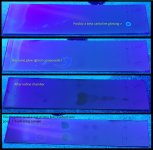
I found some UV activated TLC and ran them couple of times to have at least some insight in composition of the sample. The results are mixed at best. Some how I'm having trouble attaching images here so it's mostly words.
Eluent 10:1 methanol/ammonia the dot separated in one major (possibly two) compounds and 4 trace dots were present evenly spaced behind. At the origin sample showed some noticeable luminescence right on the circular outline of the dot (some speculate that might be beta carboline backbone), so the main material is retarded right at the middle of solvent path and supposedly luminescent compound running a little bit faster (I call it the ghost compound cause it was visible very short time in slight luminescent way and then even iodine did not stick to it) so it might be some past due TLC artifact.
What was extremely strange is what happened next, as I have tried to make a stain for this endeavor but had enough reagents only for Salkowski reagent (Part B) so after iodine chamber and examination I just splash in on the plate for to see maybe something else stands out. So after this thing dried I put it in UV and wtH the main spot became strongly luminescent with a bluish orb standing just a little shifted to the origin.
The main questions would be for now.
Can DMT become luminescent after this treatment?
Can anybody confirm picrate melting point for DMT? (cause this 167 C is the same in all refs but for example m.p. of base is mostly different, so I have doubt)
Does anybody know melting point for the oxalate?
Any specialty stain for beta caarbolines?
Anyhow the prepared picrate is lost now, so I will have to prepare more later and clean it up properly for m.p. retesting. It's strange how it was easier for me to find somebody with DMT than fumaric acid, so next weekend there might be something to compare with.
Eluent 10:1 methanol/ammonia the dot separated in one major (possibly two) compounds and 4 trace dots were present evenly spaced behind. At the origin sample showed some noticeable luminescence right on the circular outline of the dot (some speculate that might be beta carboline backbone), so the main material is retarded right at the middle of solvent path and supposedly luminescent compound running a little bit faster (I call it the ghost compound cause it was visible very short time in slight luminescent way and then even iodine did not stick to it) so it might be some past due TLC artifact.
What was extremely strange is what happened next, as I have tried to make a stain for this endeavor but had enough reagents only for Salkowski reagent (Part B) so after iodine chamber and examination I just splash in on the plate for to see maybe something else stands out. So after this thing dried I put it in UV and wtH the main spot became strongly luminescent with a bluish orb standing just a little shifted to the origin.
The main questions would be for now.
Can DMT become luminescent after this treatment?
Can anybody confirm picrate melting point for DMT? (cause this 167 C is the same in all refs but for example m.p. of base is mostly different, so I have doubt)
Does anybody know melting point for the oxalate?
Any specialty stain for beta caarbolines?
Anyhow the prepared picrate is lost now, so I will have to prepare more later and clean it up properly for m.p. retesting. It's strange how it was easier for me to find somebody with DMT than fumaric acid, so next weekend there might be something to compare with.
Why not just test m.p. of the freebase?
Recrystallize in Hexanes, there's no other chemical compound in the world that crystallizes quite like freebase DMT... Anyone in the art can recognize that. Take a piece of that crystal, run a m.p. test if you will. Picrate seems even less reliable if you are finding conflicting data.
Fumarate is the ideal salt without a doubt, recrystallize in boiling 99% IPA for ultra pure crystals.
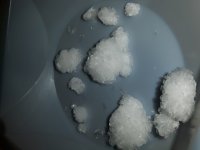
Attached is examples of freshly crystallized freebase (synthetic)
and the fumarate salt, recrystallized in isopropanol.
The m.p. of DMT fumarate is 140-142 °C (Olson; ACS Omega 2018 3 (5), 4968-4973)
I can even run a m.p. on my own sample if you want another reference
Recrystallize in Hexanes, there's no other chemical compound in the world that crystallizes quite like freebase DMT... Anyone in the art can recognize that. Take a piece of that crystal, run a m.p. test if you will. Picrate seems even less reliable if you are finding conflicting data.
Fumarate is the ideal salt without a doubt, recrystallize in boiling 99% IPA for ultra pure crystals.
Attached is examples of freshly crystallized freebase (synthetic)
and the fumarate salt, recrystallized in isopropanol.
The m.p. of DMT fumarate is 140-142 °C (Olson; ACS Omega 2018 3 (5), 4968-4973)
I can even run a m.p. on my own sample if you want another reference
Attachments


Elrik
Rising Star
The OPs TLC image is attached.
Its clear you got a mixture, and I strongly suspect a ß-carboline is in there.
If the tryptamine was derived by decarboxylation of tryptophan the catalyst can produce some quantity of 1 substituted ß-carboline, otherwise it was most likely cyclitization byproduct from reaction of tryptamine with formaldehyde.
In any case, you should clean it to one spot. It looks like its mostly one compound, recrystallization alone might be sufficient. I remember in TiHKAL, Shulgin remarking that a product of his was contaminated with a ß-carboline byproduct which was removed by recrystallization from an aliphatic solvent so Mindillusions advice on using hexane or heptane fits nicely.
If you want to go a step beyond that you could first try to remove contaminant primary and secondary amines by converting them into their toluene insoluble carbamates [ref], basically dissolve in toluene, drop in some dry ice, when its returned to room temperature mix very well and filter out the carbamates, the DMT [and things like 2-methyl-1,2,3,4-tetrahydro-ß-carboline, etc.] staying dissolved. Then recrystallize from heptane. That carbamate procedure may not be required, but is an option. Since you have TLC plates you can monitor success in different methods and heptane might be enough.
Thanks for leaving the unicorn at SWIMs house, by the way
Mindillusion, do you mind saying if those were made via the cyanoborohydride route or some other method?
I have dreams about someone showing off clean and pure DMT made by dequaternization of trimethyltryptammonium iodide
With luck that may some day be me, although I'll more likely post that to someplace like TMG or the nook.
Its clear you got a mixture, and I strongly suspect a ß-carboline is in there.
If the tryptamine was derived by decarboxylation of tryptophan the catalyst can produce some quantity of 1 substituted ß-carboline, otherwise it was most likely cyclitization byproduct
In any case, you should clean it to one spot. It looks like its mostly one compound, recrystallization alone might be sufficient. I remember in TiHKAL, Shulgin remarking that a product of his was contaminated with a ß-carboline byproduct which was removed by recrystallization from an aliphatic solvent so Mindillusions advice on using hexane or heptane fits nicely.
If you want to go a step beyond that you could first try to remove contaminant primary and secondary amines by converting them into their toluene insoluble carbamates [ref], basically dissolve in toluene, drop in some dry ice, when its returned to room temperature mix very well and filter out the carbamates, the DMT [and things like 2-methyl-1,2,3,4-tetrahydro-ß-carboline, etc.] staying dissolved. Then recrystallize from heptane. That carbamate procedure may not be required, but is an option. Since you have TLC plates you can monitor success in different methods and heptane might be enough.
Thanks for leaving the unicorn at SWIMs house, by the way
Mindillusion, do you mind saying if those were made via the cyanoborohydride route or some other method?
I have dreams about someone showing off clean and pure DMT made by dequaternization of trimethyltryptammonium iodide
With luck that may some day be me, although I'll more likely post that to someplace like TMG or the nook.
Attachments
Elrik said:Mindillusion, do you mind saying if those were made via the cyanoborohydride route or some other method?
I have dreams about someone showing off clean and pure DMT made by dequaternization of trimethyltryptammonium iodide
With luck that may some day be me, although I'll more likely post that to someplace like TMG or the nook.
from tryptamine, but an alternate reagent