• Members of the previous forum can retrieve their temporary password here, (login and check your PM).

L. Williamsii Northern Form?

Dr-Daveman

Esteemed member
Joined
Mar 8, 2020
Messages
20
Merits
42
Hello everyone! It's been quite some time since I have posted here and love the new forum!


Over the years, I have been slowly cultivating a sustainable ethnobotanical garden for personal use and to share the experience with those closest to my heart. I recently encountered an opportunity to acquire a few Lophophora Williamsii, Northern Form, which are all sustainably sourced.

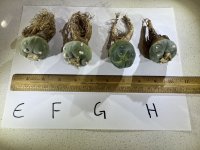
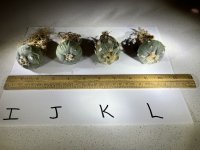
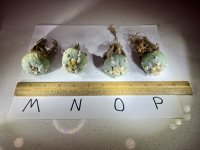
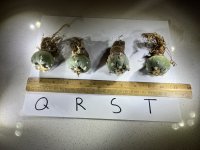
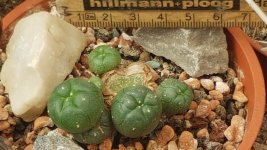
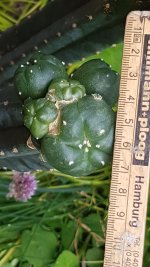
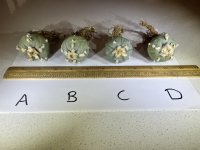
When I saw the cacti up close and in person, I was surprised that there was so much variety to their appearance. I've got to be honest that I'm a bit worried that these aren't all actually L. Williamsii... so I come to you all asking for your assistance in identifying these cacti. Specifically, the questions I am hoping to clarify are these:


1) Are these all L. Williamsii, Northern Form?

2) Is it normal for L Williamsii, Northern Form, to have so much phenotypic variation?

3) Is it possible (or perhaps even likely) that this is instead a grab-bag mix of Lophophora cacti such as L Fricii, L Koehresii, L Diffusa, and if I'm lucky, maybe the occasional L Williamsii?


Thanks everyone for your help!


Kindly,
Dr-Daveman
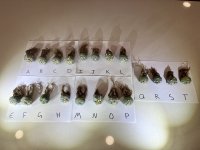
 

Attachments

  • L1.jpg
    L1.jpg
    3.1 MB · Views: 15
  • L2.jpg
    L2.jpg
    2.8 MB · Views: 17
  • L3.jpg
    L3.jpg
    3.1 MB · Views: 15
  • L4.jpg
    L4.jpg
    2.8 MB · Views: 15
  • L5.jpg
    L5.jpg
    3.1 MB · Views: 13
  • L6.jpg
    L6.jpg
    3.1 MB · Views: 14
Hey, welcome back!

I'm no Loph expert, but your specimens look like they're within the normal range for seed-grown material. You may as well get them into pots and wait until they start flowering.

Then again, I'm in no position to determine whether they could be any of the species you mentioned in question 3. I'd take a good look at a botanical key if I were you, and also bear in mind that there's a possibility some of them may be hybrids, even if experience with my specimens suggests they're quite happily self-fertile.

Fortunately, they're delightful plants and will be worth growing whatever they turn out to be. For mescaline production, you'd be better off grafting them onto, e.g., PC pachanoi anyhow. You appear to have enough plants for a bit of experimentation in that direction, especially if you've grafting stock knocking around already.
 
Hey thanks for the response! I will definitely put them in some pots, they are some beautiful cacti huh?

The info you provided me is reassuring, and I appreciate the guidance for where to look next if further investigation is desired.

Thanks again!
 
Hello everyone! It's been quite some time since I have posted here and love the new forum!


Over the years, I have been slowly cultivating a sustainable ethnobotanical garden for personal use and to share the experience with those closest to my heart. I recently encountered an opportunity to acquire a few Lophophora Williamsii, Northern Form, which are all sustainably sourced.

When I saw the cacti up close and in person, I was surprised that there was so much variety to their appearance. I've got to be honest that I'm a bit worried that these aren't all actually L. Williamsii... so I come to you all asking for your assistance in identifying these cacti. Specifically, the questions I am hoping to clarify are these:


1) Are these all L. Williamsii, Northern Form?

2) Is it normal for L Williamsii, Northern Form, to have so much phenotypic variation?

3) Is it possible (or perhaps even likely) that this is instead a grab-bag mix of Lophophora cacti such as L Fricii, L Koehresii, L Diffusa, and if I'm lucky, maybe the occasional L Williamsii?


Thanks everyone for your help!


Kindly,
Dr-Daveman

Very cool plants man!
Are you talking about that Lophophora variety that can resist sub zero temps, by Northern Form? Sorry, I forgot its variety name.
I think it could well be what you think, as most of my Casepitosae look like your G specimen, but they'll soon grow more ribs, as the tufts start to form. So, I'd say these are not regular common Lophos, they probably are what they claim to be.

I was looking at the pictures, and looking at those dried Lopho flowers/fruits on the top tufts, must be full with viable seeds, and the tufts themselves hold seeds, you may be able to find quite a bit of them if you search well.

These plants don't look like common greenhouse Lophos to me, like fricii, kohersii, and diffusa.

TBH, I never saw tuft producing lophos that stay with 5 ribs for too long.
I think you may try some grafting experiments, and perhaps, also trying to acclimate some specimens to low temps, as to see if they can get thruough the winter's cold, if we're talking about the same var.

TPb
 
Back
Top Bottom