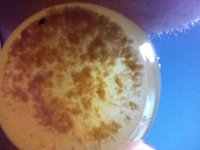
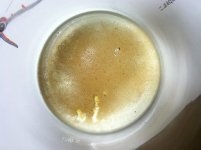
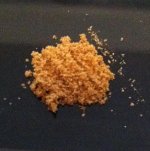
Funny thing; I've just made a similar observation only this persons NP got a cloudy sediment floting in the middle when placed in the freezer.
Other conditions are as follows;
Naphtha pull was done 'Dry-Tek' style.
Mimosa H bark was used for starters but, M H Bark was also USED (two Xylene pulls had been done on it previously), the bark was particularly excellent and produced extra beautiful and neat-o(!) visions:d so, a person waited sixty days without letting the mud dry completely (wrapped the bucket in a plastic bag while the bark was still muddy with residual solvent and water\vinegar).
Warm room-temperature VM&P was then used to pull. This Naphtha was old and had been used a few times before to pull. Plus it too had been kept in a dark, warm and humid place, undisturbed, for about sixty days.
Qt21Qt21 points out that in is not the length of the 'Solve' but, rather, it is the 'Cuagula' which determines how effective the pull is when he says;
"SWIM likes to think of using the non-polar solvent like using water to dissolve some salt. Though the salt will not instantaneously become saturated with salt, it will in a few minutes. Same with the solvent, it is the bark and lime that works for hours, not the solvent."
Lastly, the pan that was used to percipitate was an old, glazed ceramic that had a previous history in some sort of lysergine affair.
When a cloudy, brownish, sediment was observed floting in the middle of the solvent that was diffrent from the small, ruff crystal coating on the sides of the pan, the pan was removed from the freezer. The intention was to warm it back up and then filter the solvent a second time plus clean the pan better.
But the cloud dissolved alot! At a diffrent rate than the crystals too!
:?: Is it oils?! Is it a mold or fungus?! seems absurd but fungus can live in some pretty ruff conditions...
Uhh, thats my two cents. Now I'm considering a fermented DMT Citrate beverage.:shock: