
-
Members of the previous forum can retrieve their temporary password here, (login and check your PM).
You are using an out of date browser. It may not display this or other websites correctly.
You should upgrade or use an alternative browser.
You should upgrade or use an alternative browser.
[LSA]
- Thread starter slewb
- Start date
Migrated topic.


Currently got some baby flying saucers and some (hopefully) heavenly blues growing up a high fence. Both of which produce intense and beautiful flowers.. among other activities.. :thumb_up:

downwardsfromzero
Boundary condition
Now here's something: are any other parts of the morning glory plant active, particularly the flowers?
Anyone tried this?
Anyone tried this?
downwardsfromzero said:Now here's something: are any other parts of the morning glory plant active, particularly the flowers?
Anyone tried this?
Yes. I've read some reports on morning glory flowers made into an alcoholic wine but to no significant extent of an effect. A lot of flowers too, albeit. Afaik, the whole plant contains alkaloids. Only concentrated ergine is within the seeds, however. Especially when they are freshly harvested. I've used the leaves orally to mush up and hold in my mouth to be masticated, and again, to no 'true' effects. Barely a threshold even when smoked cannabis was brought into the mix.
downwardsfromzero
Boundary condition
Ok, thanks for sharing!

My first ever extraction of anything was a recent attempt with HBWR.
Kash's tek is impressive, but indeed I was loath to acquire many of the solvents needed.
So, I opted for the PanoraMIX tek. Acquiring the naptha was tricky enough, the VM&P no longer available except through mail order. I settled fo Zippo lighter fluid, it didn't leave a residue on glass...unfortunately, a later search found a controversy over residue on a mirror. I did not proceed to the polar step until the seed mush smelled clear of solvent; I can only assume my results were clear of the non.
Regardless, I followed the tek almost to the letter, using 192 proof grain alcohol for my polar solvent. I glitched when I decided to diverge from the tek and evaporate fully, even though my intent was to end up with a tincture. I ended up with goo, and I redissolved that goo in fresh alcohol.
I over-handled the product for sure, lots of light, summertime ambient heat, me drooling at the chin and farting...
...but, what I ended up with was a marvelously understated, luminous little tincture that ensures I'll refine my glitch and try again.
Bioassys were fun. I added six drops of peppermint oil to what was approximately 15 ml of tincture, and had six trials (out of an attempted ten doses) I could definitely detect the lysergic "zing", for lack of a better word, and indeed there was a sedation. Mild OEV as I slouched at my monitor for a bit, page loads were wild lol... I had chocolate and cannabis on hand, and thus detected no vasoconstriction. After six or seven hours, going to bed, closing eyes, a pleasant, persistent luminosity amused me as I rested and eventually slept.
I'm convinced that these seeds are worth the effort, as long as one has realistic expectations.
Kash's tek is impressive, but indeed I was loath to acquire many of the solvents needed.
So, I opted for the PanoraMIX tek. Acquiring the naptha was tricky enough, the VM&P no longer available except through mail order. I settled fo Zippo lighter fluid, it didn't leave a residue on glass...unfortunately, a later search found a controversy over residue on a mirror. I did not proceed to the polar step until the seed mush smelled clear of solvent; I can only assume my results were clear of the non.
Regardless, I followed the tek almost to the letter, using 192 proof grain alcohol for my polar solvent. I glitched when I decided to diverge from the tek and evaporate fully, even though my intent was to end up with a tincture. I ended up with goo, and I redissolved that goo in fresh alcohol.
I over-handled the product for sure, lots of light, summertime ambient heat, me drooling at the chin and farting...
...but, what I ended up with was a marvelously understated, luminous little tincture that ensures I'll refine my glitch and try again.
Bioassys were fun. I added six drops of peppermint oil to what was approximately 15 ml of tincture, and had six trials (out of an attempted ten doses) I could definitely detect the lysergic "zing", for lack of a better word, and indeed there was a sedation. Mild OEV as I slouched at my monitor for a bit, page loads were wild lol... I had chocolate and cannabis on hand, and thus detected no vasoconstriction. After six or seven hours, going to bed, closing eyes, a pleasant, persistent luminosity amused me as I rested and eventually slept.
I'm convinced that these seeds are worth the effort, as long as one has realistic expectations.
downwardsfromzero
Boundary condition
Last year I tried making a tincture with Ipomoea purpurea flowers (Grandpa Otts variety) and, while the resulting liquid was a very beautiful purple colour, a cautious bioassay hinted at some kind of euphoriant effect but there was also a suggestion of possible cardiotoxicity. Thus, ingestion experiments with that particular crude extract had to come to a close but it might be worth considering analysing this tincture as the subjective effects seemed at odds with the claim that I. purpurea is inactive.downwardsfromzero said:Now here's something: are any other parts of the morning glory plant active, particularly the flowers?
Anyone tried this?

DreadedShaman
Rising Star
downwardsfromzero said:Now here's something: are any other parts of the morning glory plant active, particularly the flowers?
Anyone tried this?
I have a good amount of i. Alba growing, I've read reports of the seeds at least being a similar dose (by weight) to r. Corymbosa, albeit the seeds are like 100x larger lol.
Will report back later in the growing season after having a chance to experiment
Aum_Shanti
Esteemed member
downwardsfromzero said:but it might be worth considering analysing this tincture as the subjective effects seemed at odds with the claim that I. purpurea is inactive.
There's also the possibility that it just contains some clavines, which might also have some activity. E.g. an animal study on elymoclavine (On the pharmacology of the ergot alkaloid elymoclavine - V. PETKOV et Al. - Biomed. Biochim. Acta, 43 (1984)):
Elymoclavine, which belongs to the group of clavine alkaloids, is not thoroughly investigated. There are but scarce data characterizing this clavine alkaloid as a ostjunctional dopaminergic receptor agonist. Our results suggest a plurireceptor action of this ergot alkaloid. The basic characteristic of the mechanism of action of elymoclavine is similar to that of bromocriptine, i.e. an action on the dopaminergic receptors.
But the alkaloid profile of I. purpurea really seems the most widely debated. And here it surely has not helped that quite some vendors sell I. tricolor under the name I. purpurea and vice-versa. Also there may be different fungi chemotypes on them. And negative reports could just mean the corresponding plant was lacking the fungi at all...
So many possibilities. But looking at the various works I personally would assume it is active (if it has still the fungi), but has way less ergolines than I. tricolor.
E.g. in the work (ERGOT ALKALOID CONTENTS OF Ipomoea lacunosa , I . hederaceae , I . trichocarpa , AND I . purpurea - 1986) they measured roughly about a 1/10th of the content of I. tricolor. And as you already have to take hundreds of seeds of I. tricolor, this would then mean, you would have to take thousands.
lysergicmaleate
Rising Star
hydrolysis of mixed LAA's including clavine; the clavines will be left behind when you hit it with tartaric solution would it not?benzyme said:the epimerization of lsa to iso-lsa is irrelevant, because alkaline hydrolysis converts it all to lysergic acid.
doesn't matter if you start with paspalic acid or ET.
or would it be required to start with column purified material. From my 'research' there's evidence it doesn't matter at all and you can proceed with un-purified mixed LAA's and have a successful hydrolysis with a pure end product.
lysergicmaleate
Rising Star
but for highest alkaloid concentration by weight across most known seeds Argyreia nervosa would be the winner ?
I have quite a few of those to experiment with.
I have quite a few of those to experiment with.
Aum_Shanti said:downwardsfromzero said:but it might be worth considering analysing this tincture as the subjective effects seemed at odds with the claim that I. purpurea is inactive.
There's also the possibility that it just contains some clavines, which might also have some activity. E.g. an animal study on elymoclavine (On the pharmacology of the ergot alkaloid elymoclavine - V. PETKOV et Al. - Biomed. Biochim. Acta, 43 (1984)):
Elymoclavine, which belongs to the group of clavine alkaloids, is not thoroughly investigated. There are but scarce data characterizing this clavine alkaloid as a ostjunctional dopaminergic receptor agonist. Our results suggest a plurireceptor action of this ergot alkaloid. The basic characteristic of the mechanism of action of elymoclavine is similar to that of bromocriptine, i.e. an action on the dopaminergic receptors.
But the alkaloid profile of I. purpurea really seems the most widely debated. And here it surely has not helped that quite some vendors sell I. tricolor under the name I. purpurea and vice-versa. Also there may be different fungi chemotypes on them. And negative reports could just mean the corresponding plant was lacking the fungi at all...
So many possibilities. But looking at the various works I personally would assume it is active (if it has still the fungi), but has way less ergolines than I. tricolor.
E.g. in the work (ERGOT ALKALOID CONTENTS OF Ipomoea lacunosa , I . hederaceae , I . trichocarpa , AND I . purpurea - 1986) they measured roughly about a 1/10th of the content of I. tricolor. And as you already have to take hundreds of seeds of I. tricolor, this would then mean, you would have to take thousands.

Morbidbystandard
Rising Star
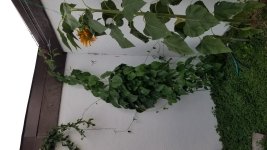
I've got a large A. Nervosa going. The seeds are about 3 to 5 time larger than ipomoea. Supposedly the Spanish conquistadors were trying to wipe out these plants so the native would be easier to indoctrinate with Catholicism. I wonder how they prepared them.
Attachments

Morbidbystandard said:I've got a large A. Nervosa going. The seeds are about 3 to 5 time larger than ipomoea. Supposedly the Spanish conquistadors were trying to wipe out these plants so the native would be easier to indoctrinate with Catholicism. I wonder how they prepared them.
Mine is almost four years old now, and I can't seem to ever get the darn thing to flower.

LogicalChaos
Logical Chaos
I love LSA. I do a simple methanol extraction from MG seeds. Its really nice.
I recently experimented with peppermint oil I bought from the store that I added during the extraction step. I think it lowered the activity of it. Not doing that again.
I recently experimented with peppermint oil I bought from the store that I added during the extraction step. I think it lowered the activity of it. Not doing that again.
Morbidbystandard
Rising Star
Mine is only 1 year old so hopefully it blooms this fall.
Are we talking a room temp methanol soak then strain and evap?
Are we talking a room temp methanol soak then strain and evap?

With as much natural selection that has been done in the cannabis industry I'm surprised no one has attempted to raise alkaloid levels in tricolor .
Because nervosa is hard to flower and does best in tropical region s and typically needs lots of root space a more potent tricolor cultivar would be a nice solution to the problem ...but damn that s a lot of work and you'd surely need some analytical equipment and a lot Of time ,
Still you re left with a small volume of seeds . ......from the plant itself .....hard to say if it would be worth it ...but maybe kinda fun ...maybe I'll embark on this as I do love tricolor flowers and have some access to test it on a semi regular basis . Maybe over the years I could hone a higher producing cultivar of tricolor .....given enough time possibly
Would be easier to just make a bioreactor of paspali I know .....still a more a potent tricolor would be fun ... Ill do it but I'm not going to promise immediate results nor any major improvent s for the obvious reason that they are going to fluctuate after fruiting most likely anyway but maybe a clone that produces more potent seeds . I gotta check how long they can live . I mean I know they are annuals but some annuals protected live a long time
Most likely not worthwhile to try but I love gardening and flowers so I suppose it depends on what you value
Because nervosa is hard to flower and does best in tropical region s and typically needs lots of root space a more potent tricolor cultivar would be a nice solution to the problem ...but damn that s a lot of work and you'd surely need some analytical equipment and a lot Of time ,
Still you re left with a small volume of seeds . ......from the plant itself .....hard to say if it would be worth it ...but maybe kinda fun ...maybe I'll embark on this as I do love tricolor flowers and have some access to test it on a semi regular basis . Maybe over the years I could hone a higher producing cultivar of tricolor .....given enough time possibly
Would be easier to just make a bioreactor of paspali I know .....still a more a potent tricolor would be fun ... Ill do it but I'm not going to promise immediate results nor any major improvent s for the obvious reason that they are going to fluctuate after fruiting most likely anyway but maybe a clone that produces more potent seeds . I gotta check how long they can live . I mean I know they are annuals but some annuals protected live a long time
Most likely not worthwhile to try but I love gardening and flowers so I suppose it depends on what you value
Morbidbystandard
Rising Star
You're definitely on to something. Makes me wonder why its never happened.
Edit:I mixed up the scientific names of Woodrose and Ololiuqui.
Its actually a Turbina Corymbosa or Ololiuqui.
Edit:I mixed up the scientific names of Woodrose and Ololiuqui.
Its actually a Turbina Corymbosa or Ololiuqui.
Morbidbystandard said:I've got a large A. Nervosa going. The seeds are about 3 to 5 time larger than ipomoea. Supposedly the Spanish conquistadors were trying to wipe out these plants so the native would be easier to indoctrinate with Catholicism. I wonder how they prepared them.
You're thinking of a different seed I believe . The Hawaiian baby wood rose I believe is native to some western islands.
Turbina corymbosa is a large, woody vine with narrow, heart shaped leaves and white, bell-shaped flowEr . These would have been native to the south Americas that the Spanish would have tryed to subdue and they were used by mazatec tribes I believe or at least native tribes historically in the south Americas
And from what I understand they just did a cold water extraction on a few to a few dozen seeds , filtered and drank
Morbidbystandard said:Edit:I mixed up the scientific names of Woodrose and Ololiuqui.
Its actually a Turbina Corymbosa or Ololiuqui.
Lol you got it posted before I had the last one brother you must have been changing it as I was putting mine together . It's all good . I read too much on these things need to find a different hobby lol
Morbidbystandard
Rising Star
Nice.
I was reading a paper from 1955 last night about this very topic. The guy stated that the indigenous tribes were just chewing the seeds. 13 to be exact. He ran tests on 14 28 60 and 100.
It was a strange read due to the fact that back then schizophrenia was believed to be an epidemic inflicting 20% of the population.
It's pretty sad that most of the scientific data on these plants came from such a dark age of medicine. Hopefully as we move past prohibition we'll be able to unlock the true value of these things and bring them to mainstream.
I was reading a paper from 1955 last night about this very topic. The guy stated that the indigenous tribes were just chewing the seeds. 13 to be exact. He ran tests on 14 28 60 and 100.
It was a strange read due to the fact that back then schizophrenia was believed to be an epidemic inflicting 20% of the population.
It's pretty sad that most of the scientific data on these plants came from such a dark age of medicine. Hopefully as we move past prohibition we'll be able to unlock the true value of these things and bring them to mainstream.
Similar threads


Staff online
-
 NydexOne With The Trees
 -
 VoidmatrixRearranging the void
Members online
Total: 1,335 (members: 11, guests: 1,324)
Robots: 203
Robots: 203