Samvidbuho
Esteemed member
So, is it 'bad' to have your freebase melted during any stage of the re-x process?
I read that the boiling point of the solvent should be below the melting point point of the solute, but that of course makes things tricky for freebase.
Yet, I wonder if it's not such a bad thing to do afterall, to have the alkaloids phase change temporarily. Anybody have any insight or observations from experiments?
The plan is to have the solvent mixture reflux for at least a half hour, preferably 1 - 3 hr before allowing to cool and precipitate. If it's better for the crystals to remain in dissolution rather than being melted for this, then only thing I could think of would be to do the reflux in pentane, or pentane-ethanol / pentane-acetone azeotrope at ~35 C or w/e, then introduce say hexane, evaporate the azeotrope off, then cool?
Thanks in advance
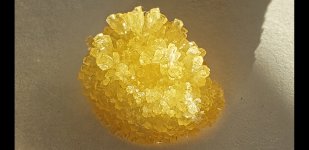
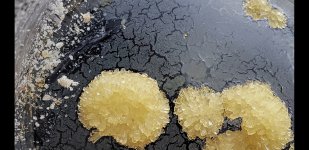
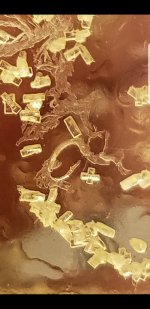
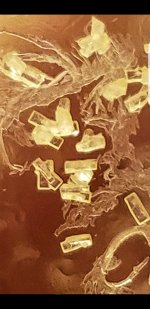
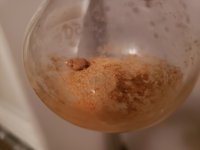
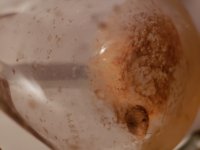
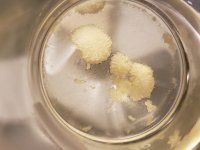
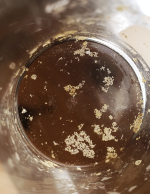
Post Script: This forum has been such a tremendous help. I'm attaching some crystals of recent experiments, to give a little back..
I read that the boiling point of the solvent should be below the melting point point of the solute, but that of course makes things tricky for freebase.
Yet, I wonder if it's not such a bad thing to do afterall, to have the alkaloids phase change temporarily. Anybody have any insight or observations from experiments?
The plan is to have the solvent mixture reflux for at least a half hour, preferably 1 - 3 hr before allowing to cool and precipitate. If it's better for the crystals to remain in dissolution rather than being melted for this, then only thing I could think of would be to do the reflux in pentane, or pentane-ethanol / pentane-acetone azeotrope at ~35 C or w/e, then introduce say hexane, evaporate the azeotrope off, then cool?
Thanks in advance
Post Script: This forum has been such a tremendous help. I'm attaching some crystals of recent experiments, to give a little back..