• Members of the previous forum can retrieve their temporary password here, (login and check your PM).

Mescaline carbonate from water pulls?

modern

Titanium Teammate
So I've been thinking about this for some time but since there is little information on mescaline carbonate thought I'd ask your thoughts here.

The idea would be doing vinegar pulls of the cactus and concentrating it down right before it gets too thick. Then adding sodium carbonate slowly until it stops reacting and ph is around 7. Then leave the solution alone maybe in the fridge will cause it to precipitate? I have no idea on the solubility of mescaline carbonate but from my limited understanding most carbonate salts are insoluble.

The mescaline acetate would need to be ph under 4.4? so it is protonated then adding the sodium carbonate slowly to prevent it from foaming too much and also prevent it from freebasing the mescaline? I'll test this myself in a few months but this seems viable no?

Anyone with a deeper understanding of chemistry willing to explain why this isn't possible or maybe even solubility of mescaline carbonate in water.
 
Last edited:
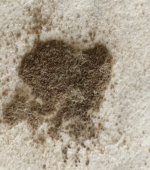
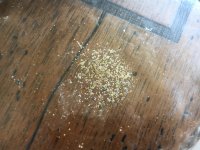
So I went around to testing this idea. I proceeded as mentioned here with 2x PC pulls on 15g dry material. Boiled down to 400ml filtered cool overnight to remove pectin and other impurities in a 4ish ph with the idea of protonated molecule. I then slowly added sodium carbonate until it reached ph of 7ish.
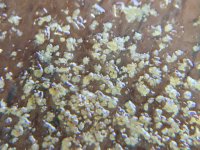
I allowed it to rest and after an hour there was a small precipitate. I left it overnight in the fridge and filtered off a greyish brown powder. It was extremely fine and if I hadn't used lab filters I'm sure it would pass a coffee filter. I'm certain it is not pectin as I left it 2 days in the fridge and filtered very well. I also added the sodium carbonate in a saturated solution so it isn't sodium carbonate.

I ended up with .1% yield which I'm sure isn't the content. however the yield was too small for me to do an a/b to test and dont gave reagents. I ended up testing orally with caapi tea. Being only 15ish mg I just swallowed. It had a familiar taste that I couldn't quite place my finger on. Didn't taste soap like. I proceeded with my day and completely forgot I had actually taken anything until I was zoning out and noticed a slight visual distortion with a wavy like pattern behind my vision. NOT pronounced and zero other effects like euphoria which I had with 50mg hcl. This could have just been placebo effect and honestly only remembered I took something after this. The effect was extremely minimal and short lived.

I originally intended on adding salt brine but skipped this since I just added lye and salt to proceed with normal extraction. I will likely reattempt this since there is no risk in losing content. I suspect that some mescaline carbonate did precipitate but perhaps a large portion remained in acetate form until freebasing or solubility of the carbonate is not too high in water? The best method would be starting with pure material which I may attempt once I have enough to test.

Anyone have idea on possible ways to improve this or different thing to test?

I was thinking maybe making the tea alkaline with near saturation of sodium carbonate than adding vinegar slowly until ph of 7ish? The solution would have more carbonate than acetate ions right?

EDIT: I finished up the extraction and indeed only pulled around 8-10% of the total yeild if it was indeed mescaline carbonate. 170-180ish mg from the rest of the material.
 

Attachments

  • powder.jpg
    powder.jpg
    117.7 KB · Views: 4
Last edited:
The cactus brew will contain soluble magnesium and calcium salts which then precipitate as their respective soluble carbonates on addition of the SC. Sodium carbonate is quite readily soluble in water, so it shouldn't precipitate by itself on addition to further acidic water, unless that water were nearly saturated with a even more soluble sodium salt.

For mescaline carbonate experimentation you'd best test the concept by using a solution of an isolated mescaline salt first. Crude cactus brews will present too many confounding factors. And not all carbonates are insoluble; in the case of mescaline I'd look to the soluble ammonium carbonate as a first analogy. An then I'd check for data on the solubility of mescaline carbonate in water if possible. Here's an interesting pdf that came up when looking: https://www.swgdrug.org/Monographs/PEYOTE.pdf
Maybe you found that one before, but it makes for useful reading on the topic of analysis of mescaline content in various ways.

I still suspect water-only mescaline extraction to be something of a pipe dream.
 
Yea I will back test using isolated mescaline in the future. I should try to get freebase mescaline and allow it to become carbonate then test solubility :)
 
The few old threads that I've been able to find covering the carbonate all refer to recovering it from limonene pulls with carbonated water. There was some talk on a old shroomery thread, originally referencing the Nexus, about cleaning up the carbonate with one of several of the usual solvents but I can't quote the specific details off the top of my read rn.
 
Revisiting this, I realise there may have been a misapprehension over the term "carbonated water". I take this to mean water with dissolved carbon dioxide, but there's a conceivable misuse of the term to mean "water with dissolved sodium carbonate" in this context. That should be referred to as "sodium carbonate solution" or "aqueous sodium carbonate" to avoid confusion.
Maybe I'm wrong in any case from the start.

Perhaps I should start with a freebase mescaline solution and bubble CO2 until it turns slightly acidic? I've seen posts here and there but no real follow ups.


For carbonate, if it even matters, as the only one the carbonate step seems to work for is SWIM:
SWIM dissolved as much as he could of the sticky carbonate resin in 91% IPA (where are you guys finding 99%?) then put it in the freezer. After a day or two, there was a significant layer of crystals coating the bottom of the container. He decanted the alcohol and collected the crystals with distilled water.
They were off-white and odorless with a bit of a yellowish tinge. SWIM never noticed anything but nice, clear headed effects from their ingestion. He wasn't sure if the impurities were completely removed of course, but he is satisfied.
The IPA was concentrated a bit and the process was repeated, yielding fewer crystals."


Considering 91-99% isopropanol is used to clean up but doesn't mention water solubility. I only guess that it is insoluble since may carbonates are but maybe wrong.

Maybe you are right and it is a pie in the sky and unlikely possible.
 
There is the outside chance that concentrated sodium carbonate solution could force the crystallisation of mescaline carbonate in a similar fashion to a Manske precipitation, so I'd hesitate to dismiss the idea out of hand entirely. This is what an experiment using some form of isolated mescaline would help determine.

There seems to be very little in the way of scientific literature - in English, at least - specifically covering mescaline carbonate in any readily accessible way online. This is where access to Chemical Abstracts through an academic institution would come in very useful. I'd also recommend getting hold of a copy of the CRC Handbook.

I'll be taking a look in the Shulgin Index and Rätsch' Encyclopedia for any sign of useful references.
 
There is the outside chance that concentrated sodium carbonate solution could force the crystallisation of mescaline carbonate in a similar fashion to a Manske precipitation, so I'd hesitate to dismiss the idea out of hand entirely. This is what an experiment using some form of isolated mescaline would help determine.

There seems to be very little in the way of scientific literature - in English, at least - specifically covering mescaline carbonate in any readily accessible way online. This is where access to Chemical Abstracts through an academic institution would come in very useful. I'd also recommend getting hold of a copy of the CRC Handbook.

I'll be taking a look in the Shulgin Index and Rätsch' Encyclopedia for any sign of useful references.
checked a lot in the past trying to find a reference. I even searched the Merck but couldn't find anything on the properties of the carbonate salt.

I don't understand how to make sodium dihydrate
Prisms, mp 183-186 °C. Soluble in hot water, methanol; sparingly soluble in cold water, ethanol. /Sodium dihydrate/
O'Neil, M.J. (ed.). The Merck Index - An Encyclopedia of Chemicals, Drugs, and Biologicals. 13th Edition, Whitehouse Station, NJ: Merck and Co., Inc., 2001., p. 1055

Crystals, mp 158 °C /Acid sulfate/
O'Neil, M.J. (ed.). The Merck Index - An Encyclopedia of Chemicals, Drugs, and Biologicals. 13th Edition, Whitehouse Station, NJ: Merck and Co., Inc., 2001., p. 1055


The wiki here says that the sulfate dihydrate is less soluble in water but the reference I could find is for sodium dihydrate. Any idea how to form that?

EDIT: I'll post what is directly on the source I found a pdf. But from memory I think I already had this source and it doesn't mention anything extra.
 
Last edited:
Sulfate dihydrate vs acid sulfate? I don't understand the difference just one is formed in water?
 

Attachments

  • mescaline.jpg
    mescaline.jpg
    191 KB · Views: 5
Sodium dihydrate
Is a typo - there should be some proper anion specified otherwise this is just nonsense. Or it's an OCR formatting error. Or have you mistyped "sulphate dihydrate"?
Sulfate dihydrate vs acid sulfate? I don't understand the difference just one is formed in water?
Mescaline sulfate dihydrate refers to the 2:1 sulfate crystallised with 2 molecules of water - 2 molecules of mescaline combined with one of sulfuric acid, etc. The variable hydration levels can get a little problematic - it's mildly annoying that the Merck index doesn't list the CAS number of the sulfate dihydrate. This makes it hard to compare with the 'sulfate hydrate' (CAS 51749-34-9) and the tetrahydrate (6043-76-1) both listed in the Shulgin Index. Anyhow, the 2:1 sulfate dihydrate is the one with m.p. 183-186 °C reported by Späth (who also reported the benzoate) in 1919.

The acid sulfate is the 1:1 sulfate, also known - perhaps rather confusingly - as bisulfate, because it has twice the amount of sulfate per (nonhydrogen) cation.
 
Is a typo - there should be some proper anion specified otherwise this is just nonsense. Or it's an OCR formatting error. Or have you mistyped "sulphate dihydrate"?

Mescaline sulfate dihydrate refers to the 2:1 sulfate crystallised with 2 molecules of water - 2 molecules of mescaline combined with one of sulfuric acid, etc. The variable hydration levels can get a little problematic - it's mildly annoying that the Merck index doesn't list the CAS number of the sulfate dihydrate. This makes it hard to compare with the 'sulfate hydrate' (CAS 51749-34-9) and the tetrahydrate (6043-76-1) both listed in the Shulgin Index. Anyhow, the 2:1 sulfate dihydrate is the one with m.p. 183-186 °C reported by Späth (who also reported the benzoate) in 1919.

The acid sulfate is the 1:1 sulfate, also known - perhaps rather confusingly - as bisulfate, because it has twice the amount of sulfate per (nonhydrogen) cation.
Regardless I don't have a source for sulfuric acid anymore and it disappeared from market shelves a few years ago.


Copy paste from pubchem
 
Regardless I don't have a source for sulfuric acid anymore and it disappeared from market shelves a few years ago.


Copy paste from pubchem
Mixing mescaline carbonate with magnesium sulfate theoretically would produce mescaline sulfate by double decomposition, with a byproduct of insoluble magnesium carbonate, although I'm wary of magnesium's propensity to form complexes with ammonia and, by extension, amines like mescaline.
 
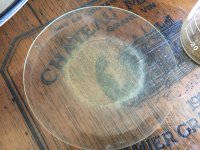
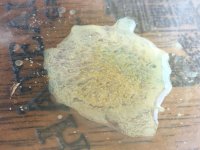
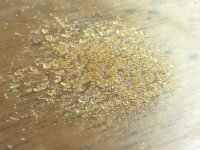
So to test the idea of water extraction of mescaline carbonate seems to be plausible HOWEVER you would need to clean up first to increase purity. I wasn't able to get 'freebase' crystals since near the very end of the isopropanol evaporate it seems to REALLY not want to evaporate. It turned almost into a goo despite starting from cleaned up mescaline hcl salt. I began with 600mg salts then after cleanup 300mg of clean salts. I added saturated sodium carbonate and evaporated completely then did 4-5x pulls with isopropanol.
Evaporated it all to get these crystals. The freebase/carbonate is EXTREMELY soluble in isopropanol which I tested tested with only 3-5ml very easy dissolved it. Now with 10ml of water it seems insoluble. I'm gonna let this dry to see if it looks different. Then test by increase water content to see if it is soluble.

This may not be 100% pure starting material but I am happy I could test this. The published solubility says slightly soluble in water so there must be some "loss"
 

Attachments

  • IMG_7082.JPG
    IMG_7082.JPG
    2.7 MB · Views: 3
  • IMG_7081.JPG
    IMG_7081.JPG
    1.7 MB · Views: 3
  • IMG_7080.JPG
    IMG_7080.JPG
    2.4 MB · Views: 3
  • IMG_7078.JPG
    IMG_7078.JPG
    1.9 MB · Views: 3
  • IMG_7076.JPG
    IMG_7076.JPG
    1.6 MB · Views: 3
Also have anyone tried to place mescaline acetate in a saturated salt solution?
I tried something like this, I believe I used ammonium sulfate as the manske salt since mescaline sulfate is not very soluble on cold water.

I got gunk, proteins precipitated first from the water.

It may be possible to do several collections at different ammonium sulfate concentrations and temperatures and have one be mescaline rich, but I think that is hard. Especially since each brew can be different and with every addition of ammonium sulfate, or every drop in temperature, more gunk precipitated.

If there is a sulfate ion concentration/temperature window where a lot of gunk can be removed first, and then a sulfate concentration/temperature step can be taken to precipitate mescaline sulfate, I could not find it. I only found continuous gunk (with perhaps fractions of mescaline co precipitating in some conditions).
 
I tried something like this, I believe I used ammonium sulfate as the manske salt since mescaline sulfate is not very soluble on cold water.

I got gunk, proteins precipitated first from the water.

It may be possible to do several collections at different ammonium sulfate concentrations and temperatures and have one be mescaline rich, but I think that is hard. Especially since each brew can be different and with every addition of ammonium sulfate, or every drop in temperature, more gunk precipitated.

If there is a sulfate ion concentration/temperature window where a lot of gunk can be removed first, and then a sulfate concentration/temperature step can be taken to precipitate mescaline sulfate, I could not find it. I only found continuous gunk (with perhaps fractions of mescaline co precipitating in some conditions).
I also tried adding acetone as the precipitating agent. Same result: gunk everywhere.
 
Hm, wouldn't freebase mescaline at least partially displace gaseous ammonia from ammonium sulfate, especially if heated? This is probably mostly useless, though, given ammonium sulfate's insolubility in virtually all organic solvents. It would presuppose having a solution of freebase mescaline in a suitable condition to react fairly cleanly with the ammonium sulfate. One to mull over a bit more.

I'm thinking aloud a bit here, but being able to produce mescaline sulfate this way would be helpful to those who have the misfortune of their local jurisdiction making it incredibly hard to get hold of sulfuric acid.
 
So just sharing my latest attempt to not make too many threads on this fixation of mine.
So I attempted to extract mescaline using 70% isopropanol. I tested the solubility of pure mescaline oxalate in 70% iso and it was insoluble even in slightly higher ml. HOWEVER in practice it doesn't form the precipitate maybe because of the other solubles like calcium sodium ect.

So I based the dry cactus with calcium hydroxide at 1/10 weight and added the 70% isopropanol and mixed and started to filter after 15-30 minutes. Took an hour to actually filter since clogged the lab filter paper. All the mescaline should have been pulled since it is EXTREMELY soluble in iso from my experiments. I then tested the ph and it was around 9+ but is higher. I cannot get it higher despite adding more more lime. The paper gets blue after a little while so I think the solvent affects reading?

Now I add oxalic acid just a small amount since super strong. Ph is around 3-4 after it completely dissolves. I was completely expecting calcium oxalate to form and some others since I didn't use 99% isopropanol there is some that is in the water. I filtered and allowed it to dry. Around 200mg dry oxalate. I then just added lye solution and pulled with xylene to test and saw a tiny amount of mescaline benzoate form. MUCH lower than the expected yield of around 100mg atleast.

So now I'm working on the idea that the mescaline didn't form and is still in the alcohol solutions and I'll now evaporate it completely. Once completely dry I should be able to precipitate freebase mescaline adding a minimal amount of lye solution. There will be some content loss but not an issue.

I'm unwilling to settle not having a pure extract without having to use strong smelling solvents like ethyl acetate and xylene.
 
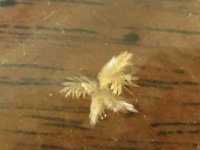
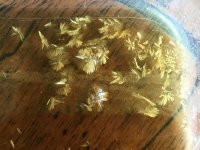
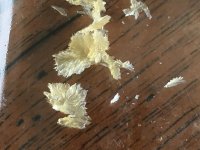
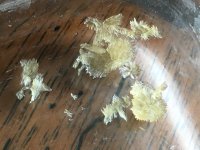
So after evaporating the alcohol pulls by 2/3 in a water bath I left it sitting overnight. Woke up to some crystals that have formed. I'm unsure what crystals they are since the main acid in here should be oxalate. I have decanted the dark amber alcohol to continue evaporating to see if more crystals form and to test the end product for content. I washed the somewhat orange crystals with 99iso isopropanol to test solubility and it only cleaned up the crystals however it also contains some insoluble white powder. I also separated to evaporate and test content at the end.
I now have two alcohol solutions evaporating... 99% iso wash of the crystals and the original amber alcohol which may still contain the mescaline. The crystals will be allowed to dry completely and I'll test via a/b with xylene pull to see if it is likely mescaline. This should be oxalate but may be something else. Found the size of the crystal strange since oxalate I've seen is always powder but maybe the water/alcohol allows it to grow more?

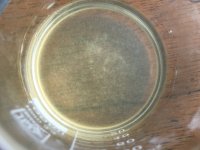
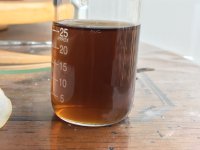
First two photos are the crystals that formed from the reduced alcohol that already filtered off the oxalates that precipitated as powders. Second two are the 99iso washed crystals that are clear and yellowing in color. 4th is the 99iso that has some solid precipitates and the last photo is the decanted amber alcohol solution. The mescaline may still be in the amber alcohol so am keeping each fraction to test.
 

Attachments

  • IMG_7593.JPG
    IMG_7593.JPG
    952.3 KB · Views: 3
  • IMG_7594.JPG
    IMG_7594.JPG
    1.9 MB · Views: 3
  • IMG_7596.JPG
    IMG_7596.JPG
    1.3 MB · Views: 4
  • IMG_7597.JPG
    IMG_7597.JPG
    1.4 MB · Views: 5
  • IMG_7598.JPG
    IMG_7598.JPG
    1.5 MB · Views: 4
  • IMG_7599.JPG
    IMG_7599.JPG
    1.3 MB · Views: 3
Just some important information to add... the volume as you can see of the liquid is just over 25ml so perhaps it just reached a saturation point with the larger crystals weighting 400mg after drying with perhaps another 25-50mg in the washing isopropanol liquid.
I did a solubility test with water on 100mg of the salt and there was little to no solubility in 5ml The main thing is being in a small enough volume of solvent. Like I mentioned I tested different concentrations and at first even 40% ethanol worked BUT overnight it dissolved the pure mescaline oxalate I used to test. Perhaps If I allowed it to evaporate or just used a lower concentration.

Regardless I have now added a lye solution at 40-50mL for the 400mg salt and it has all dissolved BUT there is a precipitate that is in the water which is extremely like the freebase mescaline. Which is sparingly soluble in water. I tested with freebase/carbonate salt before attempting this as well.

So I just need to finish up confirming the mescaline by pulling with xylene and then salting with hcl acid.

As for the most accessable way to change the oxalate to another salt I think adding a minimal amount of lye water OR even better lime water (after allowing it to settle) and then decanting keeping the precipitate then adding vinegar or hcl water to the precipitate would result in some loss but fairly minimal. Unless someone has a better route. For me with access to 99% isopropanol I think adding hcl solution to the oxalate crystals until dissolved would free the oxalic acid then when dry adding 99% isopropanol to remove the oxalic acid and clean up the hcl salts all at once.

I also want to explore the idea of adding H2O2 to the oxalate to form the carbonate salt or atleast destroy the oxalate. IDK
 
Last edited:
Back
Top Bottom