

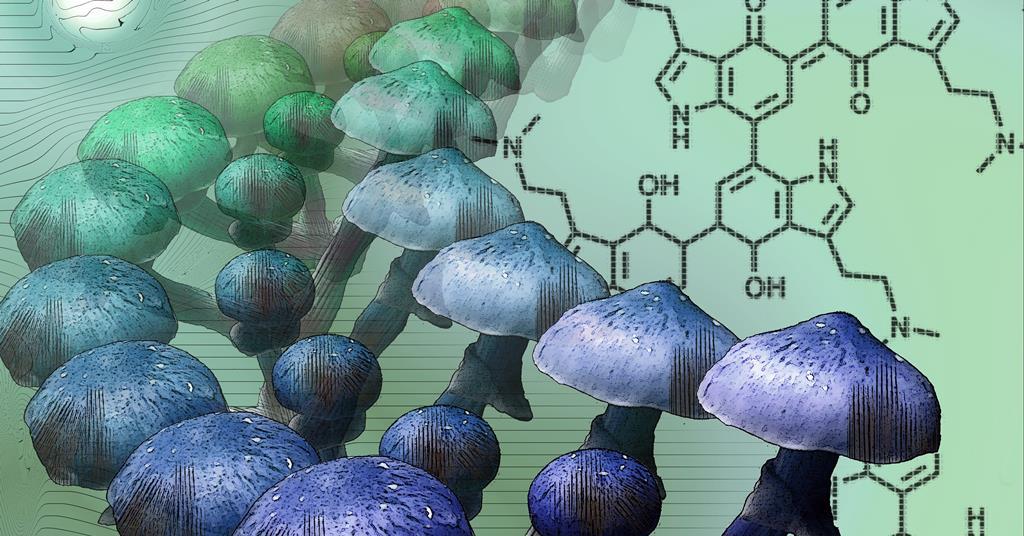
The pigment, as it turns out, is not just a single compound but a complex mixture of linked psilocybin oxidation products. Most of them are quinoid psilocyl oligomers – compounds not unlike indigo, a deep blue pigment used to dye jeans. ‘[The blue compounds and indigo] share structural similarities in the indole core, and in both the basis for the colour is a quinoid,’ says the study’s lead author Claudius Lenz.
All of the six mushroom pigments the team identified are products of a cascade reaction starting with psilocybin. A phosphatase enzyme takes off its phosphate group, converting it into psilocin. An oxidising laccase then creates psilocyl radicals, which combine to form C-5 coupled subunits and then further polymerise via C-7. ‘I think they did a beautiful job of showing the cascade reaction,’ says Jaclyn Winter, who studies natural product biosynthesis in bacteria and fungi at the University of Utah, US.
What exactly the blue pigments do, however, remains a mystery. ‘Our hypothesis – and we don’t have any evidence for this yet – is that it might serve a protective role, like an on-demand repellent against predators,’ says Hoffmeister. The compounds might produce reactive oxygen species, which are toxic to any insect nibbling on the mushrooms. ‘I think we’re going to see a lot of follow-up studies on the true ecological role of these molecules,’ Winter says.
Mystery of why magic mushrooms go blue solved
Chemists reveal colourful indigo-like polymers that turn psychotropic mushrooms blue when cut
 www.chemistryworld.com


