• Members of the previous forum can retrieve their temporary password here, (login and check your PM).

Naphtha / Heptane - color difference

floreal____

Rising Star
Hi all, i have a question:
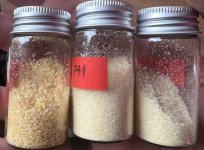
I do STB Tek and I changed from "foodgrade" naphtha (for camping cookers) to labgrade heptane. In the picture you can see 3 small bottles - the left one is made with the naphtha and the other two are made with heptane. Why is there a color difference? I know its plant oils and all but i still wonder why is there such a difference - someone out here with a satisfying answer? Also the crystals where finer with the heptane and the yield was like 10-15% better.
cheers
edit: of course i did everything else identical - same lab gear and NaOH and all
 

Attachments

  • IMG_9000.jpg
    IMG_9000.jpg
    3.1 MB · Views: 13
Heptane is slightly more selective than naptha meaning less other contaminants will get pulled that might give your extract colour. Also If you pulled from the same batch of soup then the first pull will often come out a little more coloured.. at least IMO

How fine the crystals are is probably to do with how quickly they crashed out of the solvent. Maybe with heptane the become insoluble quicker at cold temp or something. Slow crystallization will make bigger crystals.. ie gradual change of temperature. Either way all those vials look really good.
 
Last edited:
Dmt is polymorphic aka it forms different lattices in solid phase based on the solvents and conditions
Yeah, in the case of mimosa at least, the "plant fats" bit is very much an urban myth. The coloration occurs as a result of charge transfer between neighboring indole moieties within the crystal lattice, as far as we know. If taking this further, it's a question of how much we want to discuss band-splitting of molecular orbitals and the associated electronic transitions, so I'll hold off for now.
Heptane is slightly more selective than naptha meaning less other contaminants will get pulled that might give your extract colour.
Seeing as heptane is a bit more selective, the peak concentration of the DMT in the solvent possibly will be somewhat lower than in the case of naphtha, which may mean that a lower degree of molecular aggregation in terms of, say, π-π stacking can occur. I do also wonder whether the coloration in the naphtha-derived material occurs throughout each crystal, or if it perhaps only occurs as a layer on the outside.

There possibly are also uncontrolled variables at play here, particularly base concentration and contact time. The surface of the lab gear will also have been etched slightly after that first extraction... ever floweth the river!
 
@Transform I’ve wondered that as well. It probably depends on what it is that’s giving it colour, as various compounds can do so. Some impurities seem surface level, as is seen in extracts where only the top surface of crystals has colour and is quite patchy. This would suggest to me an impurity that becomes insoluble in the naptha before the DMT.

Then other extracts where the impurity is more readily soluble the colour seems easily spread.
 
Last edited:
@Transform I’ve wondered that as well. It probably depends on what it is that’s giving it colour, as various compounds can do so. Some impurities seem surface level, as is seen in extracts where only the top surface of crystals has colour and is quite patchy. This would suggest to me an impurity that becomes insoluble in the naptha before the DMT.

Then other extracts where the impurity is more readily soluble the colour seems easily spread.
It should be added, you've seen a far wider range of extracts than many of us, given your impressive body of work on the various acacia species.

Thanks for the additional insights!
 
Heptane is slightly more selective than naptha meaning less other contaminants will get pulled that might give your extract colour. Also If you pulled from the same batch of soup then the first pull will often come out a little more coloured.. at least IMO

How fine the crystals are is probably to do with how quickly they crashed out of the solvent. Maybe with heptane the become insoluble quicker at cold temp or something. Slow crystallization will make bigger crystals.. ie gradual change of temperature. Either way all those vials look really good.
thanks for the answer, i did a side by side test - i didnt pull the same soup:) same times, same amount of stirring and all.
 
thanks for the answer, i did a side by side test - i didnt pull the same soup:) same times, same amount of stirring and all.
But did you split the same batch of soup into three portions for the respective pulls? That would be the way to control for tiny variables in weighing, mixing, hydration, and inhomogeneities in the ingredients.
 
But did you split the same batch of soup into three portions for the respective pulls? That would be the way to control for tiny variables in weighing, mixing, hydration, and inhomogeneities in the ingredients.
i made two soups, each in its own erlenmeyer flask. I did the exact same ratio of NaOH and destilled water and with my lab stirrer exact same times of stirring and all. Same basematerial, everything measured by a precision scale and mass pistons - so its pretty accurate i think:) Maybe the 3 viles are a bit confusing, its just the comparison for the color, the vile on the right is from another - smaller batch - but also made identical and with heptane.
 
Back
Top Bottom