• Members of the previous forum can retrieve their temporary password here, (login and check your PM).

CuriousBoy

Rising Star
There are many guides of making DMT, but none are specifying the exact identifiers of the substances recommended.

I would like to know whether what is generally listed in the guides as Heptane for example, is exactly what I am ordering on a website which is presenting a product called n-heptan. Similarly for Naphtha, I am seeing products labelled as Cosmetic Naphtha. Apparently there are at least 5 types of Naphtha.

Can anyone please add the CAS numbers of these non-polar solvents to shed light on this? If there are multiple substances that are allowed, just list all of them there. I am finding some matches on the internet, but I would really trust someone more experienced to validate these instead. Here is the list I've found, please correct and complete it.

- Naphtha - unsure, there are many
- Heptane - 142-82-5
- Hexane - 110-54-3
- Xylene - 1330-20-7
- Toluene - 108-88-3
- d-Limonene - 5989-27-5
- Limonene (distilled d-Limonene) - not sure, same as above?
- Methylene chloride (DCM) - 75-09-2
- Octane (petrol) - 111-65-9
- Nonane (kerosene) - 111-84-2
 
Last edited:
Go for 80/120, or lower numbers [60/100, if it exists].
Lower numbers exist but the problem is they get pretty darn expensive. I think at this point it's just more convenient to continue down the Wundbenzin route even if that's also around 80 euros for 10 liters but it seems to be around 50 euros cheaper than the Ligroina path which in the long run can he very significant
 
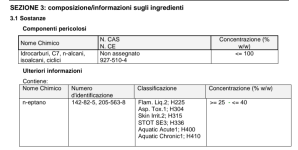
I'm looking at the Safety sheet of the Heptane I have available though I'm not sure where exactly to look, could anyone give me any sort of indication? File attached is what I believe to be the useful part though I'm absolutely unsure
 

Attachments

  • Screenshot_20251014-155630_Files by Google~2.png
    Screenshot_20251014-155630_Files by Google~2.png
    87.2 KB · Views: 4
I'm looking at the Safety sheet of the Heptane I have available though I'm not sure where exactly to look, could anyone give me any sort of indication? File attached is what I believe to be the useful part though I'm absolutely unsure
What does cilcili mean? If I am reading this correctly its a mixture of n-heptane and isoheptanes. Very similar to the different between n-hexane compared to hexanes. Explained in wikipedia:
 
What does cilcili mean? If I am reading this correctly its a mixture of n-heptane and isoheptanes. Very similar to the different between n-hexane compared to hexanes. Explained in wikipedia:
"Ciclici" directly translates to "cyclic". I don't know if it might refer to something like cyclohexane or something in that branch of solvents. So, basically, you mean it might not be good for extractions, correct? Because, and correct me if I'm wrong since I want to understand and be able to read these sheets, n-heptane which is the pure form of heptane is just >=25 - >=40 (between less or equal than 25% to less or equal than 40%)?

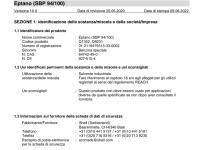
I'm also going to add this other screenshot I just took in the attachments, it says it's Heptane SBP94/100, there's also the CAS number displayed and it's manufactured by Shell Switzerland. I also attached the full PDF if it might be useful in some way although it is in Italian, I think it's mostly understandable for anyone with technical knowledge. I can give it a shot once I'm done with my second or third pull of Wundbenzin but I don't know if it might make a reaction with that
 

Attachments

  • Screenshot_20251014-175237_Files by Google~2.png
    Screenshot_20251014-175237_Files by Google~2.png
    174.3 KB · Views: 2
  • DR_16793237_23618292_080922_1344.pdf
    1.7 MB · Views: 2
Last edited:
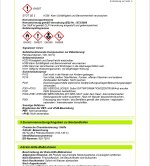
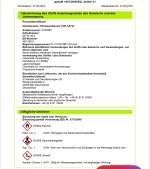
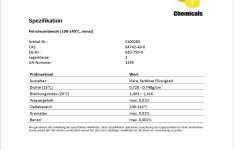
Got question how you would rate this Naptha?

CAS-Nummer:
64742-49-0

Added the data sheet but only German version.
Maybe someone still can help me?

The evap test was super good like I never dropped it on the surfaces.
When I read the PDF posted in this thread I just got confused totally again. The evaporation of this Naptha seems very slow, but the handling and emulsion resistance is superior.
Is there any other disadvantage with this Naptha vs a 60/80 or 'waschbenzin' like Naptha?
 

Attachments

  • Screenshot_2025-11-30-08-06-30-870_com.adobe.reader-edit.jpg
    Screenshot_2025-11-30-08-06-30-870_com.adobe.reader-edit.jpg
    512.1 KB · Views: 1
  • Screenshot_2025-11-30-08-06-06-392_com.adobe.reader-edit.jpg
    Screenshot_2025-11-30-08-06-06-392_com.adobe.reader-edit.jpg
    413.8 KB · Views: 1
  • Screenshot_2025-11-30-08-05-50-848_com.adobe.reader-edit.jpg
    Screenshot_2025-11-30-08-05-50-848_com.adobe.reader-edit.jpg
    137.1 KB · Views: 1
Last edited:
If it evaporates cleanly [like you say] and does the job I don't see what there is to worry about. The higher boiling range could be seen as advantage if you're planning on doing warm pulls, where the 60/80 material would be evaporating annoyingly quickly.

The EG Nummer/EC number would be an accessible data source for further technical specifications, but the SDS seems quite sufficient as it is. The low (<0.01%) content of aromatics is also a plus point in some respects. The higher boiling point does suggest there might be a higher than usual proportion of your yield remaining dissolved in this naphtha after freeze precipitation, however, based on the increase seen when going from pentane, to hexane, to heptane. Without figures from octane upwards, not to mention for naphtha of specific known compositions, the linearity of this extrapolation cannot be assumed, and there's likely to be a ceiling to it somewhere.
 
If it evaporates cleanly [like you say] and does the job I don't see what there is to worry about. The higher boiling range could be seen as advantage if you're planning on doing warm pulls, where the 60/80 material would be evaporating annoyingly quickly.

The EG Nummer/EC number would be an accessible data source for further technical specifications, but the SDS seems quite sufficient as it is. The low (<0.01%) content of aromatics is also a plus point in some respects. The higher boiling point does suggest there might be a higher than usual proportion of your yield remaining dissolved in this naphtha after freeze precipitation, however, based on the increase seen when going from pentane, to hexane, to heptane. Without figures from octane upwards, not to mention for naphtha of specific known compositions, the linearity of this extrapolation cannot be assumed, and there's likely to be a ceiling to it somewhere.
For the 60/80 is exactly what I ment referring to the better handling. Enormous advantage I don't want to give away, that's why I am asking for opinions on this Napth! So ty already.
And for whatever reason the same emulsion I provoked today with forcingly heavy swirling with an glas rod, just settled within seconds, insane!


Regarding your second section(had use translator):

I understand up to '...after freeze precipitation,...'.

After that, I'm completely lost :( I have absolutely no idea what it means, let alone what it ultimately implies.

I can only assume that certain eventualities are unpredictable in scope. However, I should expect a certain 'confined' portion, and in the worst-case scenario, this portion could certainly be significant?

Will add the PDF of the SDS maybe helps?
 

Attachments

  • SDB_Petroleumbenzin_100-140_DE.pdf
    151.4 KB · Views: 2
Ya ok, sounds acceptable. Reason to rethink my decision to evap at end. The handling advantage is to big of a deal tbh.

Will post results when I am back on it. Got some bronchitis what makes me just want to go to bed when I get home last days....
Fucking abused my body 30 years, that's the minimal price I guess.


Oh, and did I get it right that crystallize using IPA is a way? Last step to do... To reduce NPS residues?
 
Last edited:
Back
Top Bottom