


Rodríguez et al (2022) New Insights into the Chemical Composition of Ayahuasca.
I've found this paper very interesting for several reasons:
1- Fructose found as the main ingredient in ayahuasca
It has never been described before, but makes perfect sense, considering the potential sugars in plants, such as the previously described hydrolizable glycosides Banistenosides A and B and the fructose-based disaccharide β-D-fructofuranosyl-(2 → 5)-fructopyranose. Also considering how some ayahuasca has a distinct sweetness to it (some concentrated ayahuasca in Brazil is called "Mel" , or honey), it does fit in with the observation.
Samples had 3 - 33g/50ml of fructose, which is impressively high. Researchers hypothesize this may be partly responsible for diarrhea/intestinal discomfort.
This is also interesting to keep in mind for diabetic people or people with fructose intolerance taking ayahuasca
2- Harmine->THH during brewing theory dismissal, and presence of harmine in sediment
The researchers discuss Callaway's hypothesis that harmine reduces to THH during boiling, hence why brewed ayahuasca samples contain significant THH amounts while plant material generally seems to contain less. Researchers say they do not think this reduction is happening without a reducing agent, they believe the difference is related to the solubility of harmine, which seems to be partly insoluble and present in sediment which is often not analysed hence the ratio of THH to harmine increases when testing only the supernatant liquid.
I found it interesting to read that indeed there is no THH detected in sediment, only harmine.
I will definitely test this hypothesis out myself using a control (crude plant samples) vs boiled material.
3- Detection of ethanol, acetate and lactate
These are products of fermentation, so more likely to appear in older stored brews. Apart from ethanol, I dont think the other ones have been described before in publications (though I might be wrong)
4- Detection of trace amounts of bufotenine in two samples
Two samples contained trace bufotenine, which the researchers hypothesize is probably related to Diplopterys cabrerana being used in the brewing instead of Psychotria viridis.
They also found trace amounts of N-methyltryptamine, tetrahydronorharmine, and harmalol
5- Ayahuasca alkaloid content recap, support material material
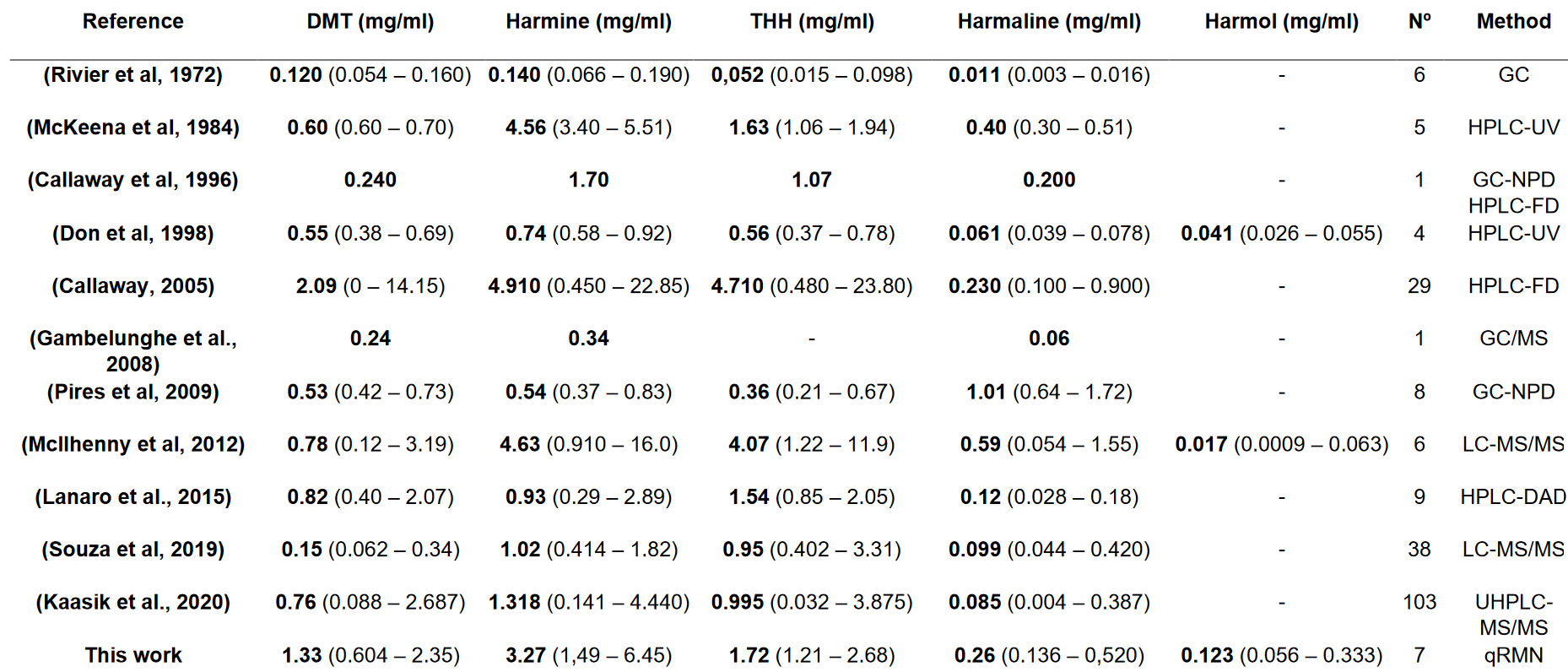
And on a last note, I find it nice when authors provide support material with more data, and describe methodology very well. They also provide an average alkaloid content in different ayahuasca samples in the literature, in a very handy table:
I've found this paper very interesting for several reasons:
1- Fructose found as the main ingredient in ayahuasca
It has never been described before, but makes perfect sense, considering the potential sugars in plants, such as the previously described hydrolizable glycosides Banistenosides A and B and the fructose-based disaccharide β-D-fructofuranosyl-(2 → 5)-fructopyranose. Also considering how some ayahuasca has a distinct sweetness to it (some concentrated ayahuasca in Brazil is called "Mel" , or honey), it does fit in with the observation.
Samples had 3 - 33g/50ml of fructose, which is impressively high. Researchers hypothesize this may be partly responsible for diarrhea/intestinal discomfort.
This is also interesting to keep in mind for diabetic people or people with fructose intolerance taking ayahuasca
2- Harmine->THH during brewing theory dismissal, and presence of harmine in sediment
The researchers discuss Callaway's hypothesis that harmine reduces to THH during boiling, hence why brewed ayahuasca samples contain significant THH amounts while plant material generally seems to contain less. Researchers say they do not think this reduction is happening without a reducing agent, they believe the difference is related to the solubility of harmine, which seems to be partly insoluble and present in sediment which is often not analysed hence the ratio of THH to harmine increases when testing only the supernatant liquid.
I found it interesting to read that indeed there is no THH detected in sediment, only harmine.
I will definitely test this hypothesis out myself using a control (crude plant samples) vs boiled material.
3- Detection of ethanol, acetate and lactate
These are products of fermentation, so more likely to appear in older stored brews. Apart from ethanol, I dont think the other ones have been described before in publications (though I might be wrong)
4- Detection of trace amounts of bufotenine in two samples
Two samples contained trace bufotenine, which the researchers hypothesize is probably related to Diplopterys cabrerana being used in the brewing instead of Psychotria viridis.
They also found trace amounts of N-methyltryptamine, tetrahydronorharmine, and harmalol
5- Ayahuasca alkaloid content recap, support material material
And on a last note, I find it nice when authors provide support material with more data, and describe methodology very well. They also provide an average alkaloid content in different ayahuasca samples in the literature, in a very handy table:


