• Members of the previous forum can retrieve their temporary password here, (login and check your PM).

official extraction help thread

Migrated topic.
Lichen said:
Update:

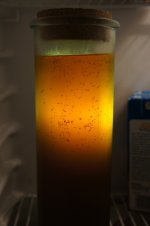
I bought some pH strips - they are for swimming pools, so only read from 6.2 to 9.0. I tested my chilled solution with the murky sediment in the bottom and the pH level didn't change even a bit, which tells me that I am essentially testing vinegar, and acids that low aren't going to register on the strip.

This being said, it also tests for 'alkalinity' which it tells me is extremely high: at 240.

I spooned off about 30-40mls of my solution, without disturbing the sediment, and put it in a shot glass. Then I added vinegar, a little at a time. No reaction whatsoever.

I spooned off another 30-40mls in a fresh shot glass. This time I made a separate solution of water and Sodium carbonate and added this solution, a few drops at a time. It immediately started precipitating, and turning very yellow. I tested the pH: 9.0 (the maximum on the stip so it could have potentially been higher). In no time at all, solids had begun to fall out of the solution and settle.

This tells me that the solution in my large jar is acidic, and that my liquid is full of alkaloids.

So the question is:
what on earth is all the sediment at the bottom?? Seems like an awful lot of unwanted matter?

The plan from here:
Decant all the liquid, and keep the solids. Rebasify the liquid.

Anyone have any ideas on what I should do with this sediment? Is there any real chance there are harmalas in there?

I'd say your solids are likely impurities. Harmala alkaloids are very soluble in acidic solutions so anything that settles is usually unwanted seed gunk. So you can either pitch the solids and continue working with what liquid you do have or you can keep trying to dissolve the solids and start the process over again (however the latter is probably unnecessary, not to mention rue is cheap and plentiful so you can always try again..)

It does sound like your acidic solution has alks in it ready to be precipitated. I also didn't see a Manske step in there anywhere. Of course I've never tried the "no filter no reduce method" so it may not be a step in this particular tek. A manske or two before the final base step will purify it further and get rid of (typically) unwanted alkaloids such as Vasicinone, Vasicine and Deoxyvasicine.

Anywho, it does seem like you are on the right track so good luck and keep us posted with your final results! Btw, how many seeds did you start with?

:)
 
hi everyone,

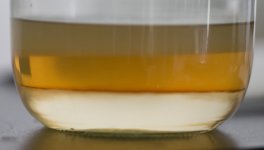
as you can see in the pic below, i am just doing some washing
i could not find anything about 3 layers when washing, is this normal?

should i just put the top layer in the freezer?

the extraction was done with MHRB and the STC tech with heptane
 

Attachments

  • wash.jpg
    wash.jpg
    188.1 KB · Views: 0
So I've been lurking here a bit using this tek ( ACRB TEK 100g "PICS" (Newbie Friendly) - A/B - Welcome to the DMT-Nexus )

I originally had issues finding containers of the correct size and shape. I tried using Voss water bottles for the mini AB at the end but found out that wouldn't work. So I ordered a 1L erlenmeyer flask but am worried that the shape is terrible for the swirling step and I've ended up w/ an emulsion? what do yall think?


The Grateful One said:
Lichen said:
Update:

I bought some pH strips - they are for swimming pools, so only read from 6.2 to 9.0. I tested my chilled solution with the murky sediment in the bottom and the pH level didn't change even a bit, which tells me that I am essentially testing vinegar, and acids that low aren't going to register on the strip.

This being said, it also tests for 'alkalinity' which it tells me is extremely high: at 240.

I spooned off about 30-40mls of my solution, without disturbing the sediment, and put it in a shot glass. Then I added vinegar, a little at a time. No reaction whatsoever.

I spooned off another 30-40mls in a fresh shot glass. This time I made a separate solution of water and Sodium carbonate and added this solution, a few drops at a time. It immediately started precipitating, and turning very yellow. I tested the pH: 9.0 (the maximum on the stip so it could have potentially been higher). In no time at all, solids had begun to fall out of the solution and settle.

This tells me that the solution in my large jar is acidic, and that my liquid is full of alkaloids.

So the question is:
what on earth is all the sediment at the bottom?? Seems like an awful lot of unwanted matter?

The plan from here:
Decant all the liquid, and keep the solids. Rebasify the liquid.

Anyone have any ideas on what I should do with this sediment? Is there any real chance there are harmalas in there?

I'd say your solids are likely impurities. Harmala alkaloids are very soluble in acidic solutions so anything that settles is usually unwanted seed gunk. So you can either pitch the solids and continue working with what liquid you do have or you can keep trying to dissolve the solids and start the process over again (however the latter is probably unnecessary, not to mention rue is cheap and plentiful so you can always try again..)

It does sound like your acidic solution has alks in it ready to be precipitated. I also didn't see a Manske step in there anywhere. Of course I've never tried the "no filter no reduce method" so it may not be a step in this particular tek. A manske or two before the final base step will purify it further and get rid of (typically) unwanted alkaloids such as Vasicinone, Vasicine and Deoxyvasicine.

Anywho, it does seem like you are on the right track so good luck and keep us posted with your final results! Btw, how many seeds did you start with?

:)

Thanks for the response Grateful One.

Yeah, my plan regarding the manske was to: brew, base, acidify, manske, and base again. My whole process has stretched over a couple of weeks now due to time restraints, so I'm losing track of any real structure to my extraction. Everything seems to be falling into place though.

However, I've been having problems with my solids settling in my base solutions. A lot of of it has settled, but there is a lot of fine particles just floating in the solution. A lot has also form a layer of flakes on top.

I ended I decanting most of it into another jar, just so I could grab the solids from the very bottom. This seemed to work quite well, but I've still got this big jar of base, with some floaties in it, and a very small layer of extremely sparkly good looking solids on the bottom. Looks like I may end up having to filter after all...

Meanwhile, my acidic solutions are ready for a manske, a final base and a wash. Gonna do some reading on the manske process today and give it a shot later!
 
Right on, sounds like a solid plan. As for the particles, letting them sit overnight or 24 hours (I put mine in the fridge, not sure if that helps but I think I read somewhere that some of the harmala alks are less soluble in cold water...it was a post from 69ron..if I find it I'll link it) usually allows most of the alkaloids to settle. But like you said (and just to be safe) I also like to filter the liquid after the final base through a coffee filter or two to catch everything.

I think with having decanted the majority of your liquid into another container the filter step shouldn't be too problematic, just a little slow moving if anything. Hopefully all goes well with the rest of the extraction.

edit: here is that post...the last post on the first page 69ron claims that harmine is insoluble in water and harmaline is very slightly soluble in cold water. So if this is 100% true (I have not cross referenced this claim for the record), placing your based solution in the fridge may help with precipitating the harmalas.
 
airclay said:
So I've been lurking here a bit using this tek ( ACRB TEK 100g "PICS" (Newbie Friendly) - A/B - Welcome to the DMT-Nexus )

I originally had issues finding containers of the correct size and shape. I tried using Voss water bottles for the mini AB at the end but found out that wouldn't work. So I ordered a 1L erlenmeyer flask but am worried that the shape is terrible for the swirling step and I've ended up w/ an emulsion? what do yall think?


Yeah, usually when a third layer appears like that it is an emulsion of some sort. Have you tried adding more base? That should break up your emulsion instantly:

breaking emulsions instantly
 
The Grateful One said:
Right on, sounds like a solid plan. As for the particles, letting them sit overnight or 24 hours (I put mine in the fridge, not sure if that helps but I think I read somewhere that some of the harmala alks are less soluble in cold water...it was a post from 69ron..if I find it I'll link it) usually allows most of the alkaloids to settle. But like you said (and just to be safe) I also like to filter the liquid after the final base through a coffee filter or two to catch everything.

I think with having decanted the majority of your liquid into another container the filter step shouldn't be too problematic, just a little slow moving if anything. Hopefully all goes well with the rest of the extraction.

edit: here is that post...the last post on the first page 69ron claims that harmine is insoluble in water and harmaline is very slightly soluble in cold water. So if this is 100% true (I have not cross referenced this claim for the record), placing your based solution in the fridge may help with precipitating the harmalas.

Hmmm, should be no harm in giving it a shot. Will finish with my current manske before I start messing around with my old base solution.

So far, my manske solution is full of tiny brownish needles, like tiny long, flat triangles. I left it out until it was about room temperature, and then it's been in the fridge for about about 15 hours.

No idea whether it's still producing any crystals, I'll leave it for overnight and then proceed from there.
 

Attachments

  • DSC05035.JPG
    DSC05035.JPG
    320.8 KB · Views: 0
Are there solids forming on the bottom? The pic is a bit dark towards the bottom and my silly eyes can't distinguish...it looks like something is there?

How much salt was used? From the Tao of Rue for the manske step:

"Take a note of how many ml's you have and add 10 grams salt per 100ml solution. Make sure your solution is hot before you add the salt, otherwise the harmalas might fall out too soon. Allow to cool slowly."

But it definitely looks like something is forming so that is a good sign.

EDIT: seems like we may have it slightly figured out from the nice folks in chat, hopefully... :)
 
Just in case anyone else comes across this same problem in their rue extractions - as in the photo above:

Despite creating a perfectly calculated salt solution* for the volume of this acid brew, the thing I didn't take into account was the concentration of alkaloids in the solution.

I had way, way too much liquid (1200mls+500mls salt solution) for harmalas extracted from 90gms of Syrian rue.

Hence why I only got little shards, and lots of powder, instead of the anticipated fiberglassy needles.


*
- 36gms of salt dissolves into 100ml of water,

- I wanted to use 15gms of salt per 100mls of solution

= 180gm salt dissolved into ~500mls of water, to be added 1200ml acidic solution
 
I apologize for breaking up the rue discussion, but I have a quick question regarding naphtha that isn't quite worthy of it's own thread.

Can naphtha go bad? For example, would naphtha that is 3 or 4 years old work as well as some purchased today?

And are there concerns over impurities entering the can?

If anyone has any info, it would be appreciated beyond words. A search through this forum and duckgo yielded nothing. h
 
Smeed said:
I apologize for breaking up the rue discussion, but I have a quick question regarding naphtha that isn't quite worthy of it's own thread.

Can naphtha go bad? For example, would naphtha that is 3 or 4 years old work as well as some purchased today?

And are there concerns over impurities entering the can?

If anyone has any info, it would be appreciated beyond words. A search through this forum and duckgo yielded nothing. h

My uneducated, unexpert opinion is...

It could pick up impurities from the container if it was made out of a material that is not resistant to the solvent.

Also I think you have much more of a chance of it evaporating before it could go bad or before impurities enter the container.

This is just me though, but I wouldn't be worried about it unless there was some specific reason why I would suspect it has been contaminated with something, i.e. I was storing it a plastic pop bottle or something.

Just make sure its a good brand of naphtha to start with, as many retail versions come with crappy additives.
 
ehud said:
Smeed said:
I apologize for breaking up the rue discussion, but I have a quick question regarding naphtha that isn't quite worthy of it's own thread.

Can naphtha go bad? For example, would naphtha that is 3 or 4 years old work as well as some purchased today?

And are there concerns over impurities entering the can?

If anyone has any info, it would be appreciated beyond words. A search through this forum and duckgo yielded nothing. h

My uneducated, unexpert opinion is...

It could pick up impurities from the container if it was made out of a material that is not resistant to the solvent.

Also I think you have much more of a chance of it evaporating before it could go bad or before impurities enter the container.

This is just me though, but I wouldn't be worried about it unless there was some specific reason why I would suspect it has been contaminated with something, i.e. I was storing it a plastic pop bottle or something.

Just make sure its a good brand of naphtha to start with, as many retail versions come with crappy additives.

Thank you very much for the reply.

I have vm+p, and it's been in the original can for all 4 or so years.

The main reason I ask is because I recently did an extraction, and the naphtha came out slightly yellow, but after 24 hours nothing has crystallized. And the freezer is at the highest possible setting.
 
Lichen said:
First time syrian rue extraction here, and didn't want to clutter up the forums with my own thread.

I'm attempting a 'no reduce-no filter' Syrian Rue extraction, but have already run into some problems. Namely, because it seems I based way too much, and now I need to know how to proceed.

Story so far:

-Boiled seeds 3 times, kept tea, discarded seeds.

-Based immediately after each boil with Sodium carbonate. Unfortunately, I continued to add multiple teaspoons of Sodium carb to my solution after it had changed colour, because I could still see solids falling out every time I added more. Eventually, I have no idea how many teaspoons I added. At this point I didn't realise I had already made mistakes.

-I left the solution in the fridge to settle for a day, and then that evening poured off as much of the liquid as possible without disturbing my solids.

-To this, I added vinegar to make the solid dissolve. I continued to add vinegar until it was no long foaming or reacting. Then I put it in the fridge overnight for the unwanted solids to settle.

I just want to follow up with this and hope to get some insights because I pretty much did the same thing. After the initial boil x3 and based the liquid (I was probably being too liberal in adding Sodium Carbonate after the color turns. Then I measured 1:3 (vinegar: water ratio) about 150 ml solution heated.

Then I pour the based liquid (after discarding the dark liquid part and kept the white sediments), but I saw still a lot of particles (now I believe they were impurities) and thought I had too much base in the solution. So I kept adding vinegar and start heading the solution (because it got chilled after mixing). At some point I realized I might had added too much vinegar, but without pH testing paper in hand I was quite lost.

I decided to manske (if understand correctly) - adding the acid solution with Sodium Chloride -- I see more white particles forming but in a gooy way. In any case, I let it all settle and took out the part that's not sediments in the bottom assuming these have to be some form of harmala. Feeling that adding Salt might not be as safe as Sodium Carbonate, I went through again A/B process this time with just 1:3 ratio and then adding Sodium Carbonate, then just wash with water many times to move to neutral pH.

Now I have two bottles. The first batch yields 3.99g of yellowing grounds and I'm going to dry the second part soon. So all these from 200g seeds. The 4% of 200g is 8g. It seems to me I might have got lucky and what I have indeed is harmala alkaloids, but I'm not quite sure if there's an easy way to test it. Anyone has advice about this? How to test it? Is it worth it to test it or just do another batch? I feel the end result although I had not seen any crystalization... the weight and final result seem to suggest I might have things turn out ok.
 
Smeed said:
Thank you very much for the reply.

I have vm+p, and it's been in the original can for all 4 or so years.

The main reason I ask is because I recently did an extraction, and the naphtha came out slightly yellow, but after 24 hours nothing has crystallized. And the freezer is at the highest possible setting.


I don't think you want the coldest setting when freeze precipitating but around -6 C although I don't think that is your issue.

What kind of plant are you using?
 
Hello! Now i know im gonna sound pretty ignorant here, but i would rather make sure I know what im doing like the back of my hand before i go doing something like this. So looking over q21q21's TEK found here: Q21Q21's Vinegar/Lime A/B Extraction Tek - DMT-Nexus Wiki i want to use tek 1 but im a little confused on the "Pull" portion of it, because it mentions waiting 2 weeks. so to keep true to the tek would I re-wet the mush as im sure in that time it would get "Bone dry" so how would I do this? Because the more i read it the less it makes sense to me, im sure im just not getting it. And if i wait that long would i reuse the same batch of non-polar solvent? or would i use fresh and recrystallize each time? I know that these are probably simple answers. But i really want i full comprehension of this, truly if anyone knew of a video or another source to help that would be great. Because i really want to use the food safe method. Again i know these are probably really silly questions but i want to make sure i do it right!

Thank you so much!😁 :thumb_up:
 
ehud said:
Smeed said:
Thank you very much for the reply.

I have vm+p, and it's been in the original can for all 4 or so years.

The main reason I ask is because I recently did an extraction, and the naphtha came out slightly yellow, but after 24 hours nothing has crystallized. And the freezer is at the highest possible setting.

I don't think you want the coldest setting when freeze precipitating but around -6 C although I don't think that is your issue.

What kind of plant are you using?

It's actually the sacred mhrb, and it's four years old as well haha.

The mhrb had already been pulled twice (at least) and I was doing some cleaning recently, had some four year old naphtha laying around, and thought "what the hey" and went for it.

For all those who are curious, after 48 hours I got a yield of approximately 0.05g. I'm satisfied, considering I was expecting nothing. I have quite a bit more used mhrb from the same time period that I may do a pull on as well. I may have 0.2g or so total.

Also thinking about doing a few pulls with xylene.

Thanks for all the help, much appreciated!
 
Hi all! New member here and am fascinated my this awesome community of people. Just finished my first extraction of 100g ACRB using Earthwalker's Tek. I tried to follow each step to the best of my abilities and ended up with 0.4g of white crystals. I was wondering why my yield was this low.

I used zippo lighter fluid as my non-polar solvent. In the pulling stage where I mix naptha into the basic soup and let the layers seperate 4 times, I noticed my layers were separating really fast. In Earthwalker's guide, it says it takes approximately 3-5 mins for the layers to separate. My emulsion was seperating in 30-40 seconds. Could this have been where I lost a part of my yield?

Additionally, which nps do you guys commonly use (those of you living in US)? I was reluctant to use VM&P since i heard about them recently changing their formula?
 
Back
Top Bottom