• Members of the previous forum can retrieve their temporary password here, (login and check your PM).

official extraction help thread

Migrated topic.
Fellow Space Travellers,

Swim successfully pulled white crystals with shellite (The only selective NP solvent that can be found in the Ausland). However after pouring the shellite into another container and letting the jar drip dry upside down in the freezer, there is still an oily residue. It makes all the crystals smell of shellite. And the crystals turn to a clear goo when touched with finger. It suggest shellite is still there. However when left to sit, it solidifies again. How does one remove this residue?
 
It could be anything. Rinse with water. If that doesnt fix it then the residue could be either a plastic or really purified dmt as an oil. Try an isopropyl alcohol or acetone rinse. If that doesnt fix it then just clean it out with more shellite. If the acetone/isopropyl cleans it out then its probably dmt.

But to really answer your question, just clean with more shellite. The reason i said the paragraph above was so that if it was a plastic or other chemical then you might want to clean your spice with a mini a/b or re-x.
 
If SWIM adds a little bit of shellite, does he then freeze precipitate again? SWIM doesnt see how this works, new residue will remain wont it?
It definitely is not plastic.

Strangely, when SWIM rinsed it with water in a glass, alot of the crystals seem to have dissolved. :?:

Definitely dmt though, I think the warmer temp is causing the crystals to go gooey. Anyways, SWIM will wait for water to evaporate, and hopefully the goo will solidify into a clean dmt product.
 
Sorry if this does not fit here.

What would be the proportion of DMT between ACRB and MHRB? I mean, I've read that ACRB has less DMT to extract but, how less? Enough to be better to have 100g of ACRB that 50g of MHRB?

Thanks!
 
Astaroth said:
Sorry if this does not fit here.

What would be the proportion of DMT between ACRB and MHRB? I mean, I've read that ACRB has less DMT to extract but, how less? Enough to be better to have 100g of ACRB that 50g of MHRB?

Thanks!
Alkaloid content varies from plant to plant significantly depending on genetic and environmental factors. Dry MHRB has been known to contain anywhere from .5% - 2% (and sometimes even more) DMT by weight. 1% is a good average and about what you can expect from either ACRB or MHRB, but MHRB is more likely to yield a greater amount. ACRB also containts N-methyltryptamine, so you are likely to have that in your end product at a ratio around 1:1. Some people prefer this DMT/NMT mix, others choose to remove the NMT.

There is a tremendous amount of info on this forum about this topic, so using the search function as Mimosa_Man suggested would probably be a good idea.
 
Hello, I'm attempting Salvinorin A Extraction and Purification for the first time.

What I've done:​
Using cold, unused, dehydrated acetone, I performed steps #1 & 2 (cold acetone extraction step) on about 236 grams (out of my 473 grams of leaves total; about 1/2 of my leaves).

At that time, the gallon container of acetone I was using became empty (had now been used & had now turned green); I noticed that the dehydrated acetone solution was between emerald green & jungle green - I got the feeling that I would need more acetone, so I performed step #3 (let settle 24hrs & discard sediment). I have still not touched the other 1/2 of the leaves, other than to put them in batches of 30 grams.

My question is:​
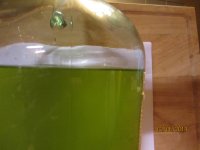
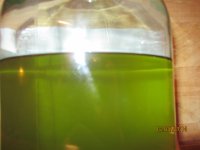
Do I need more acetone, or is this acetone most likely not saturated? (see pic below)

In other words, should I use fresh, new, unused, cold acetone for the other half of my leaves, or just put this green acetone back into the freezer, and keep using it until the evaporation step?

Update:​
I've gone ahead and re-cooled the used acetone; extracted from the second half of the leaves; let the acetone settle and discarded the sediment. Time to evaporate.
 

Attachments

  • IMG_2460.JPG
    IMG_2460.JPG
    2.4 MB · Views: 0
  • IMG_2465.JPG
    IMG_2465.JPG
    1.8 MB · Views: 0
Ive never extracted salvia, but if you would take a small portion of your leaves that you wish to know whether or not is tapped out, and soak them into IPA or some other alcohol for a period of time and see if it gets discolored then you might be able to get a ball bark for whether or not its completely drained without having to buy a whole new gallon of acetone. but my serious question is this... are you seriously going to sit and evaporate ALL of that acetone? Thats a serious waste, and unhealthy. I dont know how much that is, but it could probably be used ALOT more before its saturated.
 
Cosmic Spore said:
Hello, I'm attempting Salvinorin A Extraction and Purification for the first time.

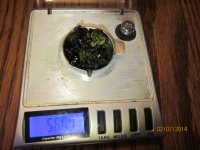
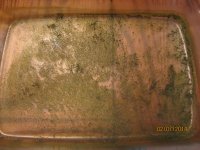
I've extracted 473g of leaves with cold acetone, allowed to settle, discarded sediment, and evaporated; I'm left (so far with a mixture between powder & goo; powder is grey/green; goo looks black).

I'll continue to let this gooey blob dry out; Is it normal to have some portion of goo at this point?

If this stuff all dries to a powder, I'll probably vaporize some of this green product, which is currently 2.889 grams (without the metal weighing dish)

Update:​

The green goo is not drying into a powder, but some was smoked, and produced a strong trip.
Happiness followed; mood uplifted.
 

Attachments

  • IMG_2470.JPG
    IMG_2470.JPG
    2.6 MB · Views: 0
  • IMG_2466.JPG
    IMG_2466.JPG
    2.9 MB · Views: 0
I was suspecting the goo was still just wet and would eventually either powder up as well, or harden some. Regardless, if its active it doesnt matter what state its in. :) Glad it turned out well.
 
Hello,

I have another question regarding lye+aluminum reaction + possible contamination + possible purification

So.. I did 5 extractions so far, applying Cyb's Hybrid Salt Tek. The first 4 times i used this bottle shown in the picture. Its shape makes pulls with pipette quite easy and i am able not to get any droplets of the basified soup come along with the solvent. The only problem for it is that its cap is aluminum. After having a hard experience with spice, and further extending my reading ( i really read quite much here , this is thesaurus of precious knowledge), i became aware that base + aluminum reaction needs to be avoided. I stumbled upon this thread.

bottle_zpsac89fe5c.jpg


So for my fifth extraction on i got a lab grade reaction bottle that is all glass including cap. But the problem with it is that its too wide and solvent layers spreads too thin on top. I tried to get as much as possible from the solvent, and then started pulling solvent + little of the basified soup, pour off from pipette in another small and really thin beaker. Despite i could see lye spots in the product in my precip dish..

So i have two questions now :

If i continue to extract in the glass bottle, and suppose lye reacts with the cap, thus hydrogen corroding the cap, and aluminum getting into the basified soup, what is the chance it gets into my final product ? Would the different purification methods allow me to get rid of this possible contamination? If so, which one of them or which combination. So far, i have done only naphtha re-x on my spice, but i am trying to be well informed on the sodium carbonate wash and acetone wash methods as well.. So , do you, fellow psychonauts know if the purification methods could help with that issue.

From now on i intend to do 3 re-x per yield and hope that would do the job?

Also, would triple re-x get out all traces of the lye i have in my last yield?
 
hello, psychonauts :)

if one were to only stir the mix, after adding the non-polar solvent [considering i'm in the pulling stage], without shaking and rolling the bottle, would that affect the pulls not collecting all the freebase spice? I am having Cyb's hybrid salt tek now for the 6th time, and i use the bottle shown in the picture one post above this one. This time i got myself a small glass beaker to use as a cap, but it doesn't fit quite well, so i roll with a towel when shaking & mixing during the previous stages. Got some minor spillage, but i prefer that to lye contacting aluminum.

Anyway, i have a glass stirring rod and was thinking if i could only roll gently and stir with the rod during the nps-stage. I.e. would not shaking (i usually shake quite vigorously) affect eminently the outcome?
 
it depends how well you can stir it, a magnetic stirrer seems to work very well but they create quite a considerable vortex in the based soup, there was a report not to long ago about only needing 2 pulls to deplete the bark of all the Magic but I cant remember who posted it. I guess a slow stir would just take a lot of pulls as the contact between the soup and the solvent would be quite low

cant you just get an extraction bottle with a decent lid? Maybe a wine bottle as cyb suggested as it has a cork stopper.
 
Yeah stirring is no problem, you can also use stainless steel, like a spoon or whatever. A glass rod might break or might be too thin to make a nice vortex? Try it out carefully.. But yeah chances are you have stainless steel spoons that you can use..

Just try to make sure as you stir, it`s creating a nice vortex in the middle and the layers are being mixed together well so that you dont even see the top layer anymore as you stir. Do a few cycles of stirring and letting stand before separating the non polar solvent.
 
3rdI said:
it depends how well you can stir it, a magnetic stirrer seems to work very well but they create quite a considerable vortex in the based soup, there was a report not to long ago about only needing 2 pulls to deplete the bark of all the Magic but I cant remember who posted it. I guess a slow stir would just take a lot of pulls as the contact between the soup and the solvent would be quite low

cant you just get an extraction bottle with a decent lid? Maybe a wine bottle as cyb suggested as it has a cork stopper.


i have a cork cap, from other bottle, but i can use it for this one..although I was under the impression that lye eats off cork? Am i mistaken?

endlessness said:
Yeah stirring is no problem, you can also use stainless steel, like a spoon or whatever. A glass rod might break or might be too thin to make a nice vortex? Try it out carefully.. But yeah chances are you have stainless steel spoons that you can use..

Just try to make sure as you stir, it`s creating a nice vortex in the middle and the layers are being mixed together well so that you dont even see the top layer anymore as you stir. Do a few cycles of stirring and letting stand before separating the non polar solvent.

yep, i had in mind it would have to be something like that - where the center of the vortex submerges at a lower surface level compared to the periphery of the mix - not very well explained, but you got the idea

Mimosa_Man said:
I have stirred several times instead of shaking or rolling with much success. My bark was depleted after 3 pulls instead of 5.

i'll try it myself this time :)
 
Hi guys ,, I'm having a few melting problems with my ACRB using both hybrid salt TEK and the max-ion TEK and was thinking maybe I'm having the naphtha ( shellitte ) to deep in the dish ( 10mm deep ) and maybe not freezing long enough approx 18-24hrs could I maybe let the naphtha pre evap to just enough naphtha to cover the bottom or it doesn't really matter how deep it is ?? And should I freeze precipe longer , as I'm sick to death if watching it just melt away ! 😞
 
Back
Top Bottom