
"The epimerization you are describing with ololiuqui (and others) is a highly specific chemical reaction that only affects a certain class of the plant's alkaloids. This basic environment triggers epimerization at the C-8 position of the ergoline ring, but it requires a specific structural vulnerability to work. This makes the C-8 proton relatively acidic. The alkaline water easily removes this proton, creating a resonance-stabilized enolate intermediate. When the molecule reprotonates, it can do so from either face, creating an equilibrium between the (8R)-epimer (e.g., ergine) and the (8S)-epimer (e.g., isoergine). Instead of a carboxamide group at C-8, lysergol has a hydroxymethyl group. It lacks the electron-withdrawing carbonyl group and cannot form an enolate intermediate. The C-8 proton in lysergol is simply not acidic enough to be stripped away by a mild base. Therefore, the traditional ash preparation is not harsh enough to force lysergol to epimerize into isolysergol; it remains entirely stable."

-
Members of the previous forum can retrieve their temporary password here, (login and check your PM).
You are using an out of date browser. It may not display this or other websites correctly.
You should upgrade or use an alternative browser.
You should upgrade or use an alternative browser.
Research ololuiqui entourage-effect under basic aqueous conditions
- Thread starter braindead
- Start date
Research done by (or for) the DMT-Nexus community




An attribution would be helpful here. What's the context of this quote? It's talking about structural correlates of susceptibility to epimerisation, not specifically directly about 'entourage effect', which is a downstream consequence of a given mixed alkaloidal profile."The epimerization you are describing with ololiuqui (and others) is a highly specific chemical reaction that only affects a certain class of the plant's alkaloids. This basic environment triggers epimerization at the C-8 position of the ergoline ring, but it requires a specific structural vulnerability to work. This makes the C-8 proton relatively acidic. The alkaline water easily removes this proton, creating a resonance-stabilized enolate intermediate. When the molecule reprotonates, it can do so from either face, creating an equilibrium between the (8R)-epimer (e.g., ergine) and the (8S)-epimer (e.g., isoergine). Instead of a carboxamide group at C-8, lysergol has a hydroxymethyl group. It lacks the electron-withdrawing carbonyl group and cannot form an enolate intermediate. The C-8 proton in lysergol is simply not acidic enough to be stripped away by a mild base. Therefore, the traditional ash preparation is not harsh enough to force lysergol to epimerize into isolysergol; it remains entirely stable."
It's specifically about the entourage effect of a 3:1 ILSA/LSA ratio.An attribution would be helpful here. What's the context of this quote? It's talking about structural correlates of susceptibility to epimerisation, not specifically directly about 'entourage effect', which is a downstream consequence of a given mixed alkaloidal profile.
I get that, the question is:It's specifically about the entourage effect of a 3:1 ILSA/LSA ratio.
Where is this quoted from?
Furthermore:
What is the ascribed entourage effect from this epimeric mixture? Is it an equilibrated mixture? How are the equilibrium conditions attained?
The epimerisation described by whom?"The epimerization you are describing […]"
Journal references for this interesting snippet would be most welcome.the traditional ash preparation
I totally get that high pH (such as would be found in wood ash preparations) favours epimerisation at tertiary carbon atoms adjacent to a carbonyl group. In this example the 9,10 double bond, conjugated to the indole moiety in lysergic acid derivatives, also serves to facilitate epimerisation by providing an extra vehicle for charge distribution.
The observation regarding the use of ash in at least one traditional ololiuqui preparation method is genuinely interested, so thanks for sharing!
"it immediately begins clogging BCRP efflux transporters. This concentrated local action makes the walls of the mouth significantly more porous, allowing other alkaloids to slip through unchallenged. Once in circulation, the lysergol reaches the blood-brain barrier ahead of the other compounds, where it continues to disable these cellular bouncers at the brain's gates. This ensures that the primary active ingredients have an unobstructed path to their target receptors, effectively using the cheek as a direct highway that bypasses typical cellular resistance."
Breast cancer resistance protein? Again, it would be very helpful if you could provide a source for these quotes.clogging BCRP efflux transporters
Taking these quotes in combination, put in your own words, how does this impact the central activity of convolvulaceous lysergamides when compared to a 'non-entourage' situation?
Interesting claim that lysergol acts as a cellular efflux inhibitor - citation still required, however.
Hm, OK: https://pdf.benchchem.com/1675/The_...hnical_Guide_to_its_Therapeutic_Potential.pdf
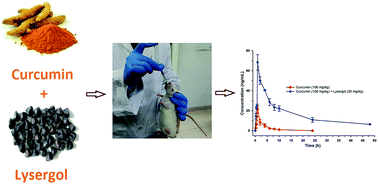
M. Shukla, M. Y. Malik, S. Jaiswal, A. Sharma, D. K. Tanpula, R. Goyanid and J. Lal: A mechanistic investigation of the bioavailability enhancing potential of lysergol, a novel bioenhancer, using curcumin. RSC Adv., 2016,6, 58933-58942
 doi.org
Thanks for the tips; any (list of) further references will be most gratefully received.
Lysergol has demonstrated significant potential as an antimicrobial agent, particularly in
overcoming antibiotic resistance. While it may not possess potent direct bactericidal activity, it
acts as a powerful efflux pump inhibitor (EPI).
Mechanism of Action: Lysergol has been shown to inhibit ATP-dependent efflux pumps in
bacteria.[1] These pumps are a major mechanism of antibiotic resistance, actively expelling
drugs from the bacterial cell. By inhibiting these pumps, lysergol can restore the efficacy of
conventional antibiotics.
Example efflux inhibition article:Research has indicated that lysergol can act as a bioenhancer, increasing the bioavailability of
other drugs.[12] One study demonstrated that co-administration of lysergol with curcumin
significantly increased the plasma concentration and half-life of curcumin in rats.[12] This effect
is attributed to the inhibition of metabolic enzymes and efflux transporters like the Breast
Cancer Resistance Protein (BCRP).[12]
M. Shukla, M. Y. Malik, S. Jaiswal, A. Sharma, D. K. Tanpula, R. Goyanid and J. Lal: A mechanistic investigation of the bioavailability enhancing potential of lysergol, a novel bioenhancer, using curcumin. RSC Adv., 2016,6, 58933-58942
A mechanistic investigation of the bioavailability enhancing potential of lysergol, a novel bioenhancer, using curcumin
Lysergol (LYZ), a novel bioenhancer, has shown potential to enhance the bioavailability of some antibiotics. In the present investigation, the bioavailability enhancing potential of LYZ on curcumin (CUR) has been explored. We initially carried out in vivo pharmacokinetic and in situ permeation...
doi.org
Thanks for the tips; any (list of) further references will be most gratefully received.
Similar threads


- Replies
- 5
- Views
- 886
- Replies
- 8
- Views
- 949


- Replies
- 0
- Views
- 389