• Members of the previous forum can retrieve their temporary password here, (login and check your PM).

Peyote ID

Migrated topic.
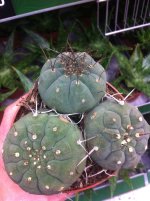
No.
Matucana madisoniorum is what you have there.

Rumored to be active but there zero confirmation of this by people who have ingested it so far as I know.
 
AlbertKLloyd said:
No.
Matucana madisoniorum is what you have there.

Rumored to be active but there zero confirmation of this by people who have ingested it so far as I know.

Ok cool, should I try it maybe and report? It is not dangerous? :want:
 
Might be a waste of a beautiful plant, but you are certainly free to do as you will.

Only LKophophora jordaniana has spines, but they are small.

All other Lophophora lack visible spines when mature.
 
It is in an entirely different tribe than Peyote is.

Peyote is in the tribe Cacteae while Matucana is in tribe Trichocereeae.

While they are both cacti they are not very closely related.
Matucana is a South American cactus, while Lophophora is North American.

While I don't regard this text as useful it has some entries about both...
 
AskErowid said:
From guest answerer, Kakster from Kak-tall-a-tree.


Paul Hutchinson of the University of California Botanical Gardens discovered Borzicactus madisoniorum about 1963 or so in an valley in Peru. It is now alternately called Submatucana madisoniorum or Matucana madisoniorum, named after the town of Matucana. Being a small globular plant with ribs resembling Lophophora, the ones that lack spines look so much like peyote that the uninformed may think they actually are.


I had a large old specimen outside that disappeared while some Mexican workers were working in the yard - I suspect they stole it for ingestion. In natural habitats they grow slowly and are very hard like jade, but in greenhouses or grafted they grow quickly with tissue that is less firm. I had a sample analyzed by GCMS once and it was completely negative for alkaloids....
...Narcotic and Hallucinogenic Cacti of the New World (pp.47-48 ) cites several cactologists as believing that this species is psychoactive.


Sadly it sounds confirmed to be inactive, though you never know.
 
Back
Top Bottom