• Members of the previous forum can retrieve their temporary password here, (login and check your PM).

Phalaris farmin'

Want to learn how to cultivate phalaris so I'm looking for firsthand tips, advice, etc.

Use search. There are quite a few threads about it. You can start here, I guess:
 
AQ1 is an old strain of aquatica selected for its DMT content. Tanit is an aquatica strain selected for its 5-MeO-DMT content.
Also AQ1 afaik does not produce offspring with the same genetics, but Tanit does. Tanit is also proving ime to be very slow to germinate unlike some other common aquatica strains I have. I assume those seedlings you have going germinated pretty quick? Unnamed strain of aquatica? I have some aquatica plants like that and they could be potent you just never know.

I would keep these plants you have and continue to collect more genetics as they are available.

One strain of aquatica you can find commercially and is worth growing is Phalaris aquatica cv. Australia.
 
If grown outdoors, as with other grasses and cereal crops cross pollination is a thing so the resultant seed / strain starts to drift. Might be something to bear in mind if you plan of harvesting seed to plant more etc.
For instance if specifically Gluten Free Oats (technically not GF but that's another story) are grown in a field the grower needs to have them tested and periodically go back to the original source seed so the genetics don't change too much and the Gluten content becomes too high to pass the test.
 
AQ1 is an old strain of aquatica selected for its DMT content.
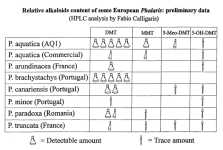
Yeah. Note that AQ1 also contains 5-MeO-DMT, in smaller quantity but potentially with big effect given the lower active dose. The chemist working with Festi and Samorini chose not to quantify in the usual way (perhaps lacking reference standards), but reports per the figure below.

fs-hplc.png

The 5-MeO-DMT may account for their overdose, which was potentially within a factor of ~3 of fatal. This is the usual problem with Phalaris ayahuasca, and the reason why for now its extracts are generally smoked or taken sublingually.

Any test result applies only to the exact variety tested, and possibly to its descendants. It does not apply to the entire species, which generally contains big variation. That's the reason why the un-named samples above are at least identified by the country where they were collected. Environmental factors also affect alkaloid content.
 
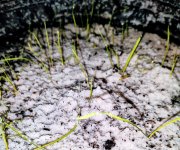
Does spacing matter with these or can I leave them like they are in one pot?

They seems to be doing ok now but once they get bigger I mean.

Can't find much solid cultivating info except on here...
 
i had profound difficulty trying to cultivate them in pots. without a certain degree of support, they do this thing where when a plants roots reach the bottom it causes all growth to stall, either because its missing something and its expanding the roots to find more nutrients, or its expending resources forcing roots into open air where they wither, but why its doing that rather than looping around is beyond me, i think its more likely phalaris likes a fixed size/proportion root system, look at some diagrams, they go quite deep.
As for germination, apparently some if not all (the popular active) phalaris grasses require a degree of light to germinate, seeds are ideally sewn on the surface not buried. my experience corroborated this, fortunately i know how to grow seeds like that but it not perfectly simple, my recommendation is use once-boiled water (no chlorine and less reactive dissolved salt profile), or natural rain water, and not tap water for keeping the seeds moist during germination, for best results, especially if you live somewhere very dry, and dont have a greenhouse.
 
I haven’t had any issues with aquatica in pots. Could be strain related.
natural p.aquatica will want to send a tap root down almost a meter to locate ground water, which near rivers and streams and such is quite high/easily reached. its not because it needs the water, this is simply the default mode for aquatica. I dont know the method but theres also a way to acclimate a seedling to life in a pot, and i dont know how to do that well, beyond avoiding damaging roots early on during transfer, i think phalaris also grows differently if it begins in a low nutrient soil like a coir mix than pure potting mix right away. Im not a horteculturalist :p
 
i think phalaris also grows differently if it begins in a low nutrient soil like a coir mix than pure potting mix right away.
I've had bad results growing Phalaris aquatica, P. brachystachys, and P. canariensis in 50/50 coir/perlite hand-watered with typical hydroponic solution. The plants grow vigorously for the first few weeks, but then they shrivel up and die. I tried various watering intervals with no visible change. I tried up to 8" pots, no change. The same seed in natural soil outdoors does fine.

Interestingly I had great results with 3" pots of P. brachystachys in coir/perlite in a tray flooded once per day with the same hydroponic solution. Growth was less vigorous than outdoors, but alkaloid content by HPLC was ~5x outdoors, around 1% 5-MeO-DMT dry weight. The pots were full of circling roots, but the plants looked healthy and set lots of seed. I think sugar content was also low, since the water extract didn't get so syrupy and was thus easier to manage. I guess this is the usual story that stress increases alkaloids, but I don't know exactly what kind of stress.

I think @Grasshoppers also got bad results in hand-watered coir. They also discovered that at least some of their P. aquatica eventually dies without seasonal cues (temperature and/or day length). My P. brachystachys completed its life cycle without seasonal cues.
 
Different strain of aquatica all proved different to grow so far ime. At the moment I have seed grown plants that are nearly a year old doing fine outside in a greenhouse in pots. They flowered over summer and still look green and healthy. Seeds from a vendor in my bio region so maybe that helps.

Others in the past died in winter, or grew very slow…never flowered. I had really bad results with brachystachys.

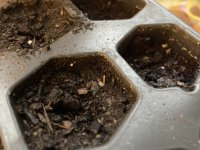
I planted 36 tanit seeds 3 weeks ago and none have germinated yet…while the plants I have atm germinated right away. I have had the Australian cultivar germinate super fast.. other batch very slow and/or not at all.
 
AQ1 is an old strain of aquatica selected for its DMT content. Tanit is an aquatica strain selected for its 5-MeO-DMT content.

Also AQ1 afaik does not produce offspring with the same genetics, but Tanit does. Tanit is also proving ime to be very slow to germinate unlike some other common aquatica strains I have. I assume those seedlings you have going germinated pretty quick? Unnamed strain of aquatica? I have some aquatica plants like that and they could be potent you just never know.

I would keep these plants you have and continue to collect more genetics as they are available.

One strain of aquatica you can find commercially and is worth growing is Phalaris aquatica cv. Australia.

jamie01 those are the very same Tanit seeds i sent you that he is growing. We noticed they have very different germination timeline in different regions and climates. Like Right now in mid winter in North Africa they suddenly started germinating in mass spontaneously in soil. They're not suffering from low viability apparently just strong dormancy.
 
@JungleGhost Glad to see you growing P. aquatica cv. Tanit.

They seems to be doing ok now but once they get bigger I mean.
Separate them. They become huge. Every single one can easily fill a 20l pot.

fs-hplc.png
An interesting list. A bit unfortunate that 5-MeO-NMT is missing, especially given its relevance in P. arundinacea. Additionally, there is no information on variability. In wild accessions of P. arundinacea and P. aquatica, inter-plant variation can be substantial, with alkaloid profiles differing dramatically even among plants growing in close proximity.
Another important point is that commercial P. aquatica has been selectively bred for low alkaloid content due to its use as animal forage. This contrasts sharply with wild strains, which can contain significant levels of DMT and 5-MeO-DMT. Notably, these two compounds tend to be mutually exclusive within individual plants, with 5-MeO-DMT occurring more frequent.

I planted 36 tanit seeds 3 weeks ago and none have germinated yet…while the plants I have atm germinated right away. I have had the Australian cultivar germinate super fast.. other batch very slow and/or not at all.
Because it originates from a very dry climate, Tanit often shows pronounced dormancy. Check this out:
How to Germinate Phalaris aquatica Seeds (Especially Dormant or “Non-Viable” Strains)
 
Last edited:
Back
Top Bottom