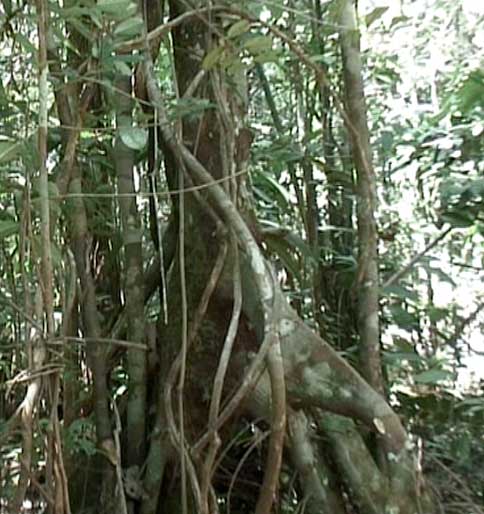
A follow-up on Callaeum antifebrile
Apparently my summary above wasn’t just "scratching the surface"; I have found little additional information in the literature beyond what was presented in that post.
As mentioned above,
Callaeum antifebrile is used in folk medicine as a febrifuge and seems to be associated with
B. caapi. I've seen several claims that it is used as a hallucinogen (e.g. Johnson 1986), but these claims all seem to refer to a 1943 report which says no such thing ("Both plants [
B. caapi and
C. antifebrile] are used in popular medicine and sorcery, but
I do not know if the species I am now describing has any narcotic propriety" [emphasis added]; Ducke 1943). It is known by common names including
bejuco de las calenturas (fever vine),
agahuasca,
ayahuasca negro,
shillinto (a Peruvian term for
ayahuasca),
shillinto blanco,
shillinto negro,
caabi, and
pajezinho (Johnson 1986; Coelho-Ferriera 2009).
Ducke wrote an additional paper (Ducke 1946) beyond the one I cited above, but Schultes (1982) references it only to mention that
C. antifebrile was reported to be used as a folk medicine, but was not known to be used as a hallucinogen -- information that was already related in Ducke 1943. A more recent report surveying ethnomedicinal plants in Pará, Brazil (the same area studied by Ducke) supports the notion that it is not used for
ayahuasca-like brews in that region, though a variety of other uses are specified. Bathing in an infusion of the plant is said to combat the evil eye,
panemice (a curse or disease where the victim is afflicted by bad luck), headaches, or “thick blood.” The juice of the plant is used to treat gastritis, stomach ulcer, and skin eruptions. It may also be used to treat rheumatism, erysipelas (a skin infection), and stroke, and it may be employed when giving massages to pregnant women. (Coelho-Ferreira 2009)
In 1928, Niedenzu, a German expert on the Malpighiaceae, published some comments on herbarium specimens housed at the Berlin Herbarium. One collection from the Yarina Cocha in eastern Peru labeled “ayawasca” contained the leaves of
C. antifebrile and the samaras of
Banisteriopsis quitensis (
B. quitensis is usually regarded as synonymous with
B. caapi these days, although Niedenzu distinguished between the two). I have not acquired a copy of Niedenzu’s original paper (Niedenzu 1928A), but Schultes has commented on it in some detail (Schultes 1957; this paper gives a very valuable look at the early ethnobotanical research into the
ayahuasca complex).
I have not yet acquired a copy of the paper that reported finding harmine in the plant (Mors & Zaltzman 1954), but references to it (Schultes 1982; Ott 1994) indicate that no other alkaloids were reported from the plant. There is another paper that I have not yet acquired relating to the pharmacology of the plant (Siqueira-Jaccoud 1959), but from the reference I found to it (Bristol 1966), it appears to report the presence of harmine, but no other alkaloids.
For the sake of completeness: Botanical descriptions can be found in Grisebach 1849, Niedenzu 1908, Niedenzu 1928B, Ducke 1943, Macbride 1950, Johnson 1986, Brako & Zarucchi 1993, Jørgensen & León-Yánez 1999, Jørgensen
et al. 2012. Phylogenetic analysis can be found in Davis
et al 2002.
Synonyms
Callaeum antifebrile (Ruiz ex Grisebach) D.M. Johnson
- =Banisteria antifebrilis Ruiz ex Griseb.
- =Cabi paraensis Ducke
- =Mascagnia psilophylla var. antifebrilis (Griseb.) Nied.
- =Mascagnia psilophylla f. peruviana Nied.
Bibliography
- Brako, L. and J.L. Zarucchi. (eds.) 1993. Catalogue of the Flowering Plants and Gymnosperms of Peru. Monographs in Systematic Botany from the Missouri Botanical Garden 45: i–xl, 1–1286.
- Bristol, M.L. 1966. The psychotropic Banisteriopsis among the Sibundoy of Colombia. Botanical Museum Leaflets Harvard University 21(5): 113-140.
- Coelho-Ferreira, M. 2009. Medicinal knowledge and plant utilization in an Amazonian coastal community of Marudá, Pará State (Brazil). Journal of Ethnopharmacology 126(1): 159–175.
- Davis, C.C., C.D. Bell, S. Mathews, and M.J. Donoghue. 2002. Laurasian migration explains Gondwanan disjunctions: Evidence from Malpighiaceae. PNAS 99(10): 6833–6837.
- Ducke, A. 1943. O cabí do Pará. Arquivos do Servicio Forestal 2(1): 13-17.
- Ducke, A. 1946. Plantas da cultura pre-Colombiana na Amazônia Brasileira. Boletin Técnico Instituto Agronomico do Norte 8: 5.
- Grisebach, A.H.R. 1849. Beiträge zu einer Flora der Aequinoctial-Gegenden der neuen Welt. Linnaea 22: 15.
- Jørgensen, P.M. and S. León-Yánez. (eds.) 1999. Catalogue of the vascular plants of Ecuador. Monographs in Systematic Botany from the Missouri Botanical Garden 75: i–viii, 1–1181
- Jørgensen, P.M., M. Nee, and S.G. Beck. (eds.) 2012. Catálogo de las plantas vasculares de Bolivia. Monographs in Systematic Botany from the Missouri Botanical Garden
- Macbride, J.F. 1950. Malpighiaceae, Flora of Peru. Publications of the Field Museum of Natural History, Botanical Series 13, Vol. 3(3): 781–871.
- Mors, W.B. and Zaltzman, P. 1954. Sôbre o alkalóide de Banisteria caapi Spruce e do Cabi paraensis Ducke. Boletin de la Instituto Agronômico do Norte, Belém 34: 17.
- Niedenzu, F.J. 1908. Arbeiten aus dem Botanischen Institut des Königl. Lyceums Hosianum in Braunsberg 3: 28.
- Niedenzu, F.J. 1928A. Über die Stammpflanzen des Yageins. Pharmazeutische Zeitung 73: 141.
- Niedenzu, F.J. 1928B. In Engler, H.G.A., Das Pflanzenreich 141(Heft 93): 121.
- Ott, J. 1994. Ayahuasca Analogues: Pangæan Entheogens. Natural Products Co.: Kennewick, WA.
- Schultes, R.E. 1957. The identity of the Malpighiaceous narcotics of South America. Botanical Museum Leaflets Harvard University 18(1): 1-56.
- Schultes, R.E. 1982. The beta-carboline hallucinogens of South America. Journal of Psychoactive Drugs 14(3): 205-220.
- Siqueira-Jaccoud, R.J. 1959. Contribucão para o estudo farmacognóstico do Cabi paraensis Ducke, I. Revista Brasileira da Farmacia 40: 75.



 ...I think I can start to look into some of those names this evening when I get home. My only critique of your post (if you could call it that) would be the use of the plant list for nomenclature. It's not necessarily a bad resource to check for the existence of a name and associated authors...but its synonymy is in error in a lot of places and I’m not 100% sure of how up to date or “correct” (to whatever degree any endeavor to map nature can be) the overall database is.