• Members of the previous forum can retrieve their temporary password here, (login and check your PM).

Purest spice yet

Migrated topic.
Loveall said:
I mostly agree, but in my personal experience it is usually DMT aggregation causing the off white color. I don't think N-oxide has been detected in a normal extraction.
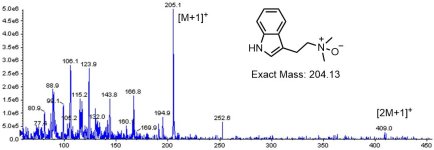
The image below is from another forum where a user (not me) did MS/MS on DMT that had yellowed in air. He found it to contain DMT N-oxide. It is safe to assume he had not intentionally treated it with hydrogen peroxide or another oxidizer. I do not know how conclusive that is.

There was also a paper on tryptophan degradation. It reported a number of oxygen-containing decomposition products formed in reactions of tryptophan with oxygen radicals in air. I do not think they reported N-oxide specifically, but tryptophan is -NH2 so the DMT decomposition may be different.

One way to confirm (or rule out) oxygen could be to add some sodium dithionite after basification. It could scavenge oxygen dissolved in the water and reduce N-oxide if it indeed forms.
 

Attachments

  • yellow+DMT.jpg
    yellow+DMT.jpg
    57.5 KB · Views: 1
Hailstorm said:
Loveall said:
I mostly agree, but in my personal experience it is usually DMT aggregation causing the off white color. I don't think N-oxide has been detected in a normal extraction.
The image below is from another forum where a user (not me) did MS/MS on DMT that had yellowed in air. He found it to contain DMT N-oxide. It is safe to assume he had not intentionally treated it with hydrogen peroxide or another oxidizer. I do not know how conclusive that is.

There was also a paper on tryptophan degradation. It reported a number of oxygen-containing decomposition products formed in reactions of tryptophan with oxygen radicals in air. I do not think they reported N-oxide specifically, but tryptophan is -NH2 so the DMT decomposition may be different.

One way to confirm (or rule out) oxygen could be to add some sodium dithionite after basification. It could scavenge oxygen dissolved in the water and reduce N-oxide if it indeed forms.

Is there more info on this analysis? What was the ratio of the n-oxide to DMT in the sample?
 
Hailstorm said:
In your case widderic, the initial extract seems already quite yellow. It is hard to say why. Perhaps you should try a defatting step – just "extract" your acidified mixture using the same technique but before basifying it, to see if that "extract" (which should be free of DMT) is yellow or not. If it is yellow – congratulations, you have removed an impurity, or perhaps your NPS is dirty. If it is colorless and the yellow color only appears after basification – I'd make sure your NaOH is reagent-grade, and try lowering the extraction temperature to see if the root cause was (oxidative) thermal degradation.

You never fail me, Hailstorm. Thanks for taking the time to lay that out for me. Saving for my notes and will experiment during my next few extractions. I haven't dabbled in defatting yet but am eager to learn.

My extractions are becoming more successful in terms of yield with every run, but eventually I'll be focusing on purity, regardless of yield, or at least try to find a fine line between the two.

I do remember you saying that 70C was fine, and in terms of yield my results seem to like that temperature, but I get what you're saying. You da best.
 
endlessness said:
Is there more info on this analysis? What was the ratio of the n-oxide to DMT in the sample?
Here is the full message, all I have:

"It looks like the primary impurity in "expired" DMT is N-oxide. MS\MS matches as well. If I get some time I will try to isolate the fraction on a semi-preparative HPLC to make sure the yellow color is N-oxide and not some other micro-impurity"

I'll send the user a PM and reply to this thread if he responds. He has not been posting since March 5, 2022 after inquiring about the war.
 
Hailstorm said:
Loveall said:
I mostly agree, but in my personal experience it is usually DMT aggregation causing the off white color. I don't think N-oxide has been detected in a normal extraction.
The image below is from another forum where a user (not me) did MS/MS on DMT that had yellowed in air. He found it to contain DMT N-oxide. It is safe to assume he had not intentionally treated it with hydrogen peroxide or another oxidizer. I do not know how conclusive that is.

No doubt once freebase has had enough exposure to air it does change. White can become yellow, yellow can become orange after years sat in a jar. I tried some aged orange spice last night and it was at least as potent as I remember. Shulgin thought N-oxides could be psychoactive.

I don't think naphtha actually pulls n-oxide though. Last I checked it was insoluble.

EDIT: The wiki does mention this though:

Insoluble in petroleum (naphtha) but appreciably soluble in petroleum which contains fats.

Hmmm... do we have concrete info on how much plant oils/fats are found in typical MHRB pulls ? Do we have data ? I recall the amount is very low. I'm wondering if oxides can form in naphtha even if they were not present in MHRB initially. Then any fats present could keep them in solution in naphtha, perhaps.
 
Orion said:
Hailstorm said:
Loveall said:
I mostly agree, but in my personal experience it is usually DMT aggregation causing the off white color. I don't think N-oxide has been detected in a normal extraction.
The image below is from another forum where a user (not me) did MS/MS on DMT that had yellowed in air. He found it to contain DMT N-oxide. It is safe to assume he had not intentionally treated it with hydrogen peroxide or another oxidizer. I do not know how conclusive that is.

No doubt once freebase has had enough exposure to air it does change. White can become yellow, yellow can become orange after years sat in a jar. I tried some aged orange spice last night and it was at least as potent as I remember. Shulgin thought N-oxides could be psychoactive.

I don't think naphtha actually pulls n-oxide though. Last I checked it was insoluble.

EDIT: The wiki does mention this though:

Insoluble in petroleum (naphtha) but appreciably soluble in petroleum which contains fats.

Hmmm... do we have concrete info on how much plant oils/fats are found in typical MHRB pulls ? Do we have data ? I recall the amount is very low. I'm wondering if oxides can form in naphtha even if they were not present in MHRB initially. Then any fats present could keep them in solution in naphtha, perhaps.

I will be forever suspended on what to think about all of this :lol: I do feel I've had some yellow DMT that is indistinguishable from white by experience.

One love
 
Voidmatrix said:

I think that's about right as far as I can tell.

This is the thread with the analysis I forgot about:


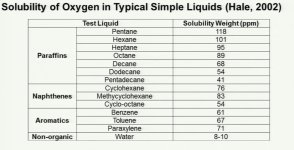
Seems fair to say MHRB has almost no N-oxide before base is added. N-oxide is something that mostly forms after adding base because you now have freebase exposed to oxygen. If the quote from the wiki in my previous post is true then N-oxide can only be carried into naphtha through plant fats which vary in quantity.

Thing is, naphtha can contain oxygen, so they could probably form there too.
 

Attachments

  • oxygen+solubility+in+liquids.jpg
    oxygen+solubility+in+liquids.jpg
    146.4 KB · Views: 0
Back
Top Bottom