
-
Members of the previous forum can retrieve their temporary password here, (login and check your PM).
You are using an out of date browser. It may not display this or other websites correctly.
You should upgrade or use an alternative browser.
You should upgrade or use an alternative browser.
question about my acacia spice
- Thread starter yatiqiri
- Start date
Migrated topic.

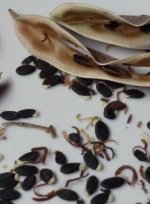


..that's really good, thanks, yatiqiri , between the acacia-heads in here should have your tree pinned down soon,
just takes time to go through details...
, between the acacia-heads in here should have your tree pinned down soon,just takes time to go through details...
..here's (as far as i can make out) the 3 top contenders..
A. obliquinervia, A. saligna & A. pycnantha (i think the flowers of A. macradenia are too numerous to be the tree in question)...
A. obliquinervia, A. saligna & A. pycnantha (i think the flowers of A. macradenia are too numerous to be the tree in question)...
Attachments
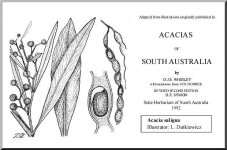
Hey, i think (after finer examination of details) that hebrew was right, and your tree yatiqiri , is..
[EDIT: this was later revised in ID, see a few posts on]
Acacia saligna (Labill.) H.L.Wendl.,
(Golden Wreath Wattle , Orange Wattle , Blue-leafed Wattle , Western Australian Golden Wattle)
Widely cultivated worldwide. A fast growing, drought tolerant species that is easy to coppice and which spreads both by root suckers and seed.
..thanks hebrew for being onto it,
what do komet, wira & others think?
..the question is now, what exactly are those beautiful looking alkaloids in there..?
[EDIT: this was later revised in ID, see a few posts on]
Acacia saligna (Labill.) H.L.Wendl.,
(Golden Wreath Wattle , Orange Wattle , Blue-leafed Wattle , Western Australian Golden Wattle)
[clavate = thicker at the apex than the base]Phyllodes often pendulous, variable in shape and size, linear to lanceolate, straight to falcate, 7–25 cm long, (2–) 4–20 mm wide, often larger towards base of plant, green to glaucous, glabrous, with prominent midrib, finely penninerved (absent on very narrow phyllodes); gland disciform, 1–2 mm wide, 0–3 mm above pulvinus;
Flowers 5-merous; sepals c. 4/5-united. Pods linear, flat, shallowly constricted between seeds, 8–12 cm long, 4–6 mm wide, thinly coriaceous, glabrous. Seeds longitudinal, oblong to slightly elliptic, 5–6 mm long, shiny, dark brown to black; aril clavate.
Widely cultivated worldwide. A fast growing, drought tolerant species that is easy to coppice and which spreads both by root suckers and seed.
..thanks hebrew for being onto it,
what do komet, wira & others think?
..the question is now, what exactly are those beautiful looking alkaloids in there..?
Attachments
Unfortunately I beg to differ with you, nen 
Acacia saligna is ruled out primarily due to the position of the gland (now that we have measurements), an important diagnostic characteristic.
A couple of days ago I sent the pictures to a very knowledgeable Australian senior botanist, who also forwarded it on to a similarly knowledgeable colleague of his. They both agreed that we're looking at a plant from the retinodes complex, probably retinodes var. retinodes or provincialis, which was once thought to be a garden hybrid between retinodes and saligna (as cyanophylla), then thought to be a form of var. retinodes, and now thought of as a separate species.
Here's what one of them said -
"Doesn't have the critical characters of A. saligna which has basal glands, more conspicuous parallel venation, more obviously glaucous and typically rather shiny and leathery textured phyllodes than those in these images seem to be and legumes typically more constricted than the ones in these images which are almost completely unconstricted between each seed.
Also doesn't match A. pycnantha although that species has quite distinct local forms - lacks the distinctly oblanceolate and typically somewhat falcate phyllode shape of most provenances, phyllode colour and texture seem too bluish and soft, flower heads too pale and not quite as large and dense as typical of most forms (although this is highly variable across the range of the species), branchlets too flattened (like in A. saligna compared with A. pycnantha which is terete or nearly so) and legumes hardly or not at all constricted.
Another possibility is A. leiophylla (endemic to South Australia and possibly extending into far SW Victoria) but not a perfect match for similar reasons to above.
In all regards a much closer match to what was well known till recently as Acacia retinodes var. retinodes and now either A. retinodes (s.s.) or A. provincialis - these two recently segregated species are well known as either Swamp Wattle or Silver Wattle in SA or else as Wirilda in Victoria.
A. provincialis is indigenous to western Victoria, widely planted and naturalising around Melbourne and other settled areas and may well be planted overseas."
Acacia saligna is ruled out primarily due to the position of the gland (now that we have measurements), an important diagnostic characteristic.
A couple of days ago I sent the pictures to a very knowledgeable Australian senior botanist, who also forwarded it on to a similarly knowledgeable colleague of his. They both agreed that we're looking at a plant from the retinodes complex, probably retinodes var. retinodes or provincialis, which was once thought to be a garden hybrid between retinodes and saligna (as cyanophylla), then thought to be a form of var. retinodes, and now thought of as a separate species.
Here's what one of them said -
"Doesn't have the critical characters of A. saligna which has basal glands, more conspicuous parallel venation, more obviously glaucous and typically rather shiny and leathery textured phyllodes than those in these images seem to be and legumes typically more constricted than the ones in these images which are almost completely unconstricted between each seed.
Also doesn't match A. pycnantha although that species has quite distinct local forms - lacks the distinctly oblanceolate and typically somewhat falcate phyllode shape of most provenances, phyllode colour and texture seem too bluish and soft, flower heads too pale and not quite as large and dense as typical of most forms (although this is highly variable across the range of the species), branchlets too flattened (like in A. saligna compared with A. pycnantha which is terete or nearly so) and legumes hardly or not at all constricted.
Another possibility is A. leiophylla (endemic to South Australia and possibly extending into far SW Victoria) but not a perfect match for similar reasons to above.
In all regards a much closer match to what was well known till recently as Acacia retinodes var. retinodes and now either A. retinodes (s.s.) or A. provincialis - these two recently segregated species are well known as either Swamp Wattle or Silver Wattle in SA or else as Wirilda in Victoria.
A. provincialis is indigenous to western Victoria, widely planted and naturalising around Melbourne and other settled areas and may well be planted overseas."
Wow! Such luck to have you guys working together on this, thank you!
last year I thought it could be acacia retinodes. If it were not for it being incorrectly labeled in the botanical garden as floribundo, I would not have tested it for alkaloids since retinodes is an acacia listed as having .02% or less total alkaloids, a very minimal amount.
Here in La Paz however, I extracted significant quantities of alkaloids from two trees from different areas.
so if this is indeed a retinodes variety, and then potency does vary within the same species complex, an acacia reported to contain very little alkaloids does not necessarily mean all varieties of that species will not be potent?
last year I thought it could be acacia retinodes. If it were not for it being incorrectly labeled in the botanical garden as floribundo, I would not have tested it for alkaloids since retinodes is an acacia listed as having .02% or less total alkaloids, a very minimal amount.
Here in La Paz however, I extracted significant quantities of alkaloids from two trees from different areas.
so if this is indeed a retinodes variety, and then potency does vary within the same species complex, an acacia reported to contain very little alkaloids does not necessarily mean all varieties of that species will not be potent?
..good to get another view wira..i will investigate retinoides more, though it should be noted that there is considerable variation of the phyllodes in saligna, and between the type collections..
..as for the 0.02% alkaloid in retinodes, i have seen another test which found much higher levels, so a single test should never be seen as the final word..
many forms of retinodes differ widely from this photo, the flowers usually larger..
..as for the 0.02% alkaloid in retinodes, i have seen another test which found much higher levels, so a single test should never be seen as the final word..
many forms of retinodes differ widely from this photo, the flowers usually larger..
Attachments
ps. see 2nd pic of A. saligna in Trying to improve acacia info. p.6 for differing form..
the reported alkaloids in A. retinodes were DMT,NMT,Nicotine
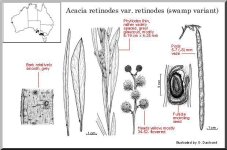
Flora Austr. says for A. retinodes
what are it's international records, though..?
the reported alkaloids in A. retinodes were DMT,NMT,Nicotine
Flora Austr. says for A. retinodes
gland not prominent, 1–16 mm above pulvinus..Flowers 5-merous; sepals united to near apex. Pods linear, to 16 cm long, 5–11 mm wide, firmly chartaceous to thinly crustaceous, glabrous. Seeds longitudinal, oblong to oblong-elliptic, 4–6 mm long, dull to slightly shiny, dark brown to black; funicle 3/4 or more encircling seed, red-brown to blackish; aril clavate.
what are it's international records, though..?
..botanical details (without the actual specimen) can be time consuming, and i don't care if i'm right or wrong, i just want to know what the plant is as well..
..but i'm not convinced (yet anyway) that the plant is A. retinodes..
A. saligna typically has glaucous (not shiny phyllodes), and has 4 varieties/subspecies..the pod is often just 'slightly' constricted, though i agree the pod photo is not typical of the type..
..but, A. retinodes is defined as having the funicle encircling the seed 3/4, which doesn't seem to be happening in yatiqiri's photos..it also typically has very rough, fissured bark..
..without the actual flowers and a magnifying glass, it is difficult to judge, but the typical flowers of retinodes seem denser to me than the yatiqiri photos..
interestingly, A. retinodes is currently under taxonomic review to work out it's own variants..
..not much time right now, so i leave acacia-heads to judge themselves (while i contemplate it all) and provide a few more images..
could be A. saligna X A. retinodes
...
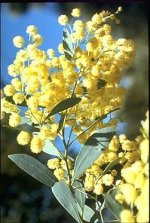
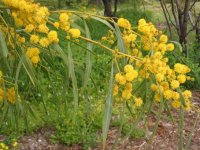
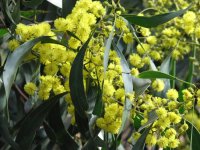
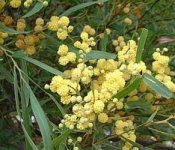
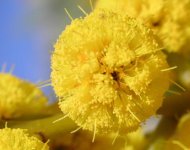
pics are 1.retinodes type 2.retinodes flower 3.saligna type 4.saligna flowers
..but i'm not convinced (yet anyway) that the plant is A. retinodes..
A. saligna typically has glaucous (not shiny phyllodes), and has 4 varieties/subspecies..the pod is often just 'slightly' constricted, though i agree the pod photo is not typical of the type..
..but, A. retinodes is defined as having the funicle encircling the seed 3/4, which doesn't seem to be happening in yatiqiri's photos..it also typically has very rough, fissured bark..
..without the actual flowers and a magnifying glass, it is difficult to judge, but the typical flowers of retinodes seem denser to me than the yatiqiri photos..
interestingly, A. retinodes is currently under taxonomic review to work out it's own variants..
..not much time right now, so i leave acacia-heads to judge themselves (while i contemplate it all) and provide a few more images..
could be A. saligna X A. retinodes
...
pics are 1.retinodes type 2.retinodes flower 3.saligna type 4.saligna flowers
Attachments
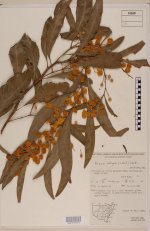
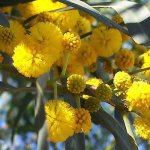
Well, that's the thing nen, A. provincialis (the probable identity) was once thought to be a hybrid between saligna and retinodes, which is what you just suggested in your last post. A retinodes sensu lato (retinodes in the broad sense) is very variable, and has indeed been circulated around the world, the provincialis form in particular, I believe. I see that I may have confused things with the mention of retinodes var. retinodes as a possibility - and the splitting that's taking place makes it more confusing. As I understand it (and admittedly I'm not fully up to date myself on the nitty-gritty details of the taxonomic changes that have happened recently or are happening now), although provincialis was at one time (as recent as the Acacia volumes of Flora of Australis [2001]) merged in with retinodes var. retinodes it is now separate, and var. retinodes as defined by Flora of Australia is being redefined. I believe that the var. retinodes suggested by my botanist friend was meant in the broader sense encompassing provincialis, and not to mean the typical form of retinodes. And, we haven't even mentioned var. uncifolia, which is rather different again. I'm getting pretty confused myself... taxonomy, what a pain :roll:
Bear in mind that the botanist I consulted is mindblowingly knowledgeable about Australian flora and could talk to you for hours about a single species. He is familiar with all of the wide variations of the species we've been discussing. I don't know the guy he asked for a second opinion, but I assume that if my friend thinks he's worth asking, he must also be very knowledgeable in this area (the second guy - who I didn't quote directly because he might not aprove - leaned towards provincialis, but agreed that at the very least it is part of retinodes in the broad sense). So, I trust his view on this as he certainly knows more about these plants in the field as well as in the literature better than any of us. The guy is a walking plant key If you aren't satisfied with that i.d., please do keep at it, but that's the best I can do to help on this one because of minimal field experience with identifying the particular broad species we're discussing (except for pycnantha, which I'm fairly familiar with in it's south-eastern Australian variations).
Yatiquiri said "an acacia reported to contain very little alkaloids does not necessarily mean all varieties of that species will not be potent?"
Yes, that's right. Also, the reports on the wikipedia list that give yields of "0.02% or less" for a whole range of species are from broad alkaloid screenings, and estimated concentrations; further investigation on such plants, if it happens, sometimes does turn up better yields. But basically, chemical concentrations in plants are variable as a rule, as are the identities and relative proportions of chemicals present.
Previous listings of DMT and NMT from retinodes are, as far as I can tell, from a misreading of an old thesis. Nicotine was once reportedly isolated (admittedly from an unflowering plant that was not definitively identified), but not found in later analysis (which did find a single major alkaloid that didn't correspond to the reference standards used). More on that later...
Bear in mind that the botanist I consulted is mindblowingly knowledgeable about Australian flora and could talk to you for hours about a single species. He is familiar with all of the wide variations of the species we've been discussing. I don't know the guy he asked for a second opinion, but I assume that if my friend thinks he's worth asking, he must also be very knowledgeable in this area (the second guy - who I didn't quote directly because he might not aprove - leaned towards provincialis, but agreed that at the very least it is part of retinodes in the broad sense). So, I trust his view on this as he certainly knows more about these plants in the field as well as in the literature better than any of us. The guy is a walking plant key
If you aren't satisfied with that i.d., please do keep at it, but that's the best I can do to help on this one because of minimal field experience with identifying the particular broad species we're discussing (except for pycnantha, which I'm fairly familiar with in it's south-eastern Australian variations).Yatiquiri said "an acacia reported to contain very little alkaloids does not necessarily mean all varieties of that species will not be potent?"
Yes, that's right. Also, the reports on the wikipedia list that give yields of "0.02% or less" for a whole range of species are from broad alkaloid screenings, and estimated concentrations; further investigation on such plants, if it happens, sometimes does turn up better yields. But basically, chemical concentrations in plants are variable as a rule, as are the identities and relative proportions of chemicals present.
Previous listings of DMT and NMT from retinodes are, as far as I can tell, from a misreading of an old thesis. Nicotine was once reportedly isolated (admittedly from an unflowering plant that was not definitively identified), but not found in later analysis (which did find a single major alkaloid that didn't correspond to the reference standards used). More on that later...
Just realised I got my funicles and arils mixed up  , though they're connected (the aril is the part of the funicle that joins with the seed).
From what I can tell in these pictures from yatiquiri, it's hard to see how much the funicle wraps around the seed, especially in the one at the top of page 3 in which they've fallen off. However there's enough there, and the right shape, to imagine that they could very well go 3/4 of the way around the seed.
, though they're connected (the aril is the part of the funicle that joins with the seed).From what I can tell in these pictures from yatiquiri, it's hard to see how much the funicle wraps around the seed, especially in the one at the top of page 3 in which they've fallen off. However there's enough there, and the right shape, to imagine that they could very well go 3/4 of the way around the seed.
i must admit that when i see an acacia listed as containing nicotine i question it, i would love to be proved wrong but it just doesnt sit well with me, i know tobacco pretty well and acacia too, and i dont think they share this alkaloid. just saying...
loved to be actually proved wrong though.. however, some acacia ash works magic with tobacco, they definately can be some reltionships between the two, pituri and marlpu (if anyone knows this particular acacia please pm me dont make it public, marlpu is the wangkamurra name for it)
loved to be actually proved wrong though.. however, some acacia ash works magic with tobacco, they definately can be some reltionships between the two, pituri and marlpu (if anyone knows this particular acacia please pm me dont make it public, marlpu is the wangkamurra name for it)
..good to hear from you hebrew
..i'm more than happy (especially in the interest of reaching consensus) to go along with distinguished senior botanists (thanks you two & wira),
..my last points of conjecture are this: the aril of yatiqiri's pics more closely matches A. saligna (& the funicle seems not wrapped around the seed 3/4, as for A. retinodes var retinodes), as well as my floral query..
until i can see the formal classification of Acacia provincialis, in particular the floral details, i must remain slightly reserved..but it's certainly a good match in many ways..
the decision may come down to whether the gland or the flower are the
key indicators, and what pod & gland variance is allowed in defined A. saligna, especially it's sub-species..
i guess i'll revise my personal species ID (for acacia info.) to: Acacia sp. aff. retinodes var.retinodes [synon.& reclassified A. provincialis], or var.retinodes X saligna (Bolivian naturalized) ..that should just about cover it
any other ideas..?
ps. in think both A.retinodes(sub.sp.) & A.saligna should be studied to determine alkaloid profile and possible chemical 'races'..this is another method of grouping or splitting within species, from a phyto-genetic rather than purely taxonomic point of view..
...
ps. hebrew, i think in the two cases i know of nicotine in an acacia, the relative amount is small, but if it was/is in retinodes, this is why i want to be sure about the ID..i still think the overall vibe of yatiqiri's tree is 'saligna-ish'...
..i'm more than happy (especially in the interest of reaching consensus) to go along with distinguished senior botanists (thanks you two & wira),
..my last points of conjecture are this: the aril of yatiqiri's pics more closely matches A. saligna (& the funicle seems not wrapped around the seed 3/4, as for A. retinodes var retinodes), as well as my floral query..
until i can see the formal classification of Acacia provincialis, in particular the floral details, i must remain slightly reserved..but it's certainly a good match in many ways..
the decision may come down to whether the gland or the flower are the
key indicators, and what pod & gland variance is allowed in defined A. saligna, especially it's sub-species..
i guess i'll revise my personal species ID (for acacia info.) to: Acacia sp. aff. retinodes var.retinodes [synon.& reclassified A. provincialis], or var.retinodes X saligna (Bolivian naturalized) ..that should just about cover it
any other ideas..?
ps. in think both A.retinodes(sub.sp.) & A.saligna should be studied to determine alkaloid profile and possible chemical 'races'..this is another method of grouping or splitting within species, from a phyto-genetic rather than purely taxonomic point of view..
...
ps. hebrew, i think in the two cases i know of nicotine in an acacia, the relative amount is small, but if it was/is in retinodes, this is why i want to be sure about the ID..i still think the overall vibe of yatiqiri's tree is 'saligna-ish'...
I apologize for taking a while to take in the info wira, I now agree A. Provincialis is the most likely candidate for yatiqiri 's tree.. now i've had time to take in the detail..it didn't help that I started looking at the confusing Retinodes complex
..also, it would be good to know if Retinodes doesn't contain nicotine, as this has made me de-emphasize this species in the past...
..at what point a hybrid becomes a new species is controversial within botany...
..now, on to the alkaloids..?
..also, it would be good to know if Retinodes doesn't contain nicotine, as this has made me de-emphasize this species in the past...
..at what point a hybrid becomes a new species is controversial within botany...
..now, on to the alkaloids..?
Hi,
I admit the i.d. from these botanists is tentative to a degree, because as nen888 pointed out, a definitive i.d. is difficult without looking at the plant first-hand. However, I agree that unless a better idea comes along, it's the best identity we have for now. Please don't go along with that just to reach consensus - go along with it if you agree about whether it's the best fit Regarding hybrids, yeah, even the line between one species and another is pretty vague sometimes, throughout biology (Trichocereus, and southeastern Australian active Psilocybes spring to mind...). A friend recently forwarded to me an article discussing recent findings that plants propagated by cloning can come to differ genetically from their parents, and develop different characteristics. Confused yet? :shock:
I agree about the nicotine occurrences... for example there are a few cactus species that have been claimed to contain nicotine, and I strongly suspect these nicotine-positives (and possibly others found by the same researchers) were a mistake.
I admit the i.d. from these botanists is tentative to a degree, because as nen888 pointed out, a definitive i.d. is difficult without looking at the plant first-hand. However, I agree that unless a better idea comes along, it's the best identity we have for now. Please don't go along with that just to reach consensus - go along with it if you agree about whether it's the best fit
Regarding hybrids, yeah, even the line between one species and another is pretty vague sometimes, throughout biology (Trichocereus, and southeastern Australian active Psilocybes spring to mind...). A friend recently forwarded to me an article discussing recent findings that plants propagated by cloning can come to differ genetically from their parents, and develop different characteristics. Confused yet? :shock: I agree about the nicotine occurrences... for example there are a few cactus species that have been claimed to contain nicotine, and I strongly suspect these nicotine-positives (and possibly others found by the same researchers) were a mistake.
well this has been an engaging thread to say the least.
now i will see if i can hunt Acacia provincialis down
one place marks it down at a location near me, but when i look on google maps theres no acacia to be seen. but i might go for a drive
now i will see if i can hunt Acacia provincialis down
one place marks it down at a location near me, but when i look on google maps theres no acacia to be seen. but i might go for a drive
hebrew wrote
...........................................................................................................................................................
..after viewing some Rovelli (1967) other papers, i can confirm that an unknown alkaloid (in reasonable amounts)was found in Acacia retinodes..
it did not correspond to any of the reference compounds, which included various tryptamines, histamines and phenethylamines..this test found no nicotine
(a previously unknown alkaloid named Spermadine was found in Acacia myrtiflora) ..
..so, yatiqiri, when you hypothesize that your experiences with this tree may involve a previously unknown alkaloid you could well be right..!:d
(the photos do look like a mixture of alkaloids, though)
commercial GCMS is usually between US$150-250..starts adding up for multiple tests, but not totally out of reach for us poorer researchers (can pool funds)
thanks once again, yatiqiri, for your groundbreaking work...
:d
that's often a good way to notice wattles..but i might go for a drive
...........................................................................................................................................................
..after viewing some Rovelli (1967) other papers, i can confirm that an unknown alkaloid (in reasonable amounts)was found in Acacia retinodes..
it did not correspond to any of the reference compounds, which included various tryptamines, histamines and phenethylamines..this test found no nicotine
(a previously unknown alkaloid named Spermadine was found in Acacia myrtiflora) ..
..so, yatiqiri, when you hypothesize that your experiences with this tree may involve a previously unknown alkaloid you could well be right..!:d
(the photos do look like a mixture of alkaloids, though)
commercial GCMS is usually between US$150-250..starts adding up for multiple tests, but not totally out of reach for us poorer researchers (can pool funds)
thanks once again, yatiqiri, for your groundbreaking work...
:d
wira wrote
Acacine, eh? hmm...
..thanks wira, i was a bit hazy whilst studying the papers..thanks for the accessJust to clarify, the alkaloid identified in Acacia myrtifolia was acacine, a spermidine alkaloid, but not called spermidine (or spermadine).
Acacine, eh? hmm...
Similar threads


- Replies
- 6
- Views
- 517


- Replies
- 0
- Views
- 116