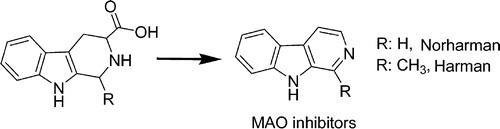
..this paper indicates that Harman and Norharman (found in quite a few Passiflora species) are effective MAOIs in humans, and that extracts of raisins could be used for this purpose..but also, importantly, many passifloras with higher levels of these harmalas than raisins can be investigated..they had previously been referred to as 'tentative/possible' in maoi activity..
Identification and Occurrence of β-Carboline Alkaloids in Raisins and Inhibition of Monoamine Oxidase (MAO)
Tomás Herraiz, J. Agric. Food Chem., 2007, 55 (21), pp 8534–8540
here is the abstract in the link..
don't know about you, but this was news to me..
..thought i'd better be 'raisin' it with some fellow explorers.. (..sorry for pun)
.
Identification and Occurrence of β-Carboline Alkaloids in Raisins and Inhibition of Monoamine Oxidase (MAO)
Tomás Herraiz, J. Agric. Food Chem., 2007, 55 (21), pp 8534–8540
here is the abstract in the link..
Monoamine oxidase (MAO) is a mitochondrial enzyme involved in the oxidative catabolism of neurotransmitters and xenobiotic amines, including vasopressor and neurotoxic amines, and a current target for antidepressant and neuroprotective drugs. Raisin extracts and homogenates exhibited reversible in vitro inhibition of MAO isozymes, particularly MAO-A, suggesting the presence of MAO-inhibiting substances. Chromatographic and spectrometric studies showed the occurrence of aromatic β-carboline alkaloids in raisins, and norharman and harman were identified as the key contributors to MAO inhibition. On average, harman ranged from 6 to 644 ng/g and norharman from 2 to 120 ng/g. Several technological variables appeared to determine the presence of these compounds in raisins. Dark-brown raisins (i.e., sun-dried) contained much higher levels than golden raisins. Tetrahydro-β-carboline-3-carboxylic acid compounds that are direct precursors of aromatic β-carbolines were also identified in raisins and appeared in a higher amount, reaching up to 50 µg/g. β-Carbolines were isolated from raisins and acted as good competitive inhibitors of MAO-A (harman) and MAO-B (norharman) isozymes. These results suggest that β-carboline alkaloids and perhaps raisins containing a high level of β-carbolines might exhibit potential activity as MAO inhibitors. The results also show that some raisins can be a source of dietary exposure to bioactive β-carbolines.
don't know about you, but this was news to me..
..thought i'd better be 'raisin' it with some fellow explorers..
(..sorry for pun).