Looking for some insight from those with experience in re-x...
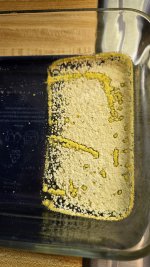
I have a 250mL pyrex bottle of heptane highly concentrated with DMT + whatever else got dissolved when heating it and the spice to 55-60C. I have already decanted twice (and I've held onto the "discard" hoping to pull more later as fumarate via FASA), and although it is certainly more clean than before decanting, leaving the bottle sit for 20 hours or so at room temperature grew some beautiful white crystals, but at the bottom of the bottle sits a layer of red liquid. Is this dmt-oxide? Or other alkaloids like jungle spice?
If it is jungle spice, I want to keep that for later separately but I'd like to end up with some good clean white crystals without the red. I just heated it up and with a quick shake it all fully dissolved without layering (homogenous), and my intent is to let it cool to room temperature and then decant again once the red layer shows up at the bottom, and transfer the light yellow liquid to another bottle for crystallization with crystals as white as possible.
Judging by the speed at which the crystals grew at 24-25C, it is very super-saturated.
Do any of you have more than just speculation of what the red would be, and what do with it? If it's dmt-oxide would it dissolve at 50C and separate at 30C like mine is doing? Would jungle spice do the same? I understand n-heptane is more selective, but I just don't have the experience to understand if maybe the higher temps still let the jungle spice dissolve in it. If it is oxide, I would probably try to convert back to NN-DMT.
Sorry I wish I had a camera to snap some pics. Too much paranoia to be using cell phone camera.
-Artificer
I have a 250mL pyrex bottle of heptane highly concentrated with DMT + whatever else got dissolved when heating it and the spice to 55-60C. I have already decanted twice (and I've held onto the "discard" hoping to pull more later as fumarate via FASA), and although it is certainly more clean than before decanting, leaving the bottle sit for 20 hours or so at room temperature grew some beautiful white crystals, but at the bottom of the bottle sits a layer of red liquid. Is this dmt-oxide? Or other alkaloids like jungle spice?
If it is jungle spice, I want to keep that for later separately but I'd like to end up with some good clean white crystals without the red. I just heated it up and with a quick shake it all fully dissolved without layering (homogenous), and my intent is to let it cool to room temperature and then decant again once the red layer shows up at the bottom, and transfer the light yellow liquid to another bottle for crystallization with crystals as white as possible.
Judging by the speed at which the crystals grew at 24-25C, it is very super-saturated.
Do any of you have more than just speculation of what the red would be, and what do with it? If it's dmt-oxide would it dissolve at 50C and separate at 30C like mine is doing? Would jungle spice do the same? I understand n-heptane is more selective, but I just don't have the experience to understand if maybe the higher temps still let the jungle spice dissolve in it. If it is oxide, I would probably try to convert back to NN-DMT.
Sorry I wish I had a camera to snap some pics. Too much paranoia to be using cell phone camera.
-Artificer




 try a mini a/b