
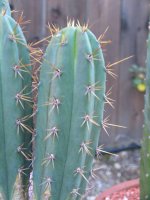
I have a few san pedro I started from seed (I think a few are pachanoi and a few are puruvianus. I noticed recently that a few of them started to get dark in color and looked as if they were shriveling up. They were watered almost every second day and were doing fantastic. I have a 8x 4ft t5 light about them. I kept the light about 8-4" above the cacti with a large fan blowing on them. They would dry out by the end of the day. Over a period of about 5 days a bunch of them started to turn very dark green and were shriveling up. I check the roots and everything seemed fine. The base of the cacti seemed fine too. Is it too much sunlight? To much heat? Over watering? I'm totally stumped. Only two of the 11 I have are growing normally. Any idea's? The picture of the two bright green ones are some healthy ones I took for a comparison.

-
Members of the previous forum can retrieve their temporary password here, (login and check your PM).
You are using an out of date browser. It may not display this or other websites correctly.
You should upgrade or use an alternative browser.
You should upgrade or use an alternative browser.
San pedro shriveling and turning dark.
- Thread starter Taproot
- Start date
Migrated topic.
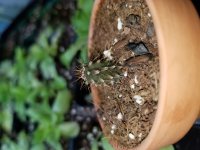
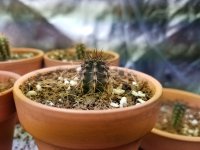
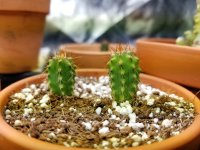
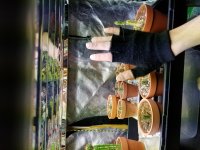


OK, I just read in the attitude section that talk of live plants is allowed.
Both of those SanPedros are readily available from zillions of cactus vendors in Arizona. 99% of them will ship inside the US. International shipping of plants is usually always a pain but if you want that Joshua Tree or Siberian Acacia bad enuf you won't stop til you unpack it.
Oh, and don't go with the cheapest supplier, or the most expensive either.
Both of those SanPedros are readily available from zillions of cactus vendors in Arizona. 99% of them will ship inside the US. International shipping of plants is usually always a pain but if you want that Joshua Tree or Siberian Acacia bad enuf you won't stop til you unpack it.
Oh, and don't go with the cheapest supplier, or the most expensive either.
Its hard to make an i.d. on plants that young. Let them get bigger and you'll know for sure. They might turn out to be Cereus or Browningia or Pilosocereus. Or they could be Trichocereus. If he bought seed from a reputable source then they probably are what they're supposed to be.

It's of course too early to tell what kind of cactus it is but they look like my own seedling who are now big enough to be extracted and they are definitly active.
IMO, the shriveling is a lack of water due to not enough watering or soil quality.
IMO, the shriveling is a lack of water due to not enough watering or soil quality.
Different recipes but the spirit is "rich and well drained"
Here is another one (tutorial with pics).dg said:..., 50% potting soil, 5% compost, and 45% perlite or turface
i also add a healthy sprinkle of 20-20-20 osmocote time release balls
When it comes to cactus, there is nothing like pumice & coir. All the big gurus use pumice & coir. I'm only a kang-guru and I use them too. (Sorry, I can never resist that pun 
I don't want to be like a 4th grader constantly asking if something is allowed so I'm going to go out on a limb here and mention a website. Let me say that it is a pure cactus website and the finest free resource that an amateur grower could ask for. The author is a true patron for the selfless sharing of his vast knowledge-base. I always wish him only my best, positive, thoughts and intentions. And having said that, please take the time to browse:
There is a good article about soil mixes and several other independent references also.
I'm nowhere near this guy's level, but he took the time to respond to a legitimate inquiry regarding his works, so he's not a snob either. If you've never been there, you'll be glad you went.
I don't want to be like a 4th grader constantly asking if something is allowed so I'm going to go out on a limb here and mention a website. Let me say that it is a pure cactus website and the finest free resource that an amateur grower could ask for. The author is a true patron for the selfless sharing of his vast knowledge-base. I always wish him only my best, positive, thoughts and intentions. And having said that, please take the time to browse:
There is a good article about soil mixes and several other independent references also.
I'm nowhere near this guy's level, but he took the time to respond to a legitimate inquiry regarding his works, so he's not a snob either. If you've never been there, you'll be glad you went.
DansMaTete said:It's of course too early to tell what kind of cactus it is but they look like my own seedling who are now big enough to be extracted and they are definitly active.
Please state the Genus/Species name of the cactus you are referring to, I must be confused about something. I'm really old and I always try to factor that in when I suspect some mistake.
Taproot said:Thank you so much for taking the chance just to help me out. I REALLY appreciate it.
Don't mention it man...compare our post numbers and seedling icon, we're both new here. I joined yesterday, or the day before...what about you?

downwardsfromzero
Boundary condition
They might not actually be liking a feed with too much calcium. Regularly adding calcium seems likely to be capable of slowing their growth somewhat. For instance, I've found that adding even coarsely crushed limestone chunks as the bottom layer of a pot filling has effectively stalled growth for a Trichocereus terscheckiiAlso this is what I've been feeding them.
 At least it's reasonably easy to get the limestone chunks out - but it would be even easier to change to a different fertilizer, were that an option.
RoundAbout
Esteemed member
dwh said:DansMaTete said:It's of course too early to tell what kind of cactus it is but they look like my own seedling who are now big enough to be extracted and they are definitly active.
Please state the Genus/Species name of the cactus you are referring to, I must be confused about something. I'm really old and I always try to factor that in when I suspect some mistake.
Just to be clear, I think Trichocereus peruvianus is being discussed in general, not Cereus peruvianus.

downwardsfromzero said:They might not actually be liking a feed with too much calcium. Regularly adding calcium seems likely to be capable of slowing their growth somewhat. For instance, I've found that adding even coarsely crushed limestone chunks as the bottom layer of a pot filling has effectively stalled growth for a Trichocereus terscheckiiAlso this is what I've been feeding them.
I suspect that the issue here in terms of stalled growth and limestone isn't excess Ca but rather is a high pH making phosphorus unavailable to the plant.
downwardsfromzero
Boundary condition
Thanks for that. I can see how a bulk of stone would selectively absorb the phosphate, effectively preventing it from diffusing back up the pot. This is clearly different from the case where, were the pH of the fertilizer - or the water it's mixed with - to be too high, 3% calcium in a 2-2-1 fertilizer could combine with pretty much all of the phosphate but in a more finely dispersed form, thus remaining more available.I suspect that the issue here in terms of stalled growth and limestone isn't excess Ca but rather is a high pH making phosphorus unavailable to the plant.
Otherwise we can discuss the limestone/phosphate matter in another thread in case this goes off at too much of a tangent. I was initially surprised that a few lumps of stone at the bottom of a pot could trap all of the phosphate. They'll be getting silicate rock soon anyhow

RoundAbout said:dwh said:DansMaTete said:It's of course too early to tell what kind of cactus it is but they look like my own seedling who are now big enough to be extracted and they are definitly active.
Please state the Genus/Species name of the cactus you are referring to, I must be confused about something. I'm really old and I always try to factor that in when I suspect some mistake.
Just to be clear, I think Trichocereus peruvianus is being discussed in general, not Cereus peruvianus.
SEE, I told you I was old!
But really, I'm glad it was my mistake. It looks like Taproot puts some good effort into his dirt, don't you think?
Actually, I think I have one of those trico's growing. I'll take some pics today.
I took a look and I don't have any Trico's, just Steno's and plain old Cereus's. Oh well, nuthin lost, I picked them for looks when they were acquired.
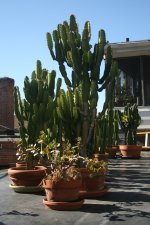
I'm posting a pic of one Euphorbia grove. It's from the growing season and they're all inside now. And just for size reference, none of them were over 4ft at the time. I get dozens of cuttings from them every season. During most of the season, these get watered (soaked) twice a day, every day...
I'm posting a pic of one Euphorbia grove. It's from the growing season and they're all inside now. And just for size reference, none of them were over 4ft at the time. I get dozens of cuttings from them every season. During most of the season, these get watered (soaked) twice a day, every day...
Attachments
Similar threads
- Replies
- 4
- Views
- 337

- Replies
- 2
- Views
- 205

Staff online
-
 VoidmatrixRearranging the void
Members online
Total: 549 (members: 11, guests: 538)
Robots: 192
Robots: 192