• Members of the previous forum can retrieve their temporary password here, (login and check your PM).

Straight To Acetone (STA)

Migrated topic.
Wow, super cool tek Loveall. Would love to try this some day... This could be the all-natural survivalist's guide to extract mescaline as NP's tend to become unavailable as time goes on.

It definitely looks like there are other salts in there given the absence of needles, but also resembles the color of mesc sulfate. If you are going to purify and want to make sure all salts are removed, basing into toluene and crashing out in acidic methanol works very well as outlined in my wiki tek.

Would also be interesting to extract the ending goo and liquid contents using traditional techniques to determine if any mesc was left behind.

Can't wait to see Benz's results! :thumb_up:
 
We were able to have DanceSafe subject this precipitate to a litany of reagents. No mescaline was detected. Unfortunately it looks like it's just inactive salts.
 
dreamer042 said:
We were able to have DanceSafe subject this precipitate to a litany of reagents. No mescaline was detected. Unfortunately it looks like it's just inactive salts.

Benzyme also reports/confirms mostly salts in his first analysis.

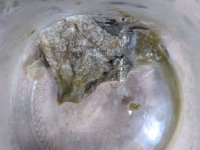
The gunk that precipitated 1st before adding sulfuric is the next place I will look for Mescaline. After a few days it has dried up. It looks interesting with white specks/clusters in it (picture below). Reminder that this gunk is easily precipitated out after adding two volumes of acetone to a plain water concentrated cacti extract

Not sure how to go about processeling the gunk (any ideas?). It is very easy to get to the gunk, hoping the Mescaline is there and we can get it out.
 

Attachments

  • IMG_20200210_195841061.jpg
    IMG_20200210_195841061.jpg
    2.6 MB · Views: 0
Thanks endlessness.

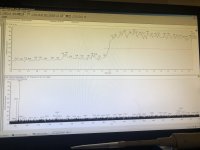
Benzyme did a a second run (done because the detector wasn't responding to direct infusions of standards) and changed the electron multiplier. No mescaline (211 peak) is present as expected from Dreamer042's reagent tests. However there are peaks at 208 and 225 (difference is an 0H). Anyone know what they could be?
 

Attachments

  • FB387985-E049-4170-BC68-1328-AF89-AD87.jpg
    FB387985-E049-4170-BC68-1328-AF89-AD87.jpg
    2.6 MB · Views: 0
Here I go over the compounds found in cact so far, could help finding the unknowns. Many are too light to be the molecules found. Could it be:

Anhalonidine
3,5-dimethoxy-4-hydroxyphenylethylamine,
3,4-dimethoxy-5-hydroxyphenylethylamine

?
 
endlessness said:
Here I go over the compounds found in cact so far, could help finding the unknowns. Many are too light to be the molecules found. Could it be:

Anhalonidine
3,5-dimethoxy-4-hydroxyphenylethylamine,
3,4-dimethoxy-5-hydroxyphenylethylamine

?

Thanks! Anhalonidine fits the 225 peak (Benzyme mentioned that the absolute calibration is off by +2). Would we expect a reagent reaction for it? There were none at DanceSafe. Are there any known effects from Anhalonidine?

Maybe I should bioassay the powder...
 
Great pioneering effort nonetheless Loveall, there needs to be more experimentation like this. Definitely more possibilities when it comes to solubility. You've etched a few ideas into the head and one may need to do a couple new experiments soon. :thumb_up:

If I had to take a guess, would think the mesc ended up in the final liquid rather than the gunk, but the gunk can be extracted for testing with traditional A/B techniques. Dissolve in acidic H2O, decant/filter, base into NP, acid H2O pull.
 
Kash said:
Great pioneering effort nonetheless Loveall, there needs to be more experimentation like this. Definitely more possibilities when it comes to solubility. You've etched a few ideas into the head and one may need to do a couple new experiments soon. :thumb_up:

If I had to take a guess, would think the mesc ended up in the final liquid rather than the gunk, but the gunk can be extracted for testing with traditional A/B techniques. Dissolve in acidic H2O, decant/filter, base into NP, acid H2O pull.

Thanks:)

Any particular reason you think the Mescaline is still in the liquid? I was leaning towards the gunk since it wasn't in the acetone and sulfuric precipitate. I'm thinking that because based on dg's Tek, mescaline would not stay in solution in that environment (so it should have precipitated earlier).

If so, another test us to add the original acetone in 10% increments. Maybe the pure gunk and other salts precipitate at different times.

The gunk later on dried to the consistency of taffy. I may just eat some 🙃
 
I did couple of similar experiments in the past, having used citric acid or HCL and isopropanol instead of sulphuric acid and acetone.

Precipitated gunk was inactive and mescaline ended up in the liquid even after freezing.
This liquid after evaporation gave a resin with approx. 8% mescaline, which was confirmed by mini A/B extraction.
 
doubledog said:
I did couple of similar experiments in the past, having used citric acid or HCL and isopropanol instead of sulphuric acid and acetone.

Precipitated gunk was inactive and mescaline ended up in the liquid even after freezing.
This liquid after evaporation gave a resin with approx. 8% mescaline, which was confirmed by mini A/B extraction.


Thanks that's great info. I think your result makes sense as the HCl salt is very water soluble.
 
Loveall said:
Kash said:
Great pioneering effort nonetheless Loveall, there needs to be more experimentation like this. Definitely more possibilities when it comes to solubility. You've etched a few ideas into the head and one may need to do a couple new experiments soon. :thumb_up:

If I had to take a guess, would think the mesc ended up in the final liquid rather than the gunk, but the gunk can be extracted for testing with traditional A/B techniques. Dissolve in acidic H2O, decant/filter, base into NP, acid H2O pull.

Thanks:)

Any particular reason you think the Mescaline is still in the liquid? I was leaning towards the gunk since it wasn't in the acetone and sulfuric precipitate. I'm thinking that because based on dg's Tek, mescaline would not stay in solution in that environment (so it should have precipitated earlier).

If so, another test us to add the original acetone in 10% increments. Maybe the pure gunk and other salts precipitate at different times.

The gunk later on dried to the consistency of taffy. I may just eat some 🙃
Sure, the reason I think that is because mescaline salts tend to be slightly soluble in acetone and likewise quite soluble in acetone/H2O, especially when in a 'relatively' dilute mixture with unknown variables. I would be surprised if they crashed out with the gunk, trace amounts maybe?

Dropping out the target would be getting the solution as clean/concentrated as possible and then making a really insoluble environment. Water can be removed with excess dried Epson Salt. Alcohol/MEK is a good solvent combo, but the solvent possibilities are nearly endless. My guess is if you add some IPA and removed most of the water from the cleaned acetone cacti mix, there would be some good precipitate in the freezer. :)
 
Thanks Kash, good perspective. This feedback is very helpful.

Upon further testing think you are right that we had trouble crashing the sulfate salts from the water/acetone.

Mescaline dilution and overall % water is a concern, agreeed. Another could be the pH, if it is too low I think a different salt can form (mescalineH)HSO4 (instead of 2(MescalineH)SO4) which should be even more soluble and difficult to crash. I didn't control the pH and kept on adding sulfuric acid which could have been an issue.

We have dg's result that showed mescaline sulfate does crash in up to 50% cold water/acetone (there the mescaline sulfate is much more concentrated though). I still have hopes for crashing mescaline sulfates in acetone and water in the freezer under more dilute mescaline conditions, especially if the % of water is reduced and the pH is controlled. Adding more SO4-- ions could help, but that seems tricky.

Next, I'm trying to lower the water % and control the pH. That is going on in another thread at the moment. In short a basic water paste made, that is pulled with acetone, and the FB is titrated out with dilute sulfuric acid. Fingers crossed for that process.

It turns out that some of the straight to acetone work was done before (I missed that thread 🤦‍♂️. The filtered water/acetone was evaped to an active resin and some other separation ideas where discussed.
 
Back
Top Bottom