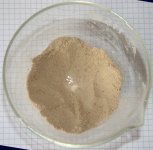
SWIM extracted 100g of rue and after 2 A/B cycles has got 9g of pretty clean looking extract.
For some reason SWIM could not attach the picture.
For some reason SWIM could not attach the picture.


endlessness said:did you do at least one manske step?
if not, then its not only harmalas but also the other alkaloids such as vasicine and vasicinone

burnt said:why use sodium carbonate or bicarbonate in such an extraction? SWIM doesn't see the point?
69ron said:In the past SWIM found his salted alkaloids to be as much as 20% salt. How you filter the salted alkaloids can really make a difference in salt contamination. At the freebasing stage, too much salt will prevent sodium carbonate from dissolving properly because water can only hold so much sodium, and then it starts to precipitate out of the water.
I think step 7 above wasn't done right, and lots of salt was still present and this messed up step 9.
Yields should be about 1-3%. Anything above that is suspicious. There are seeds that produce more, but they are not common. 10% is definitely not believable.
69ron said:Let me say this again. Salt is SODIUM CHLORIDE. Sodium carbonate is a SODIUM. Both are SODIUMS. Water can only hold so much SODIUM. This is the problem.
If the initial alkaloids are contaminated with too much SODIUM chloride then adding more SODIUM carbonate will cause SODIUM to precipitate out with the harmalas.
Because SODIUM carbonate is less water soluble than SODIUM chloride, then SODIUM carbonate precipitates out, so you'll get harmala alkaloids that taste like SODIUM BICARBONATE because there's sodium carbonate in it.
It's simple chemistry. Water can only hold so much sodium. If there’s too much sodium chloride, added sodium carbonate will not dissolve.
Trickster said:69ron said:In the past SWIM found his salted alkaloids to be as much as 20% salt. How you filter the salted alkaloids can really make a difference in salt contamination. At the freebasing stage, too much salt will prevent sodium carbonate from dissolving properly because water can only hold so much sodium, and then it starts to precipitate out of the water.
I think step 7 above wasn't done right, and lots of salt was still present and this messed up step 9.
Yields should be about 1-3%. Anything above that is suspicious. There are seeds that produce more, but they are not common. 10% is definitely not believable.
SWIM did not filter precipitate at all. She just put the salted liquid in the fridge until the it's become completely transparent and then very carefully decanted it. After that she just added warm water and some vinegar to the remaining goo (step 8 ).
69ron said:That's the problem I’m sure. Because it was decanted and not filtered, there was a lot of salt present.
69ron said:The salt prevented the sodium carbonate from dissolving properly.
You cannot easily dissolve sodium carbonate in a solution of salt. Water can only hold so much sodium.
69ron said:You also cannot easily dissolve sodium carbonate in a solution sodium acetate. If you added vinegar, you created sodium acetate when the sodium carbonate was added. So this is another problem.
2. SWIM would prefer to exclude any guesswork from the process but she is still looking for exact quantities of chemicals. Do you happen to know them?
burnt said:2. SWIM would prefer to exclude any guesswork from the process but she is still looking for exact quantities of chemicals. Do you happen to know them?
Check the solubility of NaCl and sodium carbonate in water and use less then that.
Trickster said:Now, what would be the best way to clean the product?