

Has anyone else used syringe filters? Either for extraction or something else?
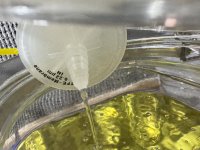
I really like them, they seem to take the extraction to another level of cleanliness. I also have a vacuum filtration setup that is comparable, but I think the syringe filters have a few advantages.
I'm specifically talking about PTFE membrane syringe filters. I found some that have 0.22 micron pore size.
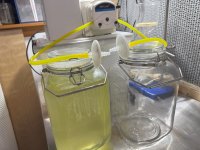
PTFE is extremely hydrophobic, and thus water can't pass the membrane. I think that's so useful. Here I am using it to transfer hexane off the water layer. I have the filters plugged into tygon tubing and a peristaltic pump is moving the fluid. But these are more often used on the tip of a syringe. I could do the pull blindfolded and never pick up a drop of base.
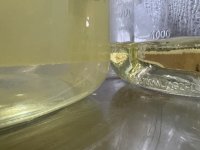
Look at that before (left) & after (right). The solvents on the left appear to be separated, but I mixed these with a high speed drill paddle and I think hexane's opacity is from suspended micro droplets of water. Even the water looks a little cloudy. Whatever it is, the filter is clearing it up completely.
The low surface tension of non polar solvents makes it such a pain to pick them up with a pipette or baster. But with the filters on the ends of the tygon line, no NPS drips out when the pump is paused. I suppose the tiny pore size makes up for the lack of surface tension and allows it to be held without dripping.
I think it's slightly more sterile than filtering through a buchner funnel. If I modify a container I could pump the filtered liquid straight into a sealed vessel that has been sterilized and maybe under inert gas. I guess you could do that with lab glass too, but this seems more flexible.
View attachment Degassing.mp4
Degassing. Apparently when these filters get really small, they start to separate gases from solution. I don't really understand how this works, but I think I saw it happening nonetheless. On the intake filter, gas percolates up the line. Not sure where else it could be coming from besides the solution. Do Whatman filters degas too? It seems like it would work better in a filter flask where the liquid falls and the gas gets sucked out the pump. In my setup, the gas gets separated and coagulates into bubbles, but it's still stuck in the line. I have another filter on the outtake though, so I guess it would be splitting them again and I just don't get to see the gas escaping as the fluid exits the second filter.
The DMT in solution had just been converted from benzoate salt. That conversion took place at room temp. Then I treated the solution with dry ice and an alkaline water wash. After at least 36 hours in solution nothing had precipitated. This was the final filtration and separation from the wash water into the growth chamber. After filtration, it was eager to precipitate.
View attachment press precip.mp4
I noticed a lot of precipitation in the outtake end of the line. It was in the line, clogging up the filter, and growing off the outtake nozzle. My theory for the inline precipitation is that the hexane is getting bottlenecked at the outtake filter, which is limited in how fast fluid can pass through the membrane. The peristaltic pump is building up pressure on the out line, exacerbated when the precipitate starts clogging the filter. I think this pressure could be causing the freshly filtered solutes to precipitate. Second guess is that it's from the pressure cycling up and down rapidly.

See the peristaltic pump works with rollers pushing the fluid along. But there's a moment when the roller disengages, for a pressurized fluid to snap back a few centimeters in the line and drop pressure, before the next roller catches it and re-pressurizes the line. You can see this in the video; the precipitate in-line is jerking back and forth as the pressure pulses. I saw some chunks in there, as if the precipitate is snowballing as it oscillates.
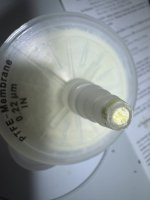
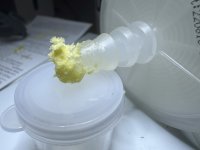
Would this be like drinking from the udder? Left image is the pressurized side of the filter, clogged with spice. The right image is on the outtake side of that clogged filter, where the double-filtered solutes grew crystals off the spout like stalactites.
In the receiving vessel, crystals the size of dust could be seen growing before the filtration was even completed. Within a day the dust grew into little gems, perfect crystals from what I could see. In hindsight I would estimate 75% of the DMT in solution had crystallized out by then.
View attachment IMG_0916 (1).MOV
I was greedy and transferred this masterpiece to the freezer and gradually chilled it over two days. There was little more to gain though and it just coated the beauties with a druze of tiny crystals that nucleated off the gems (video below). I tried to be careful but I'm not sure if it's possible to move the vessel to different environments like that without interrupting the crystal order. I've seen some crystals in slides with coarse outlines where/when it got disturbed by me, with a change of pattern following the disturbance.
View attachment VID_0052.mp4
Anyway, I'm curious why crystallizing in the vessel seemed to come so effortlessly after filtration, and mostly without any temperature change.
And the inline behavior makes me wonder if we could get DMT to crash out very quickly if we pressurize it or cycle the pressure rapidly. Has anyone tried growing crystals under increased or decreased pressure?
I really like them, they seem to take the extraction to another level of cleanliness. I also have a vacuum filtration setup that is comparable, but I think the syringe filters have a few advantages.
I'm specifically talking about PTFE membrane syringe filters. I found some that have 0.22 micron pore size.
PTFE is extremely hydrophobic, and thus water can't pass the membrane. I think that's so useful. Here I am using it to transfer hexane off the water layer. I have the filters plugged into tygon tubing and a peristaltic pump is moving the fluid. But these are more often used on the tip of a syringe. I could do the pull blindfolded and never pick up a drop of base.
Look at that before (left) & after (right). The solvents on the left appear to be separated, but I mixed these with a high speed drill paddle and I think hexane's opacity is from suspended micro droplets of water. Even the water looks a little cloudy. Whatever it is, the filter is clearing it up completely.
The low surface tension of non polar solvents makes it such a pain to pick them up with a pipette or baster. But with the filters on the ends of the tygon line, no NPS drips out when the pump is paused. I suppose the tiny pore size makes up for the lack of surface tension and allows it to be held without dripping.
I think it's slightly more sterile than filtering through a buchner funnel. If I modify a container I could pump the filtered liquid straight into a sealed vessel that has been sterilized and maybe under inert gas. I guess you could do that with lab glass too, but this seems more flexible.
View attachment Degassing.mp4
Degassing. Apparently when these filters get really small, they start to separate gases from solution. I don't really understand how this works, but I think I saw it happening nonetheless. On the intake filter, gas percolates up the line. Not sure where else it could be coming from besides the solution. Do Whatman filters degas too? It seems like it would work better in a filter flask where the liquid falls and the gas gets sucked out the pump. In my setup, the gas gets separated and coagulates into bubbles, but it's still stuck in the line. I have another filter on the outtake though, so I guess it would be splitting them again and I just don't get to see the gas escaping as the fluid exits the second filter.
The DMT in solution had just been converted from benzoate salt. That conversion took place at room temp. Then I treated the solution with dry ice and an alkaline water wash. After at least 36 hours in solution nothing had precipitated. This was the final filtration and separation from the wash water into the growth chamber. After filtration, it was eager to precipitate.
View attachment press precip.mp4
I noticed a lot of precipitation in the outtake end of the line. It was in the line, clogging up the filter, and growing off the outtake nozzle. My theory for the inline precipitation is that the hexane is getting bottlenecked at the outtake filter, which is limited in how fast fluid can pass through the membrane. The peristaltic pump is building up pressure on the out line, exacerbated when the precipitate starts clogging the filter. I think this pressure could be causing the freshly filtered solutes to precipitate. Second guess is that it's from the pressure cycling up and down rapidly.
See the peristaltic pump works with rollers pushing the fluid along. But there's a moment when the roller disengages, for a pressurized fluid to snap back a few centimeters in the line and drop pressure, before the next roller catches it and re-pressurizes the line. You can see this in the video; the precipitate in-line is jerking back and forth as the pressure pulses. I saw some chunks in there, as if the precipitate is snowballing as it oscillates.
Would this be like drinking from the udder? Left image is the pressurized side of the filter, clogged with spice. The right image is on the outtake side of that clogged filter, where the double-filtered solutes grew crystals off the spout like stalactites.
In the receiving vessel, crystals the size of dust could be seen growing before the filtration was even completed. Within a day the dust grew into little gems, perfect crystals from what I could see. In hindsight I would estimate 75% of the DMT in solution had crystallized out by then.
View attachment IMG_0916 (1).MOV
I was greedy and transferred this masterpiece to the freezer and gradually chilled it over two days. There was little more to gain though and it just coated the beauties with a druze of tiny crystals that nucleated off the gems (video below). I tried to be careful but I'm not sure if it's possible to move the vessel to different environments like that without interrupting the crystal order. I've seen some crystals in slides with coarse outlines where/when it got disturbed by me, with a change of pattern following the disturbance.
View attachment VID_0052.mp4
Anyway, I'm curious why crystallizing in the vessel seemed to come so effortlessly after filtration, and mostly without any temperature change.
And the inline behavior makes me wonder if we could get DMT to crash out very quickly if we pressurize it or cycle the pressure rapidly. Has anyone tried growing crystals under increased or decreased pressure?
Last edited:
 wow amazing stuff
 - your creativity is amazing - do you really need sub micron or can you use larger for your purposes? What a set up!

