• Members of the previous forum can retrieve their temporary password here, (login and check your PM).

T. bridgesii cultivar ID

Jameis Vu

Esteemed member
Hi all,

New poster, but I've been lurking for the past couple months. I just moved to a climate that would allow for the easy cultivation of cactus, so I thought I would educate myself on the practice.

I recently acquired 3 plants on an online market claimed to be T. bridgesii by an experienced gentleman. Upon purchase he told me they were quite potent, and experiences using them would last somewhere around 20 hours. I gave them to my good friend, SWIM. SWIM previously practiced extractions on Trichocereus spp. "PC", so SWIM was eager for something with a higher yield.

Of the 3 plants, SWIM harvested two of them. I will detail all that in another post in the relevant forum, as I think it has some interesting info on a couple of the teks out there. Of the results SWIM confirms excellent success. One tek produced a 2.5% yield (dry weight), and results are coming in for the second plant.

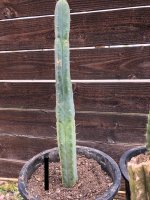
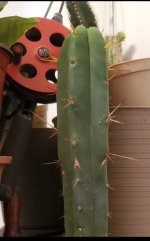
My question for this forum is, what cultivar is this, do you think? The original seller said he found the parent on his property and doesn't know any more than that. I suspect, based on the results, and the description from the Sacred Succulents website, that this is an "SS02" variety. It matches the description, including the sections of spineless column about halfway up each clone. I have attached an image, and hope someone could confirm this for me, or otherwise provide me with a better ID.

Looking forward to posting here more.

Screenshot 2024-05-15 at 8.03.24 PM.png
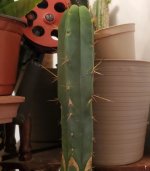
IMG_3205 copy.jpg
 
Hey there and welcome to the Nexus!

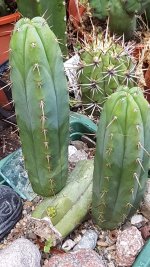
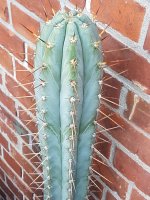
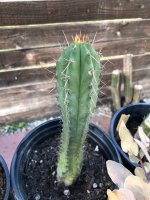
While I can't confirm the identity of your cactus down to the variety SS02, I do have a very similar-looking specimen which has been reported to be both potent and palatable.
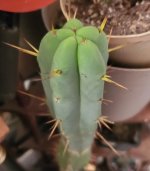
20220808_190809.jpg20220820_191251.jpg
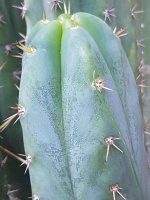
For comparison, here is the characteristic spination of what I understand to be a more standard form of Echinopsis lageniformis (syn, T. bridgesii):
20220820_191417.jpg

Have you ever looked at @Keeper Trout's work on sacred cacti? This esteemed researcher has made an immense contribution in the field of psychoactive cacti and beyond.
 
Cool, is that an SS02 hybrid? I know a lot of those float around. It would just be nice to get some confirmation on the provenance of mine, but unless there's a real expert on like Trout that can chime in, I'll probably just always have to assume. I agree that what I have is shorter spined than typical Bolivian torch specimens I have seen.

I have been slowly perusing K. Trout's extensive library of information. Thanks for the pointer.
 
Cool, is that an SS02 hybrid?
As I say, I have no idea! At least we have that in common, eh?

The person who gifted it to me said it had "had magic done on it". It certainly had the magical 4 ribs when I first got it, but it has long since popped an extra one, not to mention the pics are of 3rd and 4th generation clones, and I've passed on cuttings far and wide to help ensure its survival, as there are some rather special genetics in there for sure.

The majority of my trichs are unidentified, what with at least half of them being unlabelled gifts. With these fast-growing things and a limited amount of space, hobby cactus growing almost inevitably perpetuates gift-giving as well.

Depending on the growing conditions, the spines on your specimen may get a lot longer - up to 10cm if it's anything like mine.
 
Yeah i'm in a similar boat. My collection is fast growing with a lot of free, unlabelled gifts. But the scientist in me wants the label. Perhaps a fool's errand. I've got a couple that look like Peruvian torch, but theyre not ready for a bioassay yet. Plenty of PC also that I plan to use for grafting when the time comes.

The fact that all 3 plants had mid-sections that were completely spineless for ~3 areoles vertically just matches the SS02 description so nicely that I cant help but believe that's what I have.

What sort of yields does your magical cardinal specimen produce?
 
Plenty of PC also that I plan to use for grafting when the time comes.
PC is something of a 'goddess-send' in that having a bunch of it hanging round means you can always bang out a quick graft if the circumstances arise. Exactly this happened over here last week after I found one of my lophs had developed a sudden soft rot - I checked the rest of the plants and one of them felt too soft as well, so I quickly chopped it off, thinking it had been affected too. It turns out it was still just dehydrated from the winter and had freer-draining compost than the other plants, so it was time for a bit of impromptu grafting. I'll drop in a pic tomorrow.
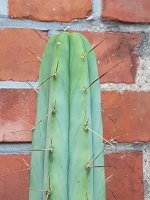
Meanwhile, here's how my macrogonus was looking, which is essentially a form of Peruvian torch:
20220820_192151.jpg
 
Yeah that looks a lot like mine. Im going to call it T. macrogonus and call it a day. Im excited for it to get nice and big. I saved this one from a pot that didn't have any drainage holes. Im surprised it didn't rot.

I also got a Loph from a local nursery just to try it out. It was feeling a bit soft today when I checked it, but Im deathly afraid of overwatering it, or even repotting it currently. How often do you water them? It just made a little flower; I'm afraid to mess with it.

IMG_3197.jpeg
 
I don't think it is possilbe to id a clone this way. The uncertainty of any bought clone is there even when the seller is legit and selling it under some name. You can id it anyhow you wish if it is just for your garden, but if there is a possibility you will sell/give it to someone else in the future, you should always be as sure as possible you have what you think you have. And that is just when acquired from legit source with clear labeling.
 
Yeah that looks a lot like mine. Im going to call it T. macrogonus and call it a day. Im excited for it to get nice and big. I saved this one from a pot that didn't have any drainage holes. Im surprised it didn't rot.

I also got a Loph from a local nursery just to try it out. It was feeling a bit soft today when I checked it, but Im deathly afraid of overwatering it, or even repotting it currently. How often do you water them? It just made a little flower; I'm afraid to mess with it.

View attachment 98419
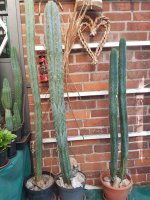
Hmm, if that's the one in the pic that you're referring to, it has some bridgesii-style spination characteristics (particularly those three large spines per areole, arranged in an inverted triangle), only more stout. Compare that to my bridgesii once more, shown here to the left of the macrogonus (the twin columns to the right are a clone from the same plant as my first picture in this thread):
20230822_172149.jpg
One more thing about bridgesii is that the areoles on the mature plant will stand out on their own little bumps, as we start to see on your specimen towards the top, perhaps.

As @pete666 says (more or less), it's very difficult to even get the species right based on the spines and outline alone. It would be a case of crossing your fingers and waiting for it to flower, or going the whole hog and getting a genetic fingerprint for the plant. I don't even know if there's a specific genetic databank for Trichocereus species, although we can be fairly sure genetic studies will have been done.

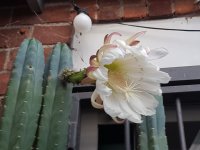
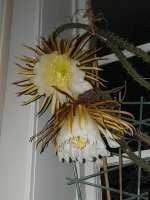
So, to round it off, here's one of the PC pach flowers I was blessed with last year, which confirmed the identity of those clones reasonably conclusively as per K.Trout's annotations (see Pachanoi or pachanot), and a Selenicereus grandiflorus (Queen of the Night):
20231005_165630.jpg20230703_011236.jpg
 
Looks very similar general form of my SS02 crosses. Amd some of the ones I've extracted from definitely had the goods in fairly high concentrations.
I wouldn't be able to say for sure what it is, but it definitely has the appearance of the SS02.

This is SS02 x Huancoensis (seeds were acquired from WSS era 2016)
Screenshot_20240523-103105_Instagram.jpg
Screenshot_20240523-103055_Instagram.jpg
Screenshot_20240523-103047_Instagram.jpg

I'll do some digging around for some better photos of some of my SS02's and crosses and post them up when i find them.

@Jameis Vu care to share some info on the Teks you/your friend was using on these Extracts?

I've been going over the different cacti teks around here reading up the last few days. I've only ever used Kash's AB and it's worked flipping wonders for me and chems are super available. So just made sense for me to go that route. But always interested in exploring different options.

@Transform Im flipping jealous, that is one beautiful flower. Growing since 2016 I've never had a Echinopsis flower for me unfortunately. Lots of Lophophora flowers but never one of my columnar cacti.
 
Gorgeous flowers @Transform. So far only my Optunia and Loph have flowers for me. But I just started, so here's hoping.

To me, the second plant I sent resembles more T. macrogonus than bridgesii, mainly due to its lack of v-notches, which I learned was a hallmark of "Peruvians", and is looks nothing like the specimen I have that was called a bridge.

I guess it's all an exercise in futility, like @pete666 says, since they all hybridize and labels become meaningless. The alkyloid content is where the rubber meets the road, so we'll see what this little rescue cactus has in store one day, if it makes it.

Speaking of, @SkunK, SWIM used 2 teks for two of the plants, starting from roughly equivalent amounts. The first one he pulled, with some minor modifications, from this experience note by user "Aeon" on erowid:
Cacti - T. bridgesii - Erowid Exp - 'Low Dose Mescaline'
He liked it because there's no boiling involved and he can easily make cactus powder with a food dehydrator and coffee grinder. He reportedly got a 2.5% yield (860 mg from 34 g) based on dry weight.

The second plant is being processed using a modified Kash A/B, but SWIM drastically lowered the NaOH concentration to 2 M, as the 12.5 M called for seems ridiculously high, and there's no justification for it given. If its to break down cells, I think freeze-thaws are easier and much safer (which he did). SWIM didn't dry it this time, so getting exact numbers will be tough, but it was starting from 718 g of fresh cactus (peeled & cored, same as previous), which assuming 95% water weight, gives 36 g dry. SWIM isn't done with that extraction yet, but so far he's collected 500 mg (unwashed) from the first two Xylene pulls. SWIM is salting each pull separately to see when it makes sense to stop pulling.

I hope to post more details soon. Right now, it seems like Aeon's tek may win out, possibly due to less loss from heating/boiling? I know there's some controversy on here regarding mesc. heat stability.
 
Last edited:
@Jameis Vu I'm very interested to hear more m from your Kashs A/B off that SS02 Specimen.

I used Kash's a/b back in the day on one or my SS02 x Juuls Giant cacti. She netted roughly the same 2.2% washed. I unfortunately only did one salting on this extract and always wondered if there were anymore good to be had. 🤔

I followed kashs tek exactly, but worked with whole cactus. Cut into stars (Core in), dried and ground in a coffee grinder. Pain in the ass to filter though.

Unfortunately this plant isn't doing the best atm and not sure if it will survive. I do have a decent cutting drying off to root.
I also have roughly 50g dried very stressed and abused material from cutting it back. Which I'm planning on running a Kash's A/B on in the very near time frame. I will definitely do multiple saltings/pulls on this material and keep them separate for educational purposes.

Not sure If another thread has replaced this one but might be beneficial for myself and others dabbling with Cacri extracts to post results here.
 
@SkunK I'll be sure to report on the final results. Mostly likely early next week.

For the Kash tek, because everyone reported powder was such a PITA, SWIM went with fresh cactus for this reason (ease of filtration). He also used an immersion blender at the beginning of the boil to help release more into solution. His filtering solution was a linen cloth, and he got more fine particulate solids through as a result, but considering the success of the Aeon tek, I don't think this matters.

What SWIM really likes about boiling prior to basification is the ability to taste the pulp for bitterness to roughly gauge how much more one should boil. Very handy for someone without experience. But Aeon's tek saves a signifcant amount of material by skipping the boiling and filtration; fewer steps = less lost material. And dry powder is a lot easier to manipulate than wet pulp.
 
I'll have a look into that tek you linked.

I've just had such greet Sucess with Kashs AB I haven't looked at many other paths of extraction.

Only recently since my return have I been exploring other paths for possible future option.
 
@Transform Im flipping jealous, that is one beautiful flower. Growing since 2016 I've never had a Echinopsis flower for me unfortunately. Lots of Lophophora flowers but never one of my columnar cacti.
It was a real surprise to get flowers - three in total - on these "pachanots" after 25 years - albeit not on a full 25 years' worth of growth since I've moved numerous times and, besides cutting them down because of that, I only really improved my trich-growing skills in the past ten years. What really seems to have made a difference was leaving them in the corner of my conservatory after being too busy to put them outside last year. It could be that they appreciate the extra bit of warmth overnight. Unfortunately, attempts to fertilise the flowers were unsuccessful. They may be self-sterile, so I'll have to cross my fingers and hope that one day I get two different trichs flowering at once. This is would be best dealt with by collecting as many different trichocereus varieties as possible :D 🌵💚

PS - fertilising with undiluted urine may also have helped.
 
@SkunK I've made a post in the appropriate forum you may find interesting:


I'll leave this thread solely for talking about the cacti themselves.
 
Very interesting plant, I think I saw some very similar to those, but they're rather skinny bridgesii, usually with up to 3 spines, and often a single lonely longer central spine, or sometimes none. AFAIK they are rather slow growers, at least around sea level.
 
OP have you looked into the ‘Bald Bridgesii’ cultivars? There are two different cultivars that bare this name from what I’ve heard, one is just “Bald Bridgesii” and the other is “SPCG Bald Bridgesii”, but the community has started to prefer calling the latter “SPCG Bare Bridgesii” to hopefully avoid confusing the two. I just received a small section of a ‘SPCG Bald/Bare Bridgesii’ which looks somewhat similar to yours, though it’s hard to be sure from the little two-inch pup that I received, I’m in the process of rooting it now. Both of these cultivars have similar tendencies to grow both spined and spineless areoles, and they both have a ‘pseudo-melty’ appearance like yours.
 
Back
Top Bottom