From Ayahuasca Admixtures Workspace
Tabernaemontana sananho Ruiz & Pav.
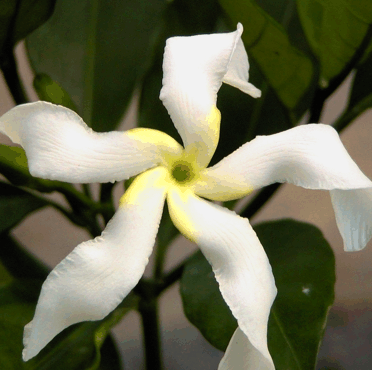
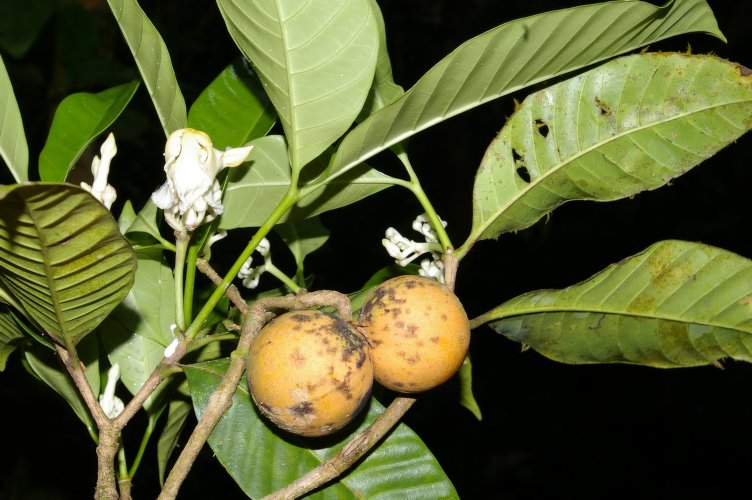
Synonyms (Tropicos.org) : Bonafousia sananho (Ruiz & Pav.) Markgr ; Merizadenia sananho (Ruiz & Pav.) Miers ; Taberna poeppigii (Müll. Arg.) Miers ; Tabernaemontana poeppigii Müll. Arg.
Herbarium Botanical Voucher: Link
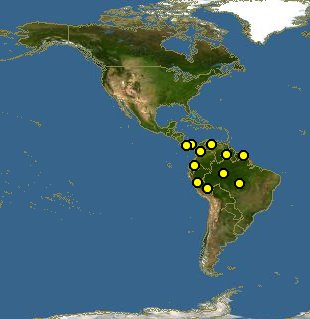
Distribution (discoverlife.org):
Ethnomedicinal use
Apparently added to ayahuasca (bark? root? Citation needed)
It is used as eyedrops by the Kaxinawa, using the juice (acqueous extraction? Squeezed 'resin'?) of the root and trunk scrapes, for the purpose of improving luck and concentration when hunting. Also when being stung by "tocandira" and stingray, topically applied. Also the latex from the bark is used for tooth ache, topically applied with some cloth, until the tooth falls out. (Ika Muru, 2014)
Much as T. rimulosa. The leaves, softened by fire, are applied to relieve rheumatic pains. In Pastaza, taken one week after delivery. "Pulp is used as a gargle for sore throat and colds". "Tikuna" mix the latex with water for eye wounds . "Jivaro" apply the bark juice to toothache. Considered sudorific, tonic, used for colds, obesity, rheumatism, syphilis. (Amazonian Ethnobotanical Dictionary)
Colombia: A mixture of latex and water can be used to cure eye wounds [375]. (Van Beek et al 1984)
Peru: In the upper part of the Amazon the plant has long been considereda panacea, the name sanango signifies a more or less all-purpose medicinal plant. In the Leticia area it is employed as a febrifuge, emetic, diuretic, calmative and for various minor ailments. A tepid decoction of the leaves and bark is used to wash wounds and afterwards powdered bark is put
over the wound; this is repeated three times a day for 10 days. A water extract of the root is drunk three times a day during 15 days against rheumatism and for wounds [ 375]. (Van Beek et al 1984)
Peru, Brazil: An infusion of the roots is used against rheumatic pains
[376]. (Van Beek et al 1984)
Alkaloid content: 1% alkaloids (sample from Satipo) - 7.5% alkaloids (sample from Tarapoto) of which Coronaridine 30-38% , Heyneanine 18-20% , 10% 19-Hydroxycoronaridine, 0-2% Ibogamine and 2-3% Voacangine (G. delle Monache et al 1977)
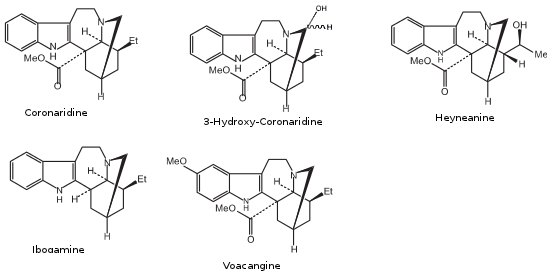
Alkaloid info and pharmacology (Van Beek et al 1984)
Coronoaridine
CAS: 467-77-6
338.44 g/mol
The alkaloid has been tested in the mouse, cat, dog, monkey and rat by a variety of pharmacological procedures. It showed autonomic and CNS activity. In mice it produced analgesia and was effective in suppressing rage caused by foot-shock. Toxicity in the anesthetised cat appeared to be associated with respiratory depression. Coronaridine was inactive in the 9 KB system in cell culture [ 150]. In a general pharmacological screening, the compound exhibited little activity [164]. A single 30 mg/kg p.o. dose of coronaridine prevented pregnancy in rats when given on day 1, 2, 3 or 4 after coitus. When given on day 5, 6, 7 or 8 of pregnancy, the results were only partially successful. The substance showed estrogenic activity, and it was this activity which appeared to be responsible for the antifertility action. However, the alkaloid was devoid of anti-estrogenic, androgenic, anti-androgenic, progestational, anti-progestational and uterine-stimulant
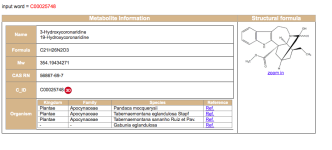
3-hydroxy-Coronaridine
CAS: 56867-69-7
354.19 g/mol
The substance had strong antibiotic activity [ 382]
Ibogamine
CAS: 481-87-8
280.41 g/mol
Central-stimulating properties were observed in a general pharmacological screening, and in mice, when administered S.C. together with Rididyl i.p., the alkaloid produced jactatio capitis [164]. On iv. injection into anesthetised guinea pigs, the effects observed were the same as with ibogaine (q.v.) [221]. Ibogamine was not active in the P-388 or KB test systems in cell culture [ 353]
Voacangine
CAS: 510-22-5
368.21 g/mol
In a general pharmacological screening, voacangine exhibited a slight central stimulating effect. The LDSo i.v. in the mouse was 54 mg/kg [ 164]. When injected i.v. into anesthetised guinea pigs it produced the same effects as did ibogaine (q.v.) [221]. Voacangine had no effect on the heart [ 178]. The alkaloid was not active in the P-388 and KB test systems in cell culture [353].
Analysis Data
GC-MS data (still lacking info on 3-Hydroxy-Coronaridine) : Mass Spectrometry Data table (Zocoler et al 2005)
TLC system: toluene-ethanol-ammonia (95:5:5, v/v/v ).
Reagents used for TLC visualization: Dragendorff's reagent, iodoplatinate, ferric chloride-perchloric acid (FCPA), and ceric sulphate-sulfuric acid (CSSA) (Zocoler et al 2005)
Plant vendors:
USA: Plant Cutting
Europe: Wood (bark?)
DMT Nexus related threads: Tabernaemontana sananho ; Ayahuasca Admixtures Workspace
Tabernaemontana undulata Vahl
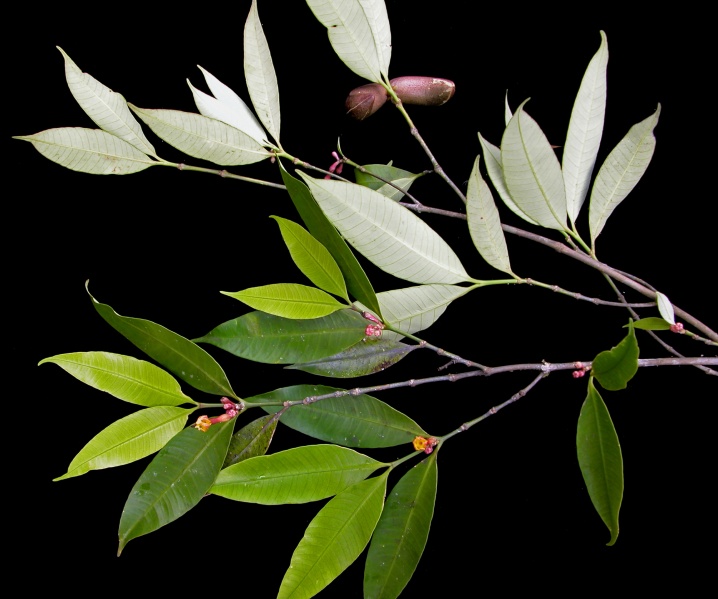
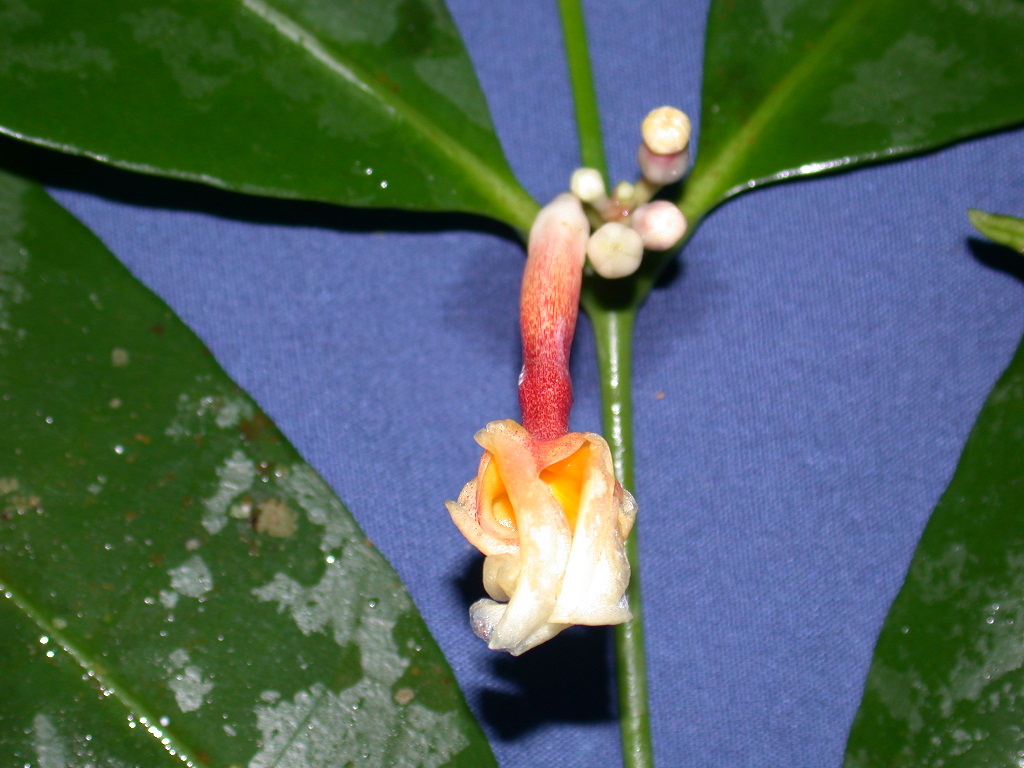
Synonyms (tropicos.org): Anacampta albescens (Rusby) Mrkgr; Anartia meyeri (G. Don) Miers; Bonafousia obliqua Miers; Bonafousia perrottetii (A. DC.) Miers; Bonafousia undulata (Vahl) A. DC. ; Bonafousia undulata var. ovalifolia Miers; Echites brasiliensis Thunb. ; Peschiera surinamensis Miq. ; Stemmadenia nervosa Standl. & L.O. Williams; Tabernaemontana albescens Rusby ; Tabernaemontana meyeri G. Don ; Tabernaemontana meyeri G. Don ; Tabernaemontana perrottetii A. DC.(tropicos.org)
Herbarium Botanical Voucher: Smithsonian Tropical Research Institute ; FMNH
Distribution: Brasil, Colombia, Costa Rica, Ecuador, Guyana, Guyana Francesa, Panamá, Perú, Surinam, Trinidad y Tobago, Venezuela (STRI)
Ethnomedicinal use
Called Becchete (pronounced B'-chew-teh by the Mati and Matses tribe, applied to the eye to improve eyesight also for better hunting. (Lambert et al 2010)

Alkaloid content: Quebrachidine, Voaphylline, Coronaridine, (-)-19-epi-Heyneanine, Voacangine, Unknown base (M+ 382) (Van Beek et al, 1984)
Eglandine, voacangine, Isovoacangine, Conopharyngine, Jollyanine, (-)-19-epi-Heyneanine, Heyneanine / 20-hydroxycoronaridine, Coronaridine, Ibophyllidine, hydroxy-7-indolenine, 11-hydroxy-coronaridine, 10-hydroxy-heyneanine, 11-hydroxy-heyneanine, dimer alkaloid mass 706 (Ladhar et al 1981)
coronaridine, voacangine, 19R-heyneanine, 19R-voacristine, 18-hydroxy-coronaridine, 18-hydroxy-voacangine Van Beek et al 1985
DMT-Nexus related thread Becchete visionary eyedrops
Vendors:
Seeds - potential vendor 1 (not checked yet)
References
Cardoso et al 1997. Gas chromatographic analysis of indole alkaloids from
Tabernaemontana hilariana. Journal of Chromatography A, 788 (1997) 204-206
Ika Muru, Agostinho Manduca Mateus (2014). Una Isi Kayawa: Livro da cura do povo Huni Kuin do Rio Jordao. Dantes Ed., Rio de Janeiro, 2014
Lambert M Surhone, Mariam T Tennoe, Susan F Henssonow 2010 Tabernaemontana undulata (Link). Verlag Dr. Mueller AG & Co.
Van Beek et al, 1984. Tabernaemontana L. (Apocynaceae): A review of its taxonomy, phytochemistry, ethnobotany and pharmacology. Download link
Zocoler et al 2005. Qualitative determination of indole alkaloids of Tabernaemontana fuchsiaefolia (Apocynaceae). J. Braz. Chem. Soc. vol.16 no.6b São Paulo Nov./Dec. 2005. Download link
G. delle Monache, S.M. de Matta, F. delle Monache and G.B. Marini-Bettolo (1977) Sugli alcaloidi di Tabernaemontana sananho R. & P. Atti Accademia Nazionale dei Lincei, Memorie, Classe di Scienze Fisiche, Matematiche et Natumli [viii] 62, 221.
Tabernaemontana sananho Ruiz & Pav.
Synonyms (Tropicos.org) : Bonafousia sananho (Ruiz & Pav.) Markgr ; Merizadenia sananho (Ruiz & Pav.) Miers ; Taberna poeppigii (Müll. Arg.) Miers ; Tabernaemontana poeppigii Müll. Arg.
Herbarium Botanical Voucher: Link
Distribution (discoverlife.org):
Ethnomedicinal use
Apparently added to ayahuasca (bark? root? Citation needed)
It is used as eyedrops by the Kaxinawa, using the juice (acqueous extraction? Squeezed 'resin'?) of the root and trunk scrapes, for the purpose of improving luck and concentration when hunting. Also when being stung by "tocandira" and stingray, topically applied. Also the latex from the bark is used for tooth ache, topically applied with some cloth, until the tooth falls out. (Ika Muru, 2014)
Much as T. rimulosa. The leaves, softened by fire, are applied to relieve rheumatic pains. In Pastaza, taken one week after delivery. "Pulp is used as a gargle for sore throat and colds". "Tikuna" mix the latex with water for eye wounds . "Jivaro" apply the bark juice to toothache. Considered sudorific, tonic, used for colds, obesity, rheumatism, syphilis. (Amazonian Ethnobotanical Dictionary)
Colombia: A mixture of latex and water can be used to cure eye wounds [375]. (Van Beek et al 1984)
Peru: In the upper part of the Amazon the plant has long been considereda panacea, the name sanango signifies a more or less all-purpose medicinal plant. In the Leticia area it is employed as a febrifuge, emetic, diuretic, calmative and for various minor ailments. A tepid decoction of the leaves and bark is used to wash wounds and afterwards powdered bark is put
over the wound; this is repeated three times a day for 10 days. A water extract of the root is drunk three times a day during 15 days against rheumatism and for wounds [ 375]. (Van Beek et al 1984)
Peru, Brazil: An infusion of the roots is used against rheumatic pains
[376]. (Van Beek et al 1984)
Alkaloid content: 1% alkaloids (sample from Satipo) - 7.5% alkaloids (sample from Tarapoto) of which Coronaridine 30-38% , Heyneanine 18-20% , 10% 19-Hydroxycoronaridine, 0-2% Ibogamine and 2-3% Voacangine (G. delle Monache et al 1977)
Alkaloid info and pharmacology (Van Beek et al 1984)
Coronoaridine
CAS: 467-77-6
338.44 g/mol
The alkaloid has been tested in the mouse, cat, dog, monkey and rat by a variety of pharmacological procedures. It showed autonomic and CNS activity. In mice it produced analgesia and was effective in suppressing rage caused by foot-shock. Toxicity in the anesthetised cat appeared to be associated with respiratory depression. Coronaridine was inactive in the 9 KB system in cell culture [ 150]. In a general pharmacological screening, the compound exhibited little activity [164]. A single 30 mg/kg p.o. dose of coronaridine prevented pregnancy in rats when given on day 1, 2, 3 or 4 after coitus. When given on day 5, 6, 7 or 8 of pregnancy, the results were only partially successful. The substance showed estrogenic activity, and it was this activity which appeared to be responsible for the antifertility action. However, the alkaloid was devoid of anti-estrogenic, androgenic, anti-androgenic, progestational, anti-progestational and uterine-stimulant
3-hydroxy-Coronaridine
CAS: 56867-69-7
354.19 g/mol
The substance had strong antibiotic activity [ 382]
Ibogamine
CAS: 481-87-8
280.41 g/mol
Central-stimulating properties were observed in a general pharmacological screening, and in mice, when administered S.C. together with Rididyl i.p., the alkaloid produced jactatio capitis [164]. On iv. injection into anesthetised guinea pigs, the effects observed were the same as with ibogaine (q.v.) [221]. Ibogamine was not active in the P-388 or KB test systems in cell culture [ 353]
Voacangine
CAS: 510-22-5
368.21 g/mol
In a general pharmacological screening, voacangine exhibited a slight central stimulating effect. The LDSo i.v. in the mouse was 54 mg/kg [ 164]. When injected i.v. into anesthetised guinea pigs it produced the same effects as did ibogaine (q.v.) [221]. Voacangine had no effect on the heart [ 178]. The alkaloid was not active in the P-388 and KB test systems in cell culture [353].
Analysis Data
GC-MS data (still lacking info on 3-Hydroxy-Coronaridine) : Mass Spectrometry Data table (Zocoler et al 2005)
TLC system: toluene-ethanol-ammonia (95:5:5, v/v/v ).
Reagents used for TLC visualization: Dragendorff's reagent, iodoplatinate, ferric chloride-perchloric acid (FCPA), and ceric sulphate-sulfuric acid (CSSA) (Zocoler et al 2005)
Plant vendors:
USA: Plant Cutting
Europe: Wood (bark?)
DMT Nexus related threads: Tabernaemontana sananho ; Ayahuasca Admixtures Workspace
Tabernaemontana undulata Vahl
Synonyms (tropicos.org): Anacampta albescens (Rusby) Mrkgr; Anartia meyeri (G. Don) Miers; Bonafousia obliqua Miers; Bonafousia perrottetii (A. DC.) Miers; Bonafousia undulata (Vahl) A. DC. ; Bonafousia undulata var. ovalifolia Miers; Echites brasiliensis Thunb. ; Peschiera surinamensis Miq. ; Stemmadenia nervosa Standl. & L.O. Williams; Tabernaemontana albescens Rusby ; Tabernaemontana meyeri G. Don ; Tabernaemontana meyeri G. Don ; Tabernaemontana perrottetii A. DC.(tropicos.org)
Herbarium Botanical Voucher: Smithsonian Tropical Research Institute ; FMNH
Distribution: Brasil, Colombia, Costa Rica, Ecuador, Guyana, Guyana Francesa, Panamá, Perú, Surinam, Trinidad y Tobago, Venezuela (STRI)
Ethnomedicinal use
Called Becchete (pronounced B'-chew-teh by the Mati and Matses tribe, applied to the eye to improve eyesight also for better hunting. (Lambert et al 2010)
Alkaloid content: Quebrachidine, Voaphylline, Coronaridine, (-)-19-epi-Heyneanine, Voacangine, Unknown base (M+ 382) (Van Beek et al, 1984)
Eglandine, voacangine, Isovoacangine, Conopharyngine, Jollyanine, (-)-19-epi-Heyneanine, Heyneanine / 20-hydroxycoronaridine, Coronaridine, Ibophyllidine, hydroxy-7-indolenine, 11-hydroxy-coronaridine, 10-hydroxy-heyneanine, 11-hydroxy-heyneanine, dimer alkaloid mass 706 (Ladhar et al 1981)
coronaridine, voacangine, 19R-heyneanine, 19R-voacristine, 18-hydroxy-coronaridine, 18-hydroxy-voacangine Van Beek et al 1985
DMT-Nexus related thread Becchete visionary eyedrops
Vendors:
Seeds - potential vendor 1 (not checked yet)
References
Cardoso et al 1997. Gas chromatographic analysis of indole alkaloids from
Tabernaemontana hilariana. Journal of Chromatography A, 788 (1997) 204-206
Ika Muru, Agostinho Manduca Mateus (2014). Una Isi Kayawa: Livro da cura do povo Huni Kuin do Rio Jordao. Dantes Ed., Rio de Janeiro, 2014
Lambert M Surhone, Mariam T Tennoe, Susan F Henssonow 2010 Tabernaemontana undulata (Link). Verlag Dr. Mueller AG & Co.
Van Beek et al, 1984. Tabernaemontana L. (Apocynaceae): A review of its taxonomy, phytochemistry, ethnobotany and pharmacology. Download link
Zocoler et al 2005. Qualitative determination of indole alkaloids of Tabernaemontana fuchsiaefolia (Apocynaceae). J. Braz. Chem. Soc. vol.16 no.6b São Paulo Nov./Dec. 2005. Download link
G. delle Monache, S.M. de Matta, F. delle Monache and G.B. Marini-Bettolo (1977) Sugli alcaloidi di Tabernaemontana sananho R. & P. Atti Accademia Nazionale dei Lincei, Memorie, Classe di Scienze Fisiche, Matematiche et Natumli [viii] 62, 221.


 thank you for this report..