


Hi All, I thought I would share this guide on how to construct a diffuser tub fruiting chamber for anyone interested in cultivating non-Cubensis exotics. It provides an elegantly simple setup that ensures the high levels of humidity and fresh air exchange that some of these species need to thrive during fruiting.
Mushroom fruiting chambers take on a number of different forms, but their purpose remains the same - to provide an isolated and controlled environment that provides optimal conditions for mushroom growth.
These conditions will vary with species, with each having its own particular temperature, humidity and fresh air requirements. The type of fruiting chamber you select will be dictated by the fungal species you are fruiting.
Some species such as Psilocybe cubensis aren’t particularly fussy, and while they appreciate a humid environment, their fresh air exchange requirements are lower than other species.
Other species - some of which may be held in higher regard than P. cubensis by psilonauts - including Panaeolus cyanescens, Psilocybe tampanensis, P. ochraceocentrata (formerly referred to as P. natalensis) and P. ingeli have higher fresh air exchange requirements during fruiting alongside high humidity levels.
This also applies to some of the Psilocybe species held in high shamanic regard in Mexico which are attracting increasing cultivator interest such as P. caerulescens, P. mexicana, P. subtropicalis and P. zapotecorum.
The fresh air and humidity requirements of these species can be ensured by using a diffuser tub fruiting chamber setup. Diffuser tubs have been successfully used to fruit all of these species, and more.
Credit must go to cultivators Yoshi Amano, Julian Mattucci and Gumbo Slinger for experimenting with and refining the diffuser tub fruiting chamber design.
The Diffuser Tub: A Tweak on the Monotub
A variation on the monotub design for fruiting, diffuser tubs make use of the same large clear plastic tubs, but use a different setup configuration to enhance humidity and fresh air exchange.
To get started, you'll need the following:
1. An aquarium pump (small pumps work just fine)
2. Aquarium pump tubing (the length depends on your setup, but a few feet should be more than enough)
3. Air stones (you can find these cheaply on Amazon or at your local pet store)
4. A clear plastic tub (aim for something in the range of 60–75 liters)
5. A drill & hole saw (I use 2" with filter discs, but aim for more, smaller holes if you don't have those)
6. Synthetic filter discs (totally optional, but you can buy those here)
7. 2x jars (not needed for the bubble tub setup. Opt for pint jars (16 oz/ 500mL)
8. Perlite (not needed for the bubble tub setup)
From here, you’ve got two main ways to actually build your diffuser tub:
Version 1: The Bubble Tub
This version is the most straightforward diffuser tub design — using nothing but water and bubbles to maintain high humidity and airflow.
Add about an inch of water to the bottom of the tub and run two aquarium hoses into it, each fitted with a long air stone. Submerge the stones so they bubble constantly.
Place your fruiting trays on a rack above the waterline.
The bubbling water keeps humidity high and moves in fresh air during fruiting. Just be sure to change the water at least once a week — this keeps things fresh, and over time, your water will absorb CO₂ from the culture and turn slightly acidic.
For a demonstration of this setup, click here.
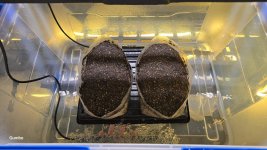
Bubble tub diffuser tub setup with water, air hoses, and long air stones. Gumbo Slinger.
Version 2: The JCM Bubbler
This version replaces the plain water base with a layer of wet perlite, which retains moisture longer and combines with jars of bubbling water to maintain stable conditions.
Add two or more inches of wet perlite to the bottom of the tub. Place two jars of water on top, each fitted with a lid drilled for an air hose and a few small “salt shaker” holes to reduce splashing. Run an aquarium pump hose into each jar with an air stone submerged.
The perlite provides steady passive humidity on its own, while the bubbling jars add a boost of fresh air and moisture to your tub. In some cases, the passive evaporation is enough. In others, the active bubbling makes all the difference.
Another popular variation, known as the “Shadowbox” skips the jars entirely and runs the hoses and air stones straight into the perlite layer.
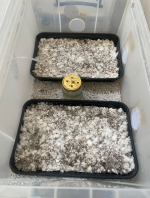
Example of a simple JCM bubbler diffuser tub setup.
Tips and hacks during fruiting
Here’s how to set yourself up for success when growing with a diffuser tub:
1. Keep everything sealed shut until pinning starts — Leave the lid on until pins appear after casing. Fruiting fungi doesn't mind the higher CO₂ and humidity at this stage. Keeping the lid on and pump off in the early days helps prevent contamination while boosting CO₂ levels.
2. Turn on the air pump when pins start to form — As soon as you see pins, switch on the aquarium pump. Crack or flip the lid slightly for more airflow if needed (skip this step if you added filter-disc holes in the sides of the diffuser tub).
3. Light — Mushrooms don't need much light, but they do need some. Natural ambient indoor daylight should suffice, but some cultivators opt for LED light setups.
4. Temperature — The ideal conditions vary slightly from one species to another, with a number of them happy at typical room temperature, but the typical range is between 20–26 ºC / 68–79 ºF. Add a submersible aquarium heater or seedling heat mat for warm-loving species (Panaeolus cyanescens) or a chiller for cold-weather species.
5. Add supplementary air holes — Several holes can also be drilled into the sides of the diffuser tub (with a 50mm or 2-inch hole saw cutter drill bit) over which adhesive synthetic filter discs can be placed to facilitate more passive air exchange.
6. Use a fogger if humidity dips (optional) — Some species, like P. zapotecorum, thrive with even more humidity (although they can be fruited without a fogger). Use a reptile fogger on a timer or humidity sensor so it only runs when needed.
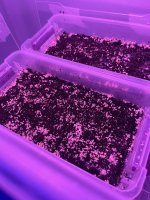
Trays of P. ingeli just starting to pin — a good time to switch on the air pump.
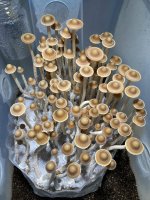
P. subtropicalis mushrooms in a diffuser tub fruiting chamber setup. Tim Pigg.
Cleanliness is Next to Godliness
Both versions of the diffuser tub setup should be cleaned with hot soapy water or a 10% bleach solution between fruiting cycles (allow the bleach spray to sit for 10 minutes inside the tub before wiping down).
Some recommend following up with a 70% isopropyl alcohol (wiping in one direction), but be careful not to mix the bleach and alcohol.
For Version 2 of the diffuser tub which makes use of perlite, between fruiting cycles, perlite can be rinsed thoroughly and then run through a pressure cooker cycle to sterilise it before it is reused. Other cultivators recommend soaking it in a bleach solution (using one cap full per gallon should suffice) or 3% hydrogen peroxide.
Some cultivators recommend discarding it after a few uses, but for any gardeners it can be used in potting soil mixes, or disposed of in compost.
Happy growing to anybody who feels the call to expand their indoor magical fungal cultivation endeavours beyond P. cubensis to encompass the various exotics (which I feel is a worthwhile and rewarding pursuit).
Mushroom fruiting chambers take on a number of different forms, but their purpose remains the same - to provide an isolated and controlled environment that provides optimal conditions for mushroom growth.
These conditions will vary with species, with each having its own particular temperature, humidity and fresh air requirements. The type of fruiting chamber you select will be dictated by the fungal species you are fruiting.
Some species such as Psilocybe cubensis aren’t particularly fussy, and while they appreciate a humid environment, their fresh air exchange requirements are lower than other species.
Other species - some of which may be held in higher regard than P. cubensis by psilonauts - including Panaeolus cyanescens, Psilocybe tampanensis, P. ochraceocentrata (formerly referred to as P. natalensis) and P. ingeli have higher fresh air exchange requirements during fruiting alongside high humidity levels.
This also applies to some of the Psilocybe species held in high shamanic regard in Mexico which are attracting increasing cultivator interest such as P. caerulescens, P. mexicana, P. subtropicalis and P. zapotecorum.
The fresh air and humidity requirements of these species can be ensured by using a diffuser tub fruiting chamber setup. Diffuser tubs have been successfully used to fruit all of these species, and more.
Credit must go to cultivators Yoshi Amano, Julian Mattucci and Gumbo Slinger for experimenting with and refining the diffuser tub fruiting chamber design.
The Diffuser Tub: A Tweak on the Monotub
A variation on the monotub design for fruiting, diffuser tubs make use of the same large clear plastic tubs, but use a different setup configuration to enhance humidity and fresh air exchange.
To get started, you'll need the following:
1. An aquarium pump (small pumps work just fine)
2. Aquarium pump tubing (the length depends on your setup, but a few feet should be more than enough)
3. Air stones (you can find these cheaply on Amazon or at your local pet store)
4. A clear plastic tub (aim for something in the range of 60–75 liters)
5. A drill & hole saw (I use 2" with filter discs, but aim for more, smaller holes if you don't have those)
6. Synthetic filter discs (totally optional, but you can buy those here)
7. 2x jars (not needed for the bubble tub setup. Opt for pint jars (16 oz/ 500mL)
8. Perlite (not needed for the bubble tub setup)
From here, you’ve got two main ways to actually build your diffuser tub:
Version 1: The Bubble Tub
This version is the most straightforward diffuser tub design — using nothing but water and bubbles to maintain high humidity and airflow.
Add about an inch of water to the bottom of the tub and run two aquarium hoses into it, each fitted with a long air stone. Submerge the stones so they bubble constantly.
Place your fruiting trays on a rack above the waterline.
The bubbling water keeps humidity high and moves in fresh air during fruiting. Just be sure to change the water at least once a week — this keeps things fresh, and over time, your water will absorb CO₂ from the culture and turn slightly acidic.
For a demonstration of this setup, click here.
Bubble tub diffuser tub setup with water, air hoses, and long air stones. Gumbo Slinger.
Version 2: The JCM Bubbler
This version replaces the plain water base with a layer of wet perlite, which retains moisture longer and combines with jars of bubbling water to maintain stable conditions.
Add two or more inches of wet perlite to the bottom of the tub. Place two jars of water on top, each fitted with a lid drilled for an air hose and a few small “salt shaker” holes to reduce splashing. Run an aquarium pump hose into each jar with an air stone submerged.
The perlite provides steady passive humidity on its own, while the bubbling jars add a boost of fresh air and moisture to your tub. In some cases, the passive evaporation is enough. In others, the active bubbling makes all the difference.
Another popular variation, known as the “Shadowbox” skips the jars entirely and runs the hoses and air stones straight into the perlite layer.
Example of a simple JCM bubbler diffuser tub setup.
Here’s how to set yourself up for success when growing with a diffuser tub:
1. Keep everything sealed shut until pinning starts — Leave the lid on until pins appear after casing. Fruiting fungi doesn't mind the higher CO₂ and humidity at this stage. Keeping the lid on and pump off in the early days helps prevent contamination while boosting CO₂ levels.
2. Turn on the air pump when pins start to form — As soon as you see pins, switch on the aquarium pump. Crack or flip the lid slightly for more airflow if needed (skip this step if you added filter-disc holes in the sides of the diffuser tub).
3. Light — Mushrooms don't need much light, but they do need some. Natural ambient indoor daylight should suffice, but some cultivators opt for LED light setups.
4. Temperature — The ideal conditions vary slightly from one species to another, with a number of them happy at typical room temperature, but the typical range is between 20–26 ºC / 68–79 ºF. Add a submersible aquarium heater or seedling heat mat for warm-loving species (Panaeolus cyanescens) or a chiller for cold-weather species.
5. Add supplementary air holes — Several holes can also be drilled into the sides of the diffuser tub (with a 50mm or 2-inch hole saw cutter drill bit) over which adhesive synthetic filter discs can be placed to facilitate more passive air exchange.
6. Use a fogger if humidity dips (optional) — Some species, like P. zapotecorum, thrive with even more humidity (although they can be fruited without a fogger). Use a reptile fogger on a timer or humidity sensor so it only runs when needed.
Trays of P. ingeli just starting to pin — a good time to switch on the air pump.
P. subtropicalis mushrooms in a diffuser tub fruiting chamber setup. Tim Pigg.
Both versions of the diffuser tub setup should be cleaned with hot soapy water or a 10% bleach solution between fruiting cycles (allow the bleach spray to sit for 10 minutes inside the tub before wiping down).
Some recommend following up with a 70% isopropyl alcohol (wiping in one direction), but be careful not to mix the bleach and alcohol.
For Version 2 of the diffuser tub which makes use of perlite, between fruiting cycles, perlite can be rinsed thoroughly and then run through a pressure cooker cycle to sterilise it before it is reused. Other cultivators recommend soaking it in a bleach solution (using one cap full per gallon should suffice) or 3% hydrogen peroxide.
Some cultivators recommend discarding it after a few uses, but for any gardeners it can be used in potting soil mixes, or disposed of in compost.
Happy growing to anybody who feels the call to expand their indoor magical fungal cultivation endeavours beyond P. cubensis to encompass the various exotics (which I feel is a worthwhile and rewarding pursuit).
Last edited:


