• Members of the previous forum can retrieve their temporary password here, (login and check your PM).

THH > DHH... does it convert back?

Migrated topic.

padawan

forever learning
Last night I based out a zinc reduction of harmaline and everything seemed to be working as it should (ie. the acetate solution had shifted from a green to blue flourescence, off-white freebase alks precipitated in about the right quantities for the starting material). But this morning, after drying the freebase THH overnight and then in the oven at 60 degC this morning, I re-dissolved it in an acetic solution (about PH 4) and under UV it was back to green flourescence again :?:

How stable is THH in freebase form? Should I just filter and manske it once the reduction is complete and leave it in salt form? Any thoughts most welcome
 
THH fluorescence work in certain concentration window so it might be the case there is some leftover harmine/harmaline that could overpower it.

If I find a little spare time I will try to oxidise my THH sample in pH 4.0 acetic acid solution to confirm.

Apart from TLC, you can also crystallize the freebase from alcohol (I think both methanol and ethanol work, not sure about IPA). If you have a microscope or a strong magnifier glass, you could be able to distinguish harmine, harmaline and THH by the crystal structure (see VDS paper for the images of crystals).
 
blue.magic said:
...If you have a microscope or a strong magnifier glass, you could be able to distinguish harmine, harmaline and THH by the crystal structure (see VDS paper for the images of crystals).
Lets do that :thumb_up:


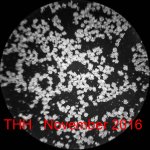
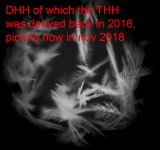
My THH is now 2 years old, always stored as freebase, and about time to see if there was any spontaneous rollback to DHH. All was stored in non air tight containers at room temperature, in a fairly dry closet. The colour did get from beige toward more beige-orange tint, just like we are used to.

Taste test:
* the DHH is still bitter after 2 years;
* the THH is still tasteless after 2 years.

In attachments: crystal structures freebased in situ, material dissolved in a drop of vinegar and based with a drop of ammonia 12%. In situ is better than dry for ID-ing.

Last 2 pics on same magnification scale.

I would think no rollback to DHH :thumb_up:
 

Attachments

  • thh1.jpg
    thh1.jpg
    273.8 KB · Views: 0
  • thh2.jpg
    thh2.jpg
    186.5 KB · Views: 0
  • dhh.jpg
    dhh.jpg
    203.6 KB · Views: 0
I should also add, the THH fluorescence is very weak compared to that of harmine and DHH, it can only be seen with short wave UV while DHH and harmine can easily be seen with long wave UV.

So its very easy for DHH to overpower it like blue.magic mentioned.

TLC is the easiest solution since you can see both flouresence and rF, would be obvious if there was any change.

You can even do 2D TLC to see if the THH gets oxidized while on the TLC plate, by taking the developed TLC plate, flipping it on its side, then developing it again. This is a common technique to see if the compound is sensitive to oxidation or is acid labile.
 
Thanks everyone. I hadn't thought of a taste test - I still have a sample of the original DHH starting material, so I'll do a comparison today. TLC is beyond my means, but you've 99% convinced me to invest in a microscope 😁

Jees - thanks for those slide pics. Perfect test case and quite reassuring to see the THH crystalline structures intact after 2 years :thumb_up:
 
Mindlusion said:
You can even do 2D TLC to see if the THH gets oxidized while on the TLC plate, by taking the developed TLC plate, flipping it on its side, then developing it again. This is a common technique to see if the compound is sensitive to oxidation or is acid labile.

Do you mean to make the compounds travel sideways instead of further up?

My TLC plates are 40 x 80 mm (Silica 60 on aluminium, UV-coated) so I hope there is enough width to enable the sample to separate.

As for the mobile phase, I found toluene-EtOAc (9:1) should work.

But at first I would just try to oxidise THH in solution. I am thinking about about several samples: control, dilute AcOH (pH 4.0), conc. AcOH, hydrogen peroxide, potassium permanganage (overkill?) and maybe also dilute AcOH + H2O2. The results will be checked qualitatively by observing change in fluorescence.

I have a sample of freebase THH for over a year and haven't observed any signs of change. It is stored in small airthight glass bottle with a bag of desiccant.
 
Back
Top Bottom