Stochastic
Esteemed member
Very interested in any information that anyone might have on this.
I've found a few mentions of THH being found in Calliandra angustifolia and C. "pentandra" (which may no longer be a recognized species), but there are no mentions of this anywhere in the published English language scientific literature.
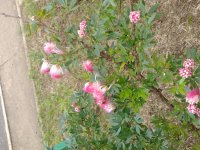
My personal contribution: I have worked with Calliandra haematocephala, one of the closest relatives of Calliandra angustifolia within the genus. In the past I have also used a THH/Harmine combination I semi-synthesized from a crude extract of P. harmala. To me, the effects of C. haematocephala are consistent with it containing THH. Many studies around the world have found it testing positive for alkaloids, but none have sought the identity of these alkaloids.
C. haematocephala is a beautiful plant commonly grown as an ornamental, and in many places represents a completely unutilized potential source of powerful medicine. I may attempt an alkaloid extraction / bioassay soon.
This quote is from Shulgin, TIHKAL #54:
The following is from chemist Jace Calloway, in the 1995 Entheogenic Review:
& here is a phylogeny of the genus Calliandra.
I've found a few mentions of THH being found in Calliandra angustifolia and C. "pentandra" (which may no longer be a recognized species), but there are no mentions of this anywhere in the published English language scientific literature.
My personal contribution: I have worked with Calliandra haematocephala, one of the closest relatives of Calliandra angustifolia within the genus. In the past I have also used a THH/Harmine combination I semi-synthesized from a crude extract of P. harmala. To me, the effects of C. haematocephala are consistent with it containing THH. Many studies around the world have found it testing positive for alkaloids, but none have sought the identity of these alkaloids.
C. haematocephala is a beautiful plant commonly grown as an ornamental, and in many places represents a completely unutilized potential source of powerful medicine. I may attempt an alkaloid extraction / bioassay soon.
This quote is from Shulgin, TIHKAL #54:
"There are a number of other plants that are known to contain tetrahydroharmine and to have been used in various native preparations. I have recently learned of analysis of an Ayahuasca brew that had used the plant Calliandra pentandra as a component, instead of the usual Psychotria viridis. Ott’s magnificent compendium Pharmacotheon makes mention of a Calliandra augustifolia as a component of ayahuasca, but there is no mention of this pentandra species. The preliminary analysis that I have been given of this decoction is that a component that had initially appeared to be DMT by HPLC analysis had proven to be tetrahydroharmine when assayed by GCMS. There was no detectable DMT present. And yet the material appears to have psychopharmacological activity."
The following is from chemist Jace Calloway, in the 1995 Entheogenic Review:
"However, in a broad (as yet unpublished) survey of Banisteriopsis caapi, Psychotria viridis and subsequent teas, which included phytochemical analyses of all, plus subjective ratings of the teas, a strong correlation was found with teas that contained high amounts of THH and not DMT! This rating was from a large body of experienced users (regular União do Vegetal members who had consumed ayahuasca for 10+ years). In short, yes, there seems to be important activity from THH, but likely not the sort of activity that currently seems valuable to the
lay user in the U.S. or E.U.; e.g., more temporal, than whirly/swirly, if you know what I mean."
...
"Calliandra pentandra has good amounts of THH in the leaves, and it is used as an add mixture by some groups like the Shuar in Equador, and visions have been reported by reliable western folk from this and Banisteriopsis caapi. So, there still may be something there to look at more closely.
...
"I am not aware of any other analyses on this plant species, aside from my own investigations (which are what Sasha refers to in TIHKAL). From my limited perspective, C. pentandra does not contain any DMT, and THH was the major component that showed up in my analysis. These two compounds have quite similar chromatographic characteristics; without mass spectral detection, I would have to doubt any claims that lack such specificity."
& here is a phylogeny of the genus Calliandra.