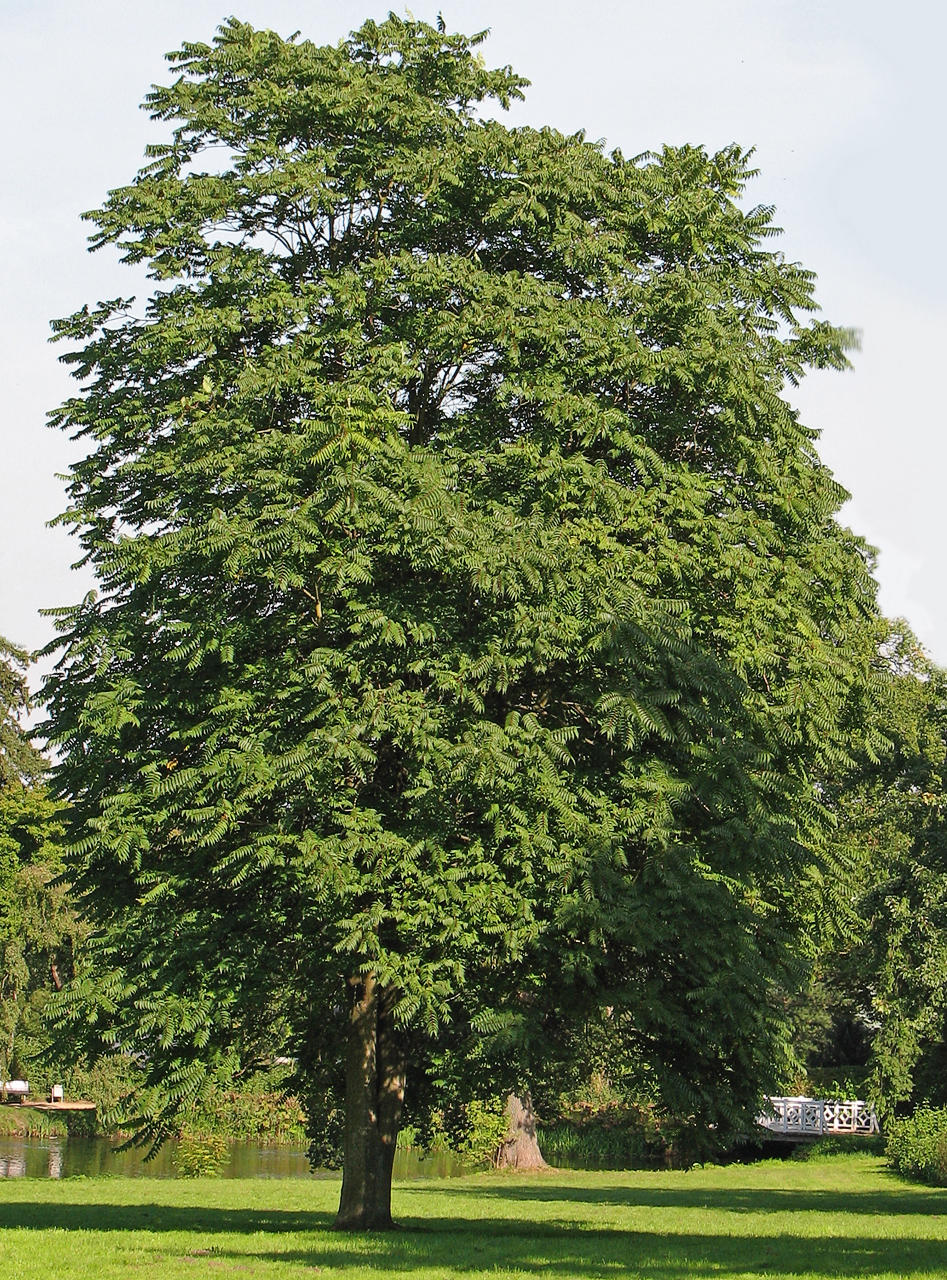
Ailanthus altissima is an interesting tree.
This tree is used in Chinese traditional medicine and is not dangerous unless very high doses are taken. All parts contain alkaloids, but the leafy parts have a lot of volatile material as well. =
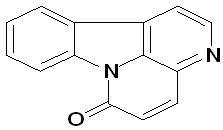
It has some Beta-carboline alkaloids and some related alkaloids called Canthins, like canthin-6-one (image attached below).
Here is some collected information about it:
"
Normally, only the bark of the root and the stemm are most used because they contain high concentration of these active compounds that produce effective theraputical effects including: [14]
1. Astringent, bitter, cardiac depressant, diuretic, emetic, febrifuge, rubefacient
2. Malaria and fevers
3. Slows the heart rate and relaxes spasms
4. Cardiac palpitations, asthma and epilepsy
5. Cancer, diarrhoea, dysentery, dysmenorrhoea, dysuria, ejaculation epilepsy, eruption, fever, gonorrhoea, haematochezia
6. The leaves, bark of the trunk, and roots are put into a wash to treat parasitic ulcers, itch, and eruptions.
7. In Korea, the root bark is used in the treatment of coughs, gastric and intestinal upsets.
8. The fruit is used in the treatment of bloody stools and dysentery."
The infusion may be given in sweetened orange-flower or other aromatic water, to lessen the bitterness and resultant sickness. Though it produces vomiting and great relaxation, it is stated not to be poisonous.
The bark, fruit, leaves, and roots of Ailanthus altissima are incorporated into a multiplicity of remedies in traditional Chinese medicine. For example, chun bai pi (Chinese: 椿白皮, chūnbáipí “white bark of spring”), a remedy that is made from the dried bark of Ailanthus altissima, is prescribed by practitioners of traditional Chinese medicine to treat diarrhea or dysentery. Its pharmaceutical name is Cortex ailanthi in traditional Chinese medicine’s Materia Medica. Associated with energy meridians of the large intestine, stomach, and liver, Cortex ailanthi has such medicinal functions as clearing heat, drying dampness, astringing the intestines, stopping bleeding, and killing worms.\
Extracts of the plant leaves have demonstrated antiproliferative (De Feo
et al. 2005), central nervous depressant (Crespi-Perellino et al. 1988), antifeedant
and insecticide (Kraus et al. 1994) activities.
 www.henriettesherbal.com
Action, Medical Uses, and Dosage.—The bark of ailanthus has been employed by Roberts, Dugat, and others, both in the recent and dried state, as a remedy for dysentery and diarrhoea; also in gonorrhoea, leucorrhoea, prolapsus ani, etc. Fifty grammes of the root-bark are infused for a short time in 75 grammes of hot water, then strained, and when cold, administered in teaspoonful doses, night and morning. To lessen the disagreeable impression following its use, as well as to mask its bitterness, it may be administered in sweetened orange-flower water, or in some other aromatic. Professor Hetet, of the Toulon Naval School, states in Jour. de Chim. Med., December, 1859, that the leaves and bark, in powder, or in the form of an aqueous or of an alcoholic extract, will remove tapeworm; but he found its action upon patients to be very disagreeable and nauseating, somewhat like that occasioned by tobacco upon young smokers. Dupuis has also found it useful as a taenifuge. In the September number of the Eclectic Medical Journal, for 1875, p. 393, Dr. H. L. True, of Ohio, states, that from his observations, the bark is not poisonous, but produces vomiting, great relaxation, and a deathlike sickness, which symptoms gradually pass away.
www.henriettesherbal.com
Physiological Action—In overdoses ailanthus causes vertigo, severe headache, pains in the back and limbs, together with great prostration, tingling and numbness; it reduces the pulse-beat and the respiration and causes great weakness, cold sweats and shivering. If it be given too frequently, or in too large doses, it causes death by paralyzing the respiratory center, its influence resembling that of tobacco.
 en.wikipedia.org
Another source from 684 AD, during the Tang dynasty and recorded in Li Shizhen's Compendium of Materia Medica, states that when the leaves are taken internally, they make one incoherent and sleepy, while when used externally they can be effectively used to treat boils, abscesses and itches. Yet another recipe recorded by Li uses the leaves to treat baldness. This formula calls for young leaves of ailanthus, catalpa and peach tree to be crushed together and the resulting liquid applied to the scalp to stimulate hair growth.[3]

 medicineherbs.net
Large doses of the drug are said to lead to queasiness, dizziness, headache, tingling in the limbs and diarrhea.
Tree-of-heaven extracts have potential use as herbicides [32,100].
The species has a long history of folk medicine and cultural use in Asia [74]. It is used as an astringent,
antispasmotic, anthelmintic, and parasitide. In powdered form it is a narcotic, with depressant effects similar
to tobacco (Nicotiana
spp.). Fresh stem bark is used to treat diarrhea and dysentery; root bark is used for heat ailments, epilepsy,
and asthma. The fruits are used as an emmenagogue and to treat ophthalmic diseases. Leaves are an
astringent and used in lotions for seborrhea and scabies [5,74]. Laboratory studies show tree-of-heaven has a
potential role in modern medicine. Pharmacological research is focusing on possible use of tree-of-heaven
extracts for treating cancer, malaria, and HIV-1 infection [5,20,26,119].
. Aim of this paper was to systematically isolate low level compounds from Ailanthus altissima, thus to provide molecular pharmacological base for TCM study.Continous ethanol heat reflux method was used in extraction of Ailanthus altissima, the extract was desolved in H2O to get hydrophilic and hydrophibic phases. The hydrophilic phase was separated by macroporous resin, and 50% methanol elution gradient was collected. The collected gradient was further fractionated by HPLC, 5 compounds were purified. Chemical structures of the 5 compounds were determined by mass spectrometry...
Three compounds, 12.1 mgβ-carboline alkaloid, 10.2mg 1-hydroxy- canthin-6-one and 10.6mg canthin-6-one were obtained from 150 g Ailanthus altissima dry material with purities as 98.2%, 99.6%, 96.8%, respectively.
Canthin-6-one is a fairly widely distributed alkaloid in plants and many of those species have seen use in herbal medicine, including as aphrodisiacs among other things. The nausea and sedation of the alkaloid, (along with some other effects) remind me of the effects of large doses of betacarbolines.
I can't however find much in the way of canthin-6-one and MAO-Inhibition, GABA, serotonin receptors etc. I am also having a hard time finding first hand accounts of the molecule.
The molecule and plant material involved is legal and has a history of medical use. The species of plant, The Tree of Heaven is a rather invasive species with a somewhat offensive odor. I don't know enough about chemistry to know how to selectively target specific alkaloids.
A method that has been used on this plant (Ohmoto et al 1980) is methanol reflux of plant matter, producing a residue that is dissolved in water and extracted with chloroform, which is then treated/salted with HCL water, the water layer is then removed, raised to pH10 and extracted with chloroform, which when evaporated gave a crude alkaloid extract (2 g extract from 3kg of rootbark in this case:
1-Acetyl-4-methoxy-beta-carboline------------------------ (50mg)
1-(2'-Hydroxyethyl)-4-methoxy-beta-carboline---------- (170mg)
1-(1',2'-Dihydroxyethyl)-4-methoxy-beta-carboline----- (215mg)
Canthin-6-one-------------------------------------------------- (330mg)
Canthin-6-one-3N-oxide-------------------------------------- (70mg)
1-Methoxycanthin-6-one-------------------------------------- (170mg)
1-Methoxycanthin-6-one-3N-oxide-------------------------- (220mg)
(total 1.2g, though the paper says that 2g crude extract was obtained, from which the above named alkaloids was obtained and identified)
I was wondering if this was a poor method and could be improved upon but do not know enough. Will canthin-6-one alkaloids precipitate at higher pH the way some betacarboline alkaloids do? I'd really like to isolate the alkaloids of this plant for further research.
This tree is used in Chinese traditional medicine and is not dangerous unless very high doses are taken. All parts contain alkaloids, but the leafy parts have a lot of volatile material as well. =
It has some Beta-carboline alkaloids and some related alkaloids called Canthins, like canthin-6-one (image attached below).
Here is some collected information about it:
"
Normally, only the bark of the root and the stemm are most used because they contain high concentration of these active compounds that produce effective theraputical effects including: [14]
1. Astringent, bitter, cardiac depressant, diuretic, emetic, febrifuge, rubefacient
2. Malaria and fevers
3. Slows the heart rate and relaxes spasms
4. Cardiac palpitations, asthma and epilepsy
5. Cancer, diarrhoea, dysentery, dysmenorrhoea, dysuria, ejaculation epilepsy, eruption, fever, gonorrhoea, haematochezia
6. The leaves, bark of the trunk, and roots are put into a wash to treat parasitic ulcers, itch, and eruptions.
7. In Korea, the root bark is used in the treatment of coughs, gastric and intestinal upsets.
8. The fruit is used in the treatment of bloody stools and dysentery."
A Modern Herbal | Tree of Heaven
Botanical, folk-lore and herbal information - Tree of Heaven.
www.botanical.com
The infusion may be given in sweetened orange-flower or other aromatic water, to lessen the bitterness and resultant sickness. Though it produces vomiting and great relaxation, it is stated not to be poisonous.
The bark, fruit, leaves, and roots of Ailanthus altissima are incorporated into a multiplicity of remedies in traditional Chinese medicine. For example, chun bai pi (Chinese: 椿白皮, chūnbáipí “white bark of spring”), a remedy that is made from the dried bark of Ailanthus altissima, is prescribed by practitioners of traditional Chinese medicine to treat diarrhea or dysentery. Its pharmaceutical name is Cortex ailanthi in traditional Chinese medicine’s Materia Medica. Associated with energy meridians of the large intestine, stomach, and liver, Cortex ailanthi has such medicinal functions as clearing heat, drying dampness, astringing the intestines, stopping bleeding, and killing worms.\
Extracts of the plant leaves have demonstrated antiproliferative (De Feo
et al. 2005), central nervous depressant (Crespi-Perellino et al. 1988), antifeedant
and insecticide (Kraus et al. 1994) activities.
Ailanthus.—Ailanthus. | Henriette's Herbal Homepage
Action, Medical Uses, and Dosage.—The bark of ailanthus has been employed by Roberts, Dugat, and others, both in the recent and dried state, as a remedy for dysentery and diarrhoea; also in gonorrhoea, leucorrhoea, prolapsus ani, etc. Fifty grammes of the root-bark are infused for a short time in 75 grammes of hot water, then strained, and when cold, administered in teaspoonful doses, night and morning. To lessen the disagreeable impression following its use, as well as to mask its bitterness, it may be administered in sweetened orange-flower water, or in some other aromatic. Professor Hetet, of the Toulon Naval School, states in Jour. de Chim. Med., December, 1859, that the leaves and bark, in powder, or in the form of an aqueous or of an alcoholic extract, will remove tapeworm; but he found its action upon patients to be very disagreeable and nauseating, somewhat like that occasioned by tobacco upon young smokers. Dupuis has also found it useful as a taenifuge. In the September number of the Eclectic Medical Journal, for 1875, p. 393, Dr. H. L. True, of Ohio, states, that from his observations, the bark is not poisonous, but produces vomiting, great relaxation, and a deathlike sickness, which symptoms gradually pass away.
Ailanthus. Ailanthus glandulosa. | Henriette's Herbal Homepage
Physiological Action—In overdoses ailanthus causes vertigo, severe headache, pains in the back and limbs, together with great prostration, tingling and numbness; it reduces the pulse-beat and the respiration and causes great weakness, cold sweats and shivering. If it be given too frequently, or in too large doses, it causes death by paralyzing the respiratory center, its influence resembling that of tobacco.
Ailanthus altissima - Wikipedia
Another source from 684 AD, during the Tang dynasty and recorded in Li Shizhen's Compendium of Materia Medica, states that when the leaves are taken internally, they make one incoherent and sleepy, while when used externally they can be effectively used to treat boils, abscesses and itches. Yet another recipe recorded by Li uses the leaves to treat baldness. This formula calls for young leaves of ailanthus, catalpa and peach tree to be crushed together and the resulting liquid applied to the scalp to stimulate hair growth.[3]
Microdosing Mushrooms & Entheogens | Trip Shrooms | USA 🍄
Microdosing to Unlock Transformative Wellness | Trip Shrooms | #1 Trusted Source for Entheogen & Mushrooms | Lab Tested Gummies | Soft gels | Chocolates | Psilo
medicineherbs.net
Large doses of the drug are said to lead to queasiness, dizziness, headache, tingling in the limbs and diarrhea.
Tree-of-heaven extracts have potential use as herbicides [32,100].
The species has a long history of folk medicine and cultural use in Asia [74]. It is used as an astringent,
antispasmotic, anthelmintic, and parasitide. In powdered form it is a narcotic, with depressant effects similar
to tobacco (Nicotiana
spp.). Fresh stem bark is used to treat diarrhea and dysentery; root bark is used for heat ailments, epilepsy,
and asthma. The fruits are used as an emmenagogue and to treat ophthalmic diseases. Leaves are an
astringent and used in lotions for seborrhea and scabies [5,74]. Laboratory studies show tree-of-heaven has a
potential role in modern medicine. Pharmacological research is focusing on possible use of tree-of-heaven
extracts for treating cancer, malaria, and HIV-1 infection [5,20,26,119].
. Aim of this paper was to systematically isolate low level compounds from Ailanthus altissima, thus to provide molecular pharmacological base for TCM study.Continous ethanol heat reflux method was used in extraction of Ailanthus altissima, the extract was desolved in H2O to get hydrophilic and hydrophibic phases. The hydrophilic phase was separated by macroporous resin, and 50% methanol elution gradient was collected. The collected gradient was further fractionated by HPLC, 5 compounds were purified. Chemical structures of the 5 compounds were determined by mass spectrometry...
Three compounds, 12.1 mgβ-carboline alkaloid, 10.2mg 1-hydroxy- canthin-6-one and 10.6mg canthin-6-one were obtained from 150 g Ailanthus altissima dry material with purities as 98.2%, 99.6%, 96.8%, respectively.
Canthin-6-one is a fairly widely distributed alkaloid in plants and many of those species have seen use in herbal medicine, including as aphrodisiacs among other things. The nausea and sedation of the alkaloid, (along with some other effects) remind me of the effects of large doses of betacarbolines.
I can't however find much in the way of canthin-6-one and MAO-Inhibition, GABA, serotonin receptors etc. I am also having a hard time finding first hand accounts of the molecule.
The molecule and plant material involved is legal and has a history of medical use. The species of plant, The Tree of Heaven is a rather invasive species with a somewhat offensive odor. I don't know enough about chemistry to know how to selectively target specific alkaloids.
A method that has been used on this plant (Ohmoto et al 1980) is methanol reflux of plant matter, producing a residue that is dissolved in water and extracted with chloroform, which is then treated/salted with HCL water, the water layer is then removed, raised to pH10 and extracted with chloroform, which when evaporated gave a crude alkaloid extract (2 g extract from 3kg of rootbark in this case:
1-Acetyl-4-methoxy-beta-carboline------------------------ (50mg)
1-(2'-Hydroxyethyl)-4-methoxy-beta-carboline---------- (170mg)
1-(1',2'-Dihydroxyethyl)-4-methoxy-beta-carboline----- (215mg)
Canthin-6-one-------------------------------------------------- (330mg)
Canthin-6-one-3N-oxide-------------------------------------- (70mg)
1-Methoxycanthin-6-one-------------------------------------- (170mg)
1-Methoxycanthin-6-one-3N-oxide-------------------------- (220mg)
(total 1.2g, though the paper says that 2g crude extract was obtained, from which the above named alkaloids was obtained and identified)
I was wondering if this was a poor method and could be improved upon but do not know enough. Will canthin-6-one alkaloids precipitate at higher pH the way some betacarboline alkaloids do? I'd really like to isolate the alkaloids of this plant for further research.