Hello,
After making sure every piece of equipment I use is either glass or stainless steel, I fear that there is one possible source left for contamination of my yield...
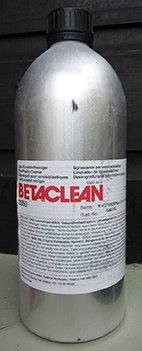
Where I live it is proving next to impossible to find a non polar solvent (naphtha or toluene) that is not sold in plastic bottles...
I really envy those who live in countries where these products usually come in metal containers...
My research revealed two final possiblities, both of which would still need to undergo an evaporation test, either a 5 l. metal can of naphtha with boiling point 100-140 (°C) or convincing my pharmacist to sell me some pharmaceutical toluene (which comes in 250 ml. glass bottles and is used as a base for some ointments)...
I just found out that the naphtha I used for my extraction came in a PET-bottle and now I'm all paranoid about possible contamination from plastic (or it's breakdown products) and not knowing how to make sure there isn't any...
I have very little knowledge about plastics and their breakdown products, or their behaviour in strong acidic or basic solutions, or their solubility in different solvents... But just the idea of even the tiniest amount ending up in my final product makes me very reluctant to bio-assay the spice that's still trapped in vinegar after back-salting my naphtha due to not having a freezer and not wanting to evaporate that amount of naphtha...
So, the last hurdle to take before I'll ever be able to come up with a yield I can be truly proud of, is finding a non polar solvent that comes in metal or glass packaging (and evaps clean)...
PLUR
After making sure every piece of equipment I use is either glass or stainless steel, I fear that there is one possible source left for contamination of my yield...
Where I live it is proving next to impossible to find a non polar solvent (naphtha or toluene) that is not sold in plastic bottles...
I really envy those who live in countries where these products usually come in metal containers...
My research revealed two final possiblities, both of which would still need to undergo an evaporation test, either a 5 l. metal can of naphtha with boiling point 100-140 (°C) or convincing my pharmacist to sell me some pharmaceutical toluene (which comes in 250 ml. glass bottles and is used as a base for some ointments)...
I just found out that the naphtha I used for my extraction came in a PET-bottle and now I'm all paranoid about possible contamination from plastic (or it's breakdown products) and not knowing how to make sure there isn't any...
I have very little knowledge about plastics and their breakdown products, or their behaviour in strong acidic or basic solutions, or their solubility in different solvents... But just the idea of even the tiniest amount ending up in my final product makes me very reluctant to bio-assay the spice that's still trapped in vinegar after back-salting my naphtha due to not having a freezer and not wanting to evaporate that amount of naphtha...
So, the last hurdle to take before I'll ever be able to come up with a yield I can be truly proud of, is finding a non polar solvent that comes in metal or glass packaging (and evaps clean)...
PLUR