• Members of the previous forum can retrieve their temporary password here, (login and check your PM).

Trouble making harmine tincture

Migrated topic.

BUJUisHAPPY

Rising Star
Donator
Hello wise Nexus, i seek your help.

I have tried dissolving 2.5grams of harmine in 30ml of water that contains 6% w/v citric acid and addition of 20ml of everclear to round my tincture up to a total of 50ml. Initially the harmine always dissolves fully, but eventually the solution turns clear with a precipitate at the bottom of the container.

What might be the reason for this, and is there an alternative recipe for harmala tinctures that works?

Kind regards

JUBU
 
Solution
doubledog said:
...
Your goal is to have your harmine still dissolved, so you should find different acid/salt form. Besides HCL, acetic acid is also a good candidate.

just for OP's clarity: You don't need hydrochloric acid to make harmine HCl. "Manske" process is done by dissolving harmala freebase in water with the aid of a little bit of acid (i use acetic), then adding table salt and letting everything cool then sit in the fridge overnight. This will grow beautiful HCl crystal needles that you can collect eg. in a coffee filter.
My guess would be that it converts to citrate and dissolves in the water, then crashes back out after the addition of alcohol. Have you tried using only water with no everclear?

I've never tried making tinctures, but i have tried to dissolve harmalas in various solvents (i never really separated the harmine from the harmaline, but i'd assume the solubility issues are similar).

From my experience, harmala freebase dissolves in ethanol given some heat and time, but not well. i doubt even one gram would dissolve in 20ml. I have not tried dissolving harmala citrate in ethanol, but i am currently trying to dissolve it in PG (for vape juice), and it took 25ml of PG to almost fully dissolve 775mg of harmala citrate - attempt still ongoing, i kinda think it will work, but maybe i'm wrong and will have to add another 5ml to get rid of the last solids.

You might have better success with harmine HCl (which you can make by Manske). Again i haven't attempted to dissolve it in ethanol, but in PG, 1g dissolved in just 8ml within a few minutes with some heating, and didn't crash back out at room temp.
 
As HT already mentions, ideally you'd find the right edible anion (from your choice of acid) that keeps your harmine salt in solution once the ethanol is added.

On the other hand, you appear to have found a simple way of recrystallising harmine citrate. I bet if you warmed it up it would dissolve again and on cooling slowly you might well get some decent crystals. If that appears to be the case, best results would be obtained by transferring to a fridge and then a freezer. [Recrystallisation from aqueous ethanol like this is a well-established method of purification during lab prep work.]

How clean did the precipitate look? While this is essentially the opposite of what you were aiming for, it surely beats messing around with butyl acetate as I did - unless one happens to like banana-flavoured harmalas :lol:
 
Reason for this is most likely that volume of your tincture solution can't dissolve the alkaloids, so they precipitate (after some time or after cooling).

There is also a possibility that your harmine citrate is still dissolved in solution and precipitate is just some impurity.

Solubility of alkaloid salts are very often lower in ethanol than in water. Addition of ethanol (IPA or acetone also works in similar situations, of course not for tinctures) decreases solubility of salt, in your case harmine citrate, so it precipitates.

It's called Dual solvent recrystallization method and could be used also for purification of other salts of our interest, for example mescaline sulfate (or tartrate) could be re-xed from water/acetone or water/IPA mixture.

Your goal is to have your harmine still dissolved, so you should find different acid/salt form. Besides HCL, acetic acid is also a good candidate.
 
doubledog said:
...
Your goal is to have your harmine still dissolved, so you should find different acid/salt form. Besides HCL, acetic acid is also a good candidate.

just for OP's clarity: You don't need hydrochloric acid to make harmine HCl. "Manske" process is done by dissolving harmala freebase in water with the aid of a little bit of acid (i use acetic), then adding table salt and letting everything cool then sit in the fridge overnight. This will grow beautiful HCl crystal needles that you can collect eg. in a coffee filter.
 
Solution
Not sure.

Try perhaps more citric acid?

IME a tincture works just fine if you shake before you use it, put your desired dose in a shot glas and dilute it with hot water.

Has worked just fine for me every time.

My mix contains more acid then harmalas by weight, though.

For further details feel free to send me a PM
 
Thank you all for your help and excuse my slow response, but I only get around to these kinds of experimentations every few days or even weeks.

There was a lot of precipitate and the tincture turned almost completely clear therefore I do think this was not just an impurity. The crystals looked jagged and dark, and a mineral in my collection labeled silicon carbide looks kind of like it. I would guess its quite clean...

The same day I initially had asked you guys for help I came across a german online store selling 500mg of harmine tincture in 10ml of 40% ethanol, without further specifications. I tried replicating the tincture with freebase, but even 20ml of vodka and a warm water bath wouldn't dissolve 500mg of freebase. As Homo Trypens pointed out maybe harmine hcl might dissolve more easily and its what i will be attempting next.

After several rue extractions im still not well versed with the chemistry behind it. When salting out there are two anions present namely chlorine and the acid and two cations namely sodium and the protonated alkaloid. Chlorine and the alkaloid are the two less soluble ions and they then form the precipitate salt, correct? What im really trying to ask: Is there an easy and intuitive way of understanding this process or is it one big rabbit hole and I shouldn't bother with it?
 
Your last paragraph describes the basic idea behind the Manske precipitation reasonably well, albeit crudely. It's to do with solubility equilibria, whereby each possible combination of cation with anion has a corresponding solubility product. Choose the appropriate translation of the wikipedia article to help understand this more easily. It's a rabbit hole worth even superficial exploration, since grasping the principles of chemical and thermodynamic equilibria is extremely useful when working with extraction and formulation like you are.
 
I need to make corrections to my previous claims.

It seems that I have sadly not accidentally precipitated harmine Citrate but rather, harmala citrate. Previously I had assumed that I was practically working with pure harmine, since my rue extractions precipitated long before reaching harmaline's supposed pKa and before I had heard of Van Der Sypt's pH depressions etc. I have since seperately precipitated harmine and harmaline using ammonia. For making a tincture I have redissolved harmala in water using hcl, evaporated the solution and then dissolved the harmala hcl (thanks for suggesting it Hyper Turtle) in vodka to make a tincture using 1ml vodka per 30mg of freebase I started out with before making the harmala hcl. So far the tincture seems stable-nothing has crashed out. I find the taste to be more bitter than previously, although Im not sure wether this has to do with it being a different salt or the ratio of harmaline to harmine increasing since I now mix them 50/50. In any case Im grateful for having been introduced to Syrian Rue and the support and knowledge on this forum and Im looking forward to our future collaboration.

Regarding the principles of chemical equilibria Im willing to look into those at some point in the future and suspect that also entails finally getting a good grasp at the darned law of mass action which has been confusing me since high school...live and learn🫡
 
Dear Nexus
Dear downwardsfromzero

I have tried to take a closer look at the chemistry of salting out in Syrian rue extraction and have used Claude (AI) to write out chemical formulas and equations and help better my understanding.
I now want to present what I have learned and visualized. This might help other novices and from experts I kindly ask to be corrected for errors in my understanding.
For convenience I will only consider harmine and not harmaline.

After adding 10% table salt to a solution of harmine in vinegar we expect the following ions to be present:

Acetic acid anion: Ac-
Chloride anion: Cl-
Sodium cation: Na+
Harmine protonated: HH+
protons: H+

Provided that these ions can form precipitates with each other one can write out so-called solubility products and equilibrium constants for them. We use solubility products when dealing with precipitate-solute equilibria and we use equilibrium constants for solute-solute equilibria. Solubility products are just equilibrium constants with the conc. of the solid phase in equilibrium integrated directly into the constant:

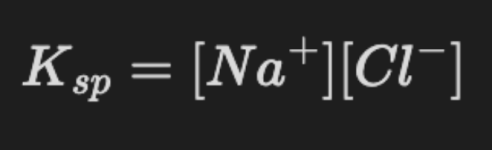
For instance the solubility product for table salt:

KspNaCl.png

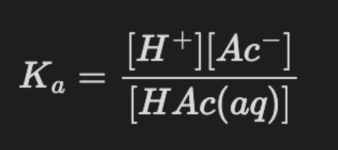
The equilibrium constant (aka acid dissociation constant) of aq. vinegar and its aq. conjugate base (acetic acid anion):

Ka.png


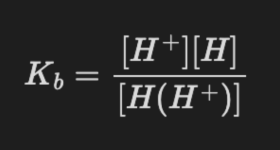
The equilibrium constant of harmine and protonated harmine:

Kb.png

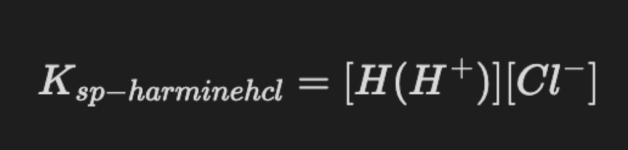
The solubility product of protonated harmine and Cl-..

Kspharminehcl.png


..which is in equilibrium with the precipitate of protonated harmine and Cl-:


HH+Cl-.png

The solubility product and equilibrium constant should always remain the same at constant temperature, pressure and assuming we have a dilute solution (is manske solution considered dilute?).

Looking at the solubility product of protonated harmine and Cl-, raising Cl- (by adding table salt), if Ksp of protonated harmine Cl- is low and is to remain the same, aq harmine H+ needs to fall out of solution to rebalance the Ksp.

When we salt out we raise the solution temperature, raising the Ksp and allowing for the 10% NaCl solution to dissolve alongside everything else. Once the temperature drops of, the Ksp lowers as well and only now does harmine H+ need to fall out to account for the increase in Cl-.

Some further questions I now have:

1. Does this explain salting out in its entirety or do I need to consider additional stuff, like ionic strengths?

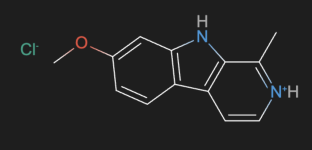
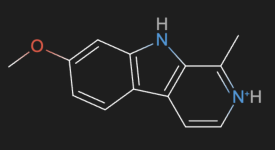
2. What form does harmine mainly take when dissolved in vinegar?
Will it be this:


HH+.png


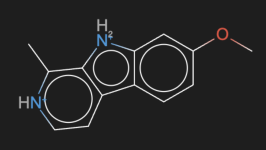
3. Or could we also encounter a version with a further proton attached to the indole ring?
Like so:

HH+H+.png


4. If I dissolve Harmine in aq. HCL and add everclear to crash it out, would this produce the same precipitate we are talking about here?
Im assuming that adding alcohol would once again decrease the Ksp and therefore force protonated Harmine Cl- to crash out.


Lastly I want to mention that I plan to experiment on harmala tinctures and share the results. I still cannot make harmala soluble at concentrations high enough for convenience (say 20mg per ml). Does everyone here just work with the powder?

Kind regards

BUJU

 
Dear Nexus
Dear downwardsfromzero

I have tried to take a closer look at the chemistry of salting out in Syrian rue extraction and have used Claude (AI) to write out chemical formulas and equations and help better my understanding.
I now want to present what I have learned and visualized. This might help other novices and from experts I kindly ask to be corrected for errors in my understanding.
For convenience I will only consider harmine and not harmaline.

After adding 10% table salt to a solution of harmine in vinegar we expect the following ions to be present:

Acetic acid anion: Ac-
Chloride anion: Cl-
Sodium cation: Na+
Harmine protonated: HH+
protons: H+

Provided that these ions can form precipitates with each other one can write out so-called solubility products and equilibrium constants for them. We use solubility products when dealing with precipitate-solute equilibria and we use equilibrium constants for solute-solute equilibria. Solubility products are just equilibrium constants with the conc. of the solid phase in equilibrium integrated directly into the constant:

For instance the solubility product for table salt:

View attachment 102212

The equilibrium constant (aka acid dissociation constant) of aq. vinegar and its aq. conjugate base (acetic acid anion):

View attachment 102213


The equilibrium constant of harmine and protonated harmine:

View attachment 102214

The solubility product of protonated harmine and Cl-..

View attachment 102215


..which is in equilibrium with the precipitate of protonated harmine and Cl-:


View attachment 102216

The solubility product and equilibrium constant should always remain the same at constant temperature, pressure and assuming we have a dilute solution (is manske solution considered dilute?).

Looking at the solubility product of protonated harmine and Cl-, raising Cl- (by adding table salt), if Ksp of protonated harmine Cl- is low and is to remain the same, aq harmine H+ needs to fall out of solution to rebalance the Ksp.

When we salt out we raise the solution temperature, raising the Ksp and allowing for the 10% NaCl solution to dissolve alongside everything else. Once the temperature drops of, the Ksp lowers as well and only now does harmine H+ need to fall out to account for the increase in Cl-.

Some further questions I now have:

1. Does this explain salting out in its entirety or do I need to consider additional stuff, like ionic strengths?

2. What form does harmine mainly take when dissolved in vinegar?
Will it be this:


View attachment 102217


3. Or could we also encounter a version with a further proton attached to the indole ring?
Like so:

View attachment 102218


4. If I dissolve Harmine in aq. HCL and add everclear to crash it out, would this produce the same precipitate we are talking about here?
Im assuming that adding alcohol would once again decrease the Ksp and therefore force protonated Harmine Cl- to crash out.


Lastly I want to mention that I plan to experiment on harmala tinctures and share the results. I still cannot make harmala soluble at concentrations high enough for convenience (say 20mg per ml). Does everyone here just work with the powder?

Kind regards

BUJU
1) Yes, that's a pretty good summary as far as I could comprehend at this hour. Extension of the concepts would involve considering entropic changes, enthalpy of crystallisation, solvation energy - a bunch of stuff I'd prefer to consider in daylight, basically :LOL: One relatively minor piece of feedback is that it's better, down the line, to use the shorthand "AcO⁻" for acetate anions, since the symbol "Ac" - besides being used for the radioactive element, actinium - is generally taken to represent the acetyl radical/group, CH₃CO- [that's not a minus sign there]. This is also why I use the abbreviation "BuOAc" for butyl acetate.

2) and 3) Acetic acid is only strong enough to protonate the weakly basic harmine molecule the once. It would take a far stronger acid to diprotonate it, and this would just as likely attack the oxygen atom, leading to the loss of the methyl group and conversion to harmol. But not in acetic acid.

4) Yes, ethanol can be used to crash out salts from solutions. It's a single instance of the more general principle of exploiting mixed solvent systems for crystallisation processes. If you were to very carefully float ethanol on top of the harmine HCl solution, you may even be able to grow some nice crystals.

Vinegar might be a better means of preserving harmala solutions if you're intent on working with a liquid dosing format. The low solubility in ethanol would appear to be problematic unless one were to stumble across a salt form with better solubility properties.
 
Back
Top Bottom