• Members of the previous forum can retrieve their temporary password here, (login and check your PM).

Tryptomics - CO based psychedelic analytical lab

Icon

Titanium Teammate
Donator
I didn't get a single hit for Tryptomics on shroomery or here. Has anyone heard of this organization?

Looks like they take psychedelic biomass or isolate samples from the public and provide analytics. Weed, shrooms, cacti, tryptamines, beta-carbolines. There's even sample competitions; for DMT it's comparing purity.
chrome_2025-09-11_22-30-55.png
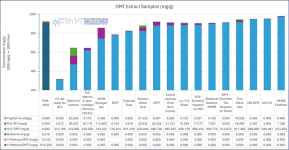
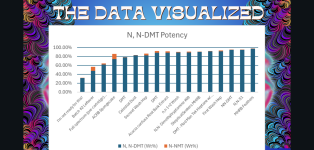
2024 competition results. It's interesting to me that trace NMT was detected in every sample. wtf?

Sounds a little too cool to be true. Anyone think it's trustworthy? I've been thinking really hard about going back to school for analytical chemistry the past week, but this could save me a lot of time and money lol. I'd love to toss a sample in the competition at least.

Found a reddit thread about it. I guess this organization is related to the Psychedelic Club of Denver that sponsors the competition and hosted an event to discuss the results.
Oh, and Rick Strassman was the keynote speaker. I got to chat with him 1-on-1 for 20 minutes. I was talking to him about experimenting with different ROAs and he told me he ONLY DID DMT ONE TIME IN HIS LIFE!!!

He never tried the IV DMT they administered in his experiments (which blew my fucking mind) and only had it once... at Esalen with Terrence McKenna.

I kinda froze after he told me that.

He also said that he now believes everything we see on a DMT trip (or any psychedelic trip) comes from our own mind, which I've always agreed with, but when I read his Spirit Molecule book, it seemed he was far more woo woo.
Psychedelics were decriminalized a few years ago in Colorado and it's insane how fast they're moving on the commercialization of every aspect of it. I've seen pictures of at least ten commercial vape carts with product packaging on reddit.
 
Last edited:
Interesting, didn't know about them. They seem to be legit, but give off a weird vibe to me. It's a startup (they say they're going to be doing fundraising rounds soon) and... they're asking for donations on Patreon. Who would donate to a startup, I don't know. But if they offer a good service service with analyses, I guess it's fine for that.

About Strassman, AFAIK now he thinks it's "in the brain" in the sense that Yahweh uses the brain to communicate with humans, no? What he calls "theoneurology".
 
Interesting, didn't know about them. They seem to be legit, but give off a weird vibe to me. It's a startup (they say they're going to be doing fundraising rounds soon) and... they're asking for donations on Patreon. Who would donate to a startup, I don't know. But if they offer a good service service with analyses, I guess it's fine for that.
I agree, there's something a little cartoony about it. When you go to the testing page it's all about motives for doing a test and not a word about what tests they do and how they do them. Looks like they screen for tryptamines but besides just flexing a purity % I'd like to find an analysis that can report solvent traces and more.
Altitude consulting is another good one and Friday Ventures is one to keep an eye out for in terms of testing companies.
Thanks I'll look into those. One reddit comment mentioned Altitude and noted feeling like they got a better analysis from tryptomics because their altitude results came back 102% dmt or something.
 
I agree, there's something a little cartoony about it. When you go to the testing page it's all about motives for doing a test and not a word about what tests they do and how they do them. Looks like they screen for tryptamines but besides just flexing a purity % I'd like to find an analysis that can report solvent traces and more.

Thanks I'll look into those. One reddit comment mentioned Altitude and noted feeling like they got a better analysis from tryptomics because their altitude results came back 102% dmt or something.
Yeah, as @blig-blug said, that's a weird phenomenon that happens sometimes. You try to get the best reference sample you can, but because it's the reference sample it's hard to know if it's 100%.

But they've been in the game a long time.

One love
 
Yeah, as @blig-blug said, that's a weird phenomenon that happens sometimes. You try to get the best reference sample you can, but because it's the reference sample it's hard to know if it's 100%.

But they've been in the game a long time.

One love
Is there different standards for analysis? If they're just comparing to a reference would that be considered "qualitative"? vs a quantitative analysis? I honestly have no idea how modern analytical tools work. Do they all compare to a reference or are there some tests like gcms that are more precise and don't rely on reference? I'm more interested in knowing what the trace % impurities are instead of just the amount of impurities.

I've also been looking into XRD analysis. I think I already have some crystals that could be used for XRD, which is apparently the hardest part. Shouldn't cost more than a few hundred dollars to get a crystal scanned and characterised. There's a state of the art XRD lab near me, but I think it's limited to scientific academia. It's not in CO though, so it's probably moot anyway.

Anyone have thoughts about the chronic NMT presence in samples? Maybe none of them thought to do a CO2 step. But it makes me second guess the dry ice wash I did, where I didn't visibly yield any NMT carbamate. Can the dimethyl de-methyl to NMT? I believe I've read that's what happens in the body, either by MAO or CYP enzymes. But can DMT decompose to NMT during reactions or storage?
 
Last edited:

Give em a call. They're very kind, knowledgeable, and helpful.

I'd go into more detail, but I'm in ceremony today. On break right now.

One love
 
I'd like to find an analysis that can report solvent traces and more.
Most labs should be able to quantify residual solvents by headspace GC-FID, sampling the gas above the sample in the vial. That's conceptually equivalent to smelling it, with the GC replacing your nose.

Tryptamines would typically be quantified by a separate analysis, HPLC or GC of a dilute solution of the solid sample. HPLC-UV or GC-FID can identify and quantify only those constituents for which the lab has reference standards. (We can identify some unknowns looking at relative retention times, UV spectra, etc., but it's not very confident.) GC- or LC-MS can identify many unknowns without standards by comparison to published fragmentation patterns, since those are generally distinctive and repeatable. The MS is a more expensive instrument, though still commonly owned by small independent labs.

XRD is much more expensive, and probably not useful unless you're studying crystal polymorphs. NMR can identify unknowns that MS can't alone, but is also very expensive and requires a more complex sample prep. Neither is commonly available at labs that do this kind of work.

Yeah, as @blig-blug said, that's a weird phenomenon that happens sometimes. You try to get the best reference sample you can, but because it's the reference sample it's hard to know if it's 100%.
Beyond the purity of the reference standard, these methods aren't perfectly repeatable. Careful crystallization may purify DMT to >99.9%, and the RSD for their method is probably around a percent. So with a perfect standard and good amateur effort at the submitted sample, we expect measured purity >100% about a quarter of the time (taking the probability that a normal random variable X > 0.6, so that 99.9 + X would round to >100%). It's conventional to report that directly, trusting the reader to understand that effect.

Purity by comparison to a reference standard is usually the best measurement. It's also possible to report purity with respect to the sum of all the peaks in the chromatogram. This will typically give a more repeatable number, and one closer to 100%. That's usually a less informative number though, since it neglects impurities that the detector doesn't respond to or that don't elute. For example DMT contaminated with excess sodium hydroxide can still show a perfect single peak by HPLC-UV (since the sodium hydroxide doesn't absorb the UV), but comparison to a standard will show that the peak has unexpectedly low area for the mass injected.
 
Very cool seeing labs like this pop up more.
It's very cool seeing YOU! Glad you're back around :)

What do you think about the trace NMT in all these samples?

Either no one did a CO2 step to carbamate the NMT, or that step is not sufficient to remove trace amounts, or is it possible for a methyl group to break off during extraction or re-x... creating more NMT after it has been washed out?
 
I'm not sure. Are they analyzing synthetic DMT? I didn't know people were making synthetic DMT under these quasi legal grey markets and passing it off under "natural" substances categories?
Huh? Most of the entries seem to mention MHRB or ACRB extracts, but idk why they wouldn't test a synth. I think they'll test any product under the guise of substance testing safety.
 

Attachments

  • chrome_2025-10-19_15-09-09.png
    chrome_2025-10-19_15-09-09.png
    162.7 KB · Views: 7
Oh I got confused abiut the NMT and CO2 carbamate stuff. I was thinking this was some kind of synthetic route that maybe made NMT as side product.

Do people use CO2 to help remove NMT from extracts? I never heard of this. Would be curious to know more.

I think alot plants that make dmt have nmt as well in lesser quantities. So wouldnt be surprised to see it coming up.
 
Do people use CO2 to help remove NMT from extracts? I never heard of this. Would be curious to know more.
Yea, there's a thread on using CO2 to separate NMT from acacia extracts.

I tried it on my MHRB spice in hexane, but I couldn't see that any carbamate goo fell out. I suspect the reaction either doesn't adequately react with trace amounts, or doesn't condense trace amounts enough to fall out of solution, or maybe solvent water content is a factor.

There's also this thread on separating amines with aspirin, which I haven't tried yet but I'm hoping it's a more thorough way than CO2

But yea, I'm surprised NMT is in every sample. Which makes me wonder if trace amounts of DMT could be getting de-methylated along the way?
 
Last edited:
Is there any possible way for trace amounts of DMT to convert to NMT during typical a/b liquid-liquid extractions? Just to rule that out.
 
Is there any possible way for trace amounts of DMT to convert to NMT during typical a/b liquid-liquid extractions? Just to rule that out.
It's interesting in the data that one of the only 2 samples with a significant amount on NMT is called "Batch #2 Leftover", it's only 1 data point but it may indicate that leaving the extraction sit creates more NMT (and tryptamine).
 
Back
Top Bottom