• Members of the previous forum can retrieve their temporary password here, (login and check your PM).

Using less EA pulls in CIELO

Nachooo1

Esteemed member
Was thinking in this..instead of using 6 EA pulls, Would be posible to use , let say half the number of pulls but increasing 2 times the pulling time, and obtain same results?.
So 3 pulls of 2 minutes each one and letting the EA rest also doubling time so 4 minutes per pull.
I understand that there is a limit in the capacity of EA to hold the alkaloids, so maybe with high content specimens , is better to use more EA than in others considering the same dry weight.
But with common 2% Bridgesii maybe is possible.. this could be a way to save EA or at least spent less time destilling it to reuse it again.
Sorry if this has been answered before, I would like to know your opinion .
 
The limitations is not a limit in the EA to hold mescaline, but that some of the dough has mescaline (since freebase mescaline is soluble in water, and the dough retains some EA too, about 80g of EA are never recovered).

The ratio of mescaline concentration in the solvent/dough is called the partition coefficient.

Equilibrium is reached quickly so doubling the time will not help.

Doubling the volume will obviously give more mescaline than one pull with normal volume, but the key is that it will give less mescaline than two pulls with normal volume.

Let's say for the sake of argument that the partition coefficient is 0.7 (I made this number up).

That is, at equilibrium;

Concentration of Mescaline in EA / Concentration of Mescaline in dough = Ce/Cd = 0.7 (I made this number up for the sake of argument)

Amount of dough is ~ 100 (cactus) + 25 lime + 145 (water) + 80 (EA) = 350g

Then we can calculate the extracted mescaline % under two situations:

First, let's do two pulls of 220g each. Assume there is 1g of mescaline to extract.

First pull is special since only 160g of solvent are recovered:

Ce/Cd = 0.7 = (Me/160)/(Md/350),

Me/Md = 0.7 * 160/350 = 0.32

Since the total mescaline amount Mt = Me + Md = 1g (obvious notation), that gives Me = 1/(1+1/.32) = 242mg, and Md = 758mg (which is also the remaining mescaline to extract in the next pull - let's call that Mt'.

Now second pull, this time we recover 220mg of solvent. So,

Me'/Md' = 0.7 * 220 / 350 = 0.44
Me' + Md' = 0.758

Therefore Me' = 330mg, and Md' = 428mg

Repeating the calculations,

Me'' = 186mg, Md'' = 242mg
Me''' = 105mg, Md''' = 137mg

So after 4 pulls with 220g of solvent each, yield is 86%

Now, let's do two pulls of 440g.

First pull,

0.7 = (Me/360)/(Md/350), Me/Md = 0.72
Me + Md = 1

Therefore, Me = 417mg, Md = 581mg

Second pull,

Me'/Md' = 0.88
Me' + Md' = 581mg

Therefore Me' = 272mg and Md' = 310mg

So after two pulls of 440g each, yield is 69%

Therefore, assuming I didn't make any algebra mistakes, in this example, two pulls of double the volume are less efficient (~690mg recovered) than four pulls of standard volume (~860mg recovered).

Not doing the calculations here, but After 3 pulls of 440g, yield will only be up to 84% (below the 90% yield considered good). And the yield after 6 pulls of 220g will be at 93% (good).

Makes sense?
 
Last edited:
Also, what I said above is theory. Experiment is king, so you can try a side by side experiment and track the yield for each and every pull separetly and report back. That would be very interesting. You can also experiment with doubling the time and report back on that.
 
The limitations is not a limit in the EA to hold mescaline, but that some of the dough has mescaline (since freebase mescaline is soluble in water, and the dough retains some EA too, about 80g of EA are never recovered).

The ratio mescaline concentration in the solvent/dough is called the partition coefficient.

Equilibrium is reached quickly so doubling the time will not help.

Doubling the volume will obviously give more mescaline than one pull with normal volume, but the key is that it will give less mescaline than two pulls with normal volume.

Let's say for the sake of argument that the partition coefficient is 0.7 (I made this number up).

That is, at equilibrium;

Concentration of Mescaline in EA / Concentration of Mescaline in dough = Ce/Cd = 0.7 (I made this number up for the sake of argument)

Amount of dough is ~ 100 (cactus) + 25 lime + 145 (water) + 80 (EA) = 350g

Then we can calculate the extracted mescaline % under two situations:

First, let's do two pulls of 220g each. Assume there is 1g of mescaline to extract.

First pull is special since only 160g of solvent are recovered:

Ce/Cd = 0.7 = (Me/160)/(Md/350),

Me/Md = 0.7 * 160/350 = 0.32

Since the total mescaline amount Mt = Me + Md = 1g (obvious notation), that gives Me = 1/(1+1/.32) = 242mg, and Md = 758mg (which is also the remaining mescaline to extract in the next pull - let's call that Mt'.

Now second pull, this time we recover 220mg of solvent. So,

Me'/Md' = 0.7 * 220 / 350 = 0.44
Me' + Md' = 0.758

Therefore Me' = 330mg, and Md' = 428mg

Repeating the calculations,

Me'' = 186mg, Md'' = 242mg
Me''' = 105mg, Md''' = 137mg

So after 4 pulls with 220g of solvent each, yield is 86%

Now, let's do two pulls of 440g.

First pull,

0.7 = (Me/360)/(Md/350), Me/Md = 0.72
Me + Md = 1

Therefore, Me = 417mg, Md = 581mg

Second pull,

Me'/Md' = 0.88
Me' + Md' = 581mg

Therefore Me' = 272mg and Md' = 310mg

So after two pulls of 440g each, yield is 69%

Therefore, assuming I didn't make any algebra mistakes, in this example, two pulls of double the volume are less efficient (~690mg recovered) than four pulls of standard volume (~860mg recovered).

Not doing the calculations here, but After 3 pulls of 440g, yield will only be up to 84% (below the 90% yield considered good). And the yield after 6 pulls of 220g will be at 93% (good).

Makes sense?
Yes, thanks for taking your time and write this long and exhaustive response.
 
At much smaller scale (1g and 2g) there were some tests by Cheelin where they increased time and EtAc and only did 1 pull and still met the expected yield for that particular lot of powder. I assume this may not be the same at normal/larger scale? I tried to reproduce this once doing similar with 2.5g but also did nylon filter squeezing and a much smaller and shorter 'rinsing' pull in the end; however I haven't done a normal CIELO large scale run on the rest of the powder to see if the yield is the same.

Edit: I can see now that increasing the EtAc along with time is really not what you're going for though 😅

...
For example: 1g samples from a 10g batch, placed in a testube with 30mL fresh EA, for 30 minute extraction, passively crystallized with citric acid for 72 hrs: sample A received a 30 second stir (using a bamboo chopstick) at the beginning and end of the time period; sample B received a 30 second stir at the beginning; then 5 second stirs every 5 minutes; sample C received a 30 second stir at the beginning and every subsequent 5 minutes. Sample A yielded 1.1%, samples B and C yielded 1.2% with C slightly higher than B. All products appeared and tasted identical to passively crystallized standard product. Standard method on larger sample produces 1.1% with 6 pulls, rounding to 1.2% with 7. All weights taken on an Ohaus Pioneer, reading at 0.0000g.
...
TEK - Ethyl acetate approach [CIELO]

Still working to keep the flame of hope alive on small sample assay method.

No luck, yet, on 1g samples, though i’m only 10% low! Running out of ideas, so may switch to a predictive model approach.

BUT, did get a 2g sample to hit expected 1.1% yield! Made scaled 2g paste using standard method; then put it in a testube with 30mL fresh EA, stirred it 6 times with a chopstick, every 5 minutes for 30 seconds; after last stir rested 5 mins, filtered the loaded solvent through coffee filter-stainless funnel into a clean testube; rested for 1hr; salted w 0.1g citric acid, stirred a couple revolutions; passively crystallized for 72 hours; filtered, rinsed w EA, & air dried, water washed the tube, evaporated, and scraped residue.
TEK - Ethyl acetate approach [CIELO]
 
Last edited:
Amount of dough is ~ 100 (cactus) + 25 lime + 145 (water) + 80 (EA) = 350g

Then we can calculate the extracted mescaline % under two situations:

First, let's do two pulls of 220g each. Assume there is 1g of mescaline to extract.

First pull is special since only 160g of solvent are recovered:

Am i correct in assuming since you used 80g EA in the dough mass that is supposed to be deducted from the first pull? If i read correctly It was deducted as 80g in your 2nd example for 440g pulls, but in your 1st example of 220g pulls only 60g is deducted from the first pull.

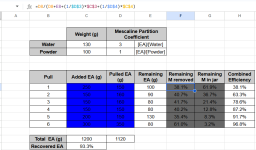
I was plugging all this into a spreadsheet to wrap my head around it and play with the input values, but I'm not getting the same Me' and Me'' results as your 220g example even if I set the 1st pull to 160g, but the Me''' value came out close...
 

Attachments

  • CIELO partition coefficient.xlsx
    17.9 KB · Views: 3
Back
Top Bottom