• Members of the previous forum can retrieve their temporary password here, (login and check your PM).

UV fluorescence of active acacia bark (and maybe more?) - help wanted!

Migrated topic.
You are correct. I expect it’s partly to do with our eyes perception of the uv spectrum, and in terms of images on here - different cameras and the way the light has been photographed that leads to the different perception. Along with the aforementioned issues with certain torches not being the wavelength advertised and or having a lot of emotions either side of the specified wavelength - lack of filter, less quality led etc..

365nm looks much more “light blue” to me than 405nm. I find 405 looks more purple and dark. I got chatGPT to generate this for me. It’s not exact, but it goes one an idea.
View attachment 104708
  • 300–350 nm → deep UV shown as dark purples.
  • 350–380 nm → near-UV glow, moving toward violet with a bluish tint (around 365 nm you see that light blue-violet hue).
  • 380–440 nm → violet through deep blue.
  • 440–450 nm → transition into strong blue
Your subjective experience seems likely to be one of the aforementioned artefacts - or have you had your eye lenses replaced with implants?

Harmonics of 'light blue' would still be way down in the hard UV~270nm perhaps - rather a long way from 365nm :confused:
 
It's a good question @Transform and a mystery I'm curious about as well. Even with filtered 365nm, you'd think light leak would be purple if anything. But with a strong filtered torch there's a visibly whitish-blue hue to the spotlight.
 
Huh? Blue light has a longer wavelength than purple - or am I missing something about the subjective perceived colours of invisible radiation, such as corneal fluorescence or light wave subharmonics from the emitter?
Purple is not a monographic wave, it's blue and red waves, that your brain interprets as 'purple'. So purple does not have it's own wavelength, it's the combination of the two.

Hence with a red light intensity knob and a blue light intensity knob you can turn those to get from pink to deep purple (and now I have music in my mind).


Kind regards,

The Traveler
 
Last edited:
Purple is not a monographic wave, it's blue and red waves, that your brain interprets as 'purple'. So purple does not have it's own wavelength, it's the combination of the two.

Hence with a red light intensity knob and a blue light intensity knob you can turn those to get from pink to deep purple (and now I have music in my mind).


Kind regards,

The Traveler
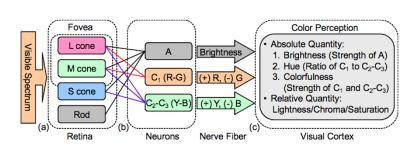
You're right, one does need to take into account the sensing capabilities of the eye's (usually) three different cone-receptor types (r,g,b).
 
You're right, one does need to take into account the sensing capabilities of the eye's (usually) three different cone-receptor types (r,g,b).
Our eyes are quite interesting, just lookup the yellow-blue receptor and how the brain almost always makes the right interpretation (when not on psychedelics :p).


Kind regards,

The Traveler
 
Our eyes are quite interesting, just lookup the yellow-blue receptor and how the brain almost always makes the right interpretation (when not on psychedelics :p).


Kind regards,

The Traveler
Ooh yes, that's quite fun - the subsequent neurological processing of sensory input and possible cultural influences, even, on the final interpretation as experienced by subjective consciousness deserves contemplation (maybe with the help of psychedelics :D )
1755972636807.png
 
Another interesting observation: Because our eyes are mostly water, they are transparent to the same wavelengths that travel best through water. These wavelengths are what we now call visible, or natural, light.
  • UV gets absorbed quickly, which is why sunlight underwater is not UV-rich.
  • IR (longer wavelengths) is absorbed and converted to heat very efficiently.

Kind regards,

The Traveler
 
In short, I have found that active A. Obtusifolia bark when scraped down to a certain layer glows bright bright blue under UV light. I'm suspecting this is concentrated DMT as no inactive acacia that I have tested glows this way nor does any other tree that I have checked.

I've also found that this is a great way to ID dead, fallen material & trees leading to a much more sustainable form of gathering material. It seems that the phyllodes even glow in the dead of night - some more than others (potentially indicating a higher alkaloid content?)

Moving forward what we need is more testing! I'm calling out for anyone growing active acacia that's able - get a UV light and lets gather some data! The UV light that I used was just a cheap 365nm torch from eBay but I expect anything close to that wavelength would be fine.
That’s a great idea. I think this could make an important contribution to using resources more efficiently.
It would mean less exploitation of plants and allow us to get more out of a single tree.

I’m really curious to see the results of experiments and measurements from others.
Thanks a lot for sharing this!
 
Huh? Blue light has a longer wavelength than purple - or am I missing something about the subjective perceived colours of invisible radiation, such as corneal fluorescence or light wave subharmonics from the emitter?
looking my deep UV LEDs, almost nothing is able to pass through plastic. the simple use of an acrylic lens totally filtered almost all the UV except for <1% which resided in the visible spectrum, causing no strong phosphorescence in anything that didnt also respond to regular blue somewhat. since theres no violet component i think this is either a side-emission, or, its deliberately added phosphors producing bluey-white to make the UV visible, which some low power SMD-LEDs i know for a fact do since even with phosphorescence its barely visible.

If you have ever looked at a UVC sterilizer lamp they also look light-blue. obviously its hard to say if its deliberate or not, but, high quality UVC at least would be totally invisible and you could destroy your eyes accidentally facing a running UVC lamp for a minute or two if you didnt know it was on, because only UVC was being emitted and no visible spectrum light.

Anyway to clarify, looking directly at my LEDs they appear sky blue, and looking at the light they reflect, is rather subjective since anything that doesnt phosphoresce is basically absorbing 99% of the light and just reflecting the dim pale blue. Pale is perhaps a better description than light blue.

I think there is another thing we can do here too though, which is finally determine, the effects of fertilizers on acacias. Specifically, ammonium phosphates. lets say you have two trees in pots, saplings. or just two wild or more wild trees that demonstrate some notable differences in overall glow, like lighting up all the foliage at once. what im getting at is, try fertilizing the tree, or otherwise before and after certain water like heavy rain, observe changes in the brightness of the leaves.
checking for a change in the glow overall from fertilizing, by comparison to its neighbor if thats possible, as well as, also taking note of changes in leaves at certain areas, after prolonged cloud cover, before and after rain, etc, like top leaves, new vs old, etc. any observable changes means one could optimize a harvest without having to collect kilos of material to verify a hypothesis. DMT supposedly fluctuates heavily in a span of several hours sometimes. Oh, speaking of, try observing the difference at, the absolute earliest the UV light works, vs the absolute latest, before sunrise, for some morning vs night readings. potted plants would work better for this i suppose as you can relocate it to a dark room to directly compare artificially lit trees for a side-by-side.
it would be great if one could cause the leaf brightness to change to such a degree that one controlled variable as tuned could cause it to go from darker to brighter than a refference plant, you could very easily eyeball the effects of anything really, in theory too you could possibly record light emissions from a photograph restricted to the emission-wavelength reflected by the leaves to photographically determine changes.
this can already be done do perform chromatography using a webcam and a prism, to ascertain the chemical composition of a given substance within certain limitations. What im proposing is far more basic though, and just heavily filtering for a limited color band, and watching for relative shifts, you probably cant tell, its potent now, vs not, just, it went up after i did X, or it went totally dark after i did Y

 
Last edited:
This is really cool and leads me to start back on my UV sensor I was building for a specific type of photography.
I have several VEML6075 sensors and several 365 LEDs.
I am inspired to create something like a densiometer for photography but use it for this as well.
ie a Box with LED light source and a UV sensor on one side and a display of UV intensity on the back.
Point it at the material and press a button.
Read the background UV
Turn on the LED read the reflected UV.
Display the intensity value.
This could be a really cool way to get definitive measurements for comparison,
After some research my idea wont fly as it is fluorescence not reflected UV so it's back to the UV torch idea.
 
Last edited:
I find active plant material has a sorta blue-ish yellow under UV.. but then I've seen non active material look very similar as well. Extracts tend to be a light turquoise for me very similar to @drpotato 's photo. And is a much more brilliant electric blue when dissolved in solvent.. attached below is an A. floribunda branch/stem bark extraction where you can see the tryptamines glowing nicely in the DCM layer.

I have a whole bunch of different samples I'll take some photos of tomorrow to upload.. just need my UV light back off my friend.

I'd be interested to see the inner bark fibres with UV on it?. they should be less patchy than the outer bark and have an even spread of light.


View attachment IMG_1450.jpeg
 
Back
Top Bottom