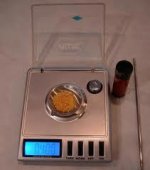
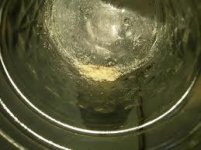
..nmt seems to turn increasingly (dark) orange over times (can be initially white), it isn't (to my knowledge) yet recorded from M. hostilis (but is from M. opthalmocentra (with dmt)...simple tryptamine, however, has..it is recorded as pale brown needles or prisms becoming dark brown over time..[it's activity is not totally understood..it was found (by, i think, Sazra) in the '60s to be a very fast acting psychedelic when injected in large amounts (will attempt to find reference), there is also some evidence that the occurrence of tryptamine, in some vaporized extracts (of other plants), changed or slightly modified the subjective effects..]
..serotonin (5-hydroxytryptamine) has also apparently been found in traces in M. hostils..not sure of it's x-tal colors..could it be purple?..bufotenine (dimethyl-serotonin) is recorded by J. Ott as brown crystals with a shiny hue..
the only other fairly common tryptamine i can think of (other than 5meo which should be more obvious in small doses) is: 5-methoxytryptamine - potentiates sedatives, more active than serotonin [Bhudavari et al. 1989], oxytocic, natural trace component of human urine.. (properties?)
..ß-carbolines (such as harmine, harman or 2-meTHBC) often turn red in solution or upon solidification, or browny yellow, and can be altered by acids/heat etc.,or be by-products (as extraction artifacts) of simple tryptamines..
..now, DMT-N-Oxide..what it looks like is not yet widely established..it has not been chemically confirmed in any Mimosa species, only speculated..
q21q21, your 'jungle alkaloid' is probably may not be dmt-oxide
hope any of this is helpful in some way...
..serotonin (5-hydroxytryptamine) has also apparently been found in traces in M. hostils..not sure of it's x-tal colors..could it be purple?..bufotenine (dimethyl-serotonin) is recorded by J. Ott as brown crystals with a shiny hue..
the only other fairly common tryptamine i can think of (other than 5meo which should be more obvious in small doses) is: 5-methoxytryptamine - potentiates sedatives, more active than serotonin [Bhudavari et al. 1989], oxytocic, natural trace component of human urine.. (properties?)
..ß-carbolines (such as harmine, harman or 2-meTHBC) often turn red in solution or upon solidification, or browny yellow, and can be altered by acids/heat etc.,or be by-products (as extraction artifacts) of simple tryptamines..
..now, DMT-N-Oxide..what it looks like is not yet widely established..it has not been chemically confirmed in any Mimosa species, only speculated..
q21q21, your 'jungle alkaloid' is probably may not be dmt-oxide
hope any of this is helpful in some way...