
• Members of the previous forum can retrieve their temporary password here, (login and check your PM).

what happened here?

Migrated topic.

Sakkadelic

Titanium Teammate
Donator
Senior Member
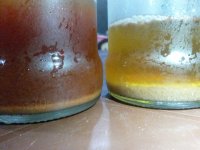
While preparing haoma this strange thing happened and i'm trying to find out how it happened.
After brewing the acacia (multiple microwave and straining acidic boils then reducing) i was reducing the rue tea and i decided to add the root bark (that i pressed most of the water out of it) so the root bark and the rue tea were boiling together for around 20 mins and then i filtered and again pressed the liquid out.
I placed both brews in the fridge to cool so i can transfer them to plastic bottles and when i came back there was this precipitation in the rue jar that looked like some kind of freebase(i'm not saying it is but really looks and acts like fb when extracting harmalas)
So anyone has an idea what exactly is going on here?
If a salt solution is pretty saturated will this happen when cooling?
Could this be something similar to manske, a new water insoluble harmalas salt formed?
 

Attachments

  • 20151004_210313.jpg
    20151004_210313.jpg
    2.5 MB · Views: 2
So, you did not add any salt at all anywhere? If you did it is obviously some harmala-hcl salt. If not then perhaps it is some unfiltered plant material that sunk to the bottom? Perhaps if you really are keen you can filter it and then see if it re-dissolves, or straight bio-assay.
 
Check the pH of that right bottle yellow rue tea please, then you're sure if it could be harmala precips or not. At pH 5 then 0.2% harmaline can precip, at pH 6 then 2%.
 
So, you did not add any salt at all anywhere? If you did it is obviously some harmala-hcl salt. If not then perhaps it is some unfiltered plant material that sunk to the bottom? Perhaps if you really are keen you can filter it and then see if it re-dissolves, or straight bio-assay.
No salt at all, i'm working with 5g whole seeds i filtered with a piece of cotton cloth and the tea was clear before putting it in the fridge, so i really don't think it's unfiltered plant material.
Check the pH of that right bottle yellow rue tea please, then you're sure if it could be harmala precips or not. At pH 5 then 0.2% harmaline can precip, at pH 6 then 2%
I'm sorry i don't have a ph meter but i used 5% vinegar 1 part and tap water 10 parts when preparing the rue tea so in worst case 2% is only 0.1g and that quantity is definitely more than 0.1g

I will try heating it again and see what happens
 
Sakkadelic said:
...If a salt solution is pretty saturated will this happen when cooling?
As you say there was no added NaCl: I would think: no.
And 5 gr of rue is low to saturate.
Mansking by added NaCl is needed to push the harmaloids out of solution, even in a fridge.

Sakkadelic said:
...Could this be something similar to manske, a new water insoluble harmalas salt formed?
Well if that was so, you invented a way that makes manske obsolete isn't it?

It is a phenomena that is curious though.
Yes heating it is a good idea to see it's result.
 
I meant if there is some kind of salt in the root bark that turned the harmala acetate into another water insoluble salt like how NaCl make harmala hcl.
 
Unlikely if we see how much NaCl is needed in a manske to do the trick.
I'm still puzzled.
The bark can deliver tannins though, but I've no idea how that interacts.
 
Sakkadelic said:
I meant if there is some kind of salt in the root bark that turned the harmala acetate into another water insoluble salt
The sludge is probably something like calcium oxalate at my first guess.

Decant the liquid off and have a tinker anyhow.

The jar on the right looks more yellow simply because there's less liquid in it, yes?
 
Sakkadelic said:
I'm sorry i don't have a ph meter but i used 5% vinegar 1 part and tap water 10 parts when preparing the rue tea so in worst case 2% is only 0.1g and that quantity is definitely more than 0.1g

You can use way more than that just to be sure, I think harmalas are more stable than dmt at low ph.

Sometime I add heaps of acid and the ph is still neutral because once the water get's inside the seeds it returns the ph back to neutral. This is the same with bark too. Only once everything is super saturated does the PH not keep resetting.
 
The jar on the right looks more yellow simply because there's less liquid in it, yes?
Sorry i didn't mention that the jar on the left is the acacia bark tea and on the right is the syrian rue tea, usually the rue tea looks red when it's cooked for long but i only boiled it 2 mins twice in microwave(i mashed and squeezed the seeds after each boil) which i think is enough for maoi effects.
The precipitations in the acacia jar are plant material because the bark was finely powdered most of the plant powder that could escape the filtering are in the acacia jar i don't believe it's the same case in the rue jar for many reasons and the two precipitations look and act differently...

You can use way more than that just to be sure, I think harmalas are more stable than dmt at low ph.

Sometime I add heaps of acid and the ph is still neutral because once the water get's inside the seeds it returns the ph back to neutral. This is the same with bark too. Only once everything is super saturated does the PH not keep resetting.
I tried not to make it very acidic because i want to drink it and i don't want acid reflux when i'm in the journey.
i will keep some of the precipitation and liquid and add it to hot vinegar solution and see what happens
 
Back
Top Bottom