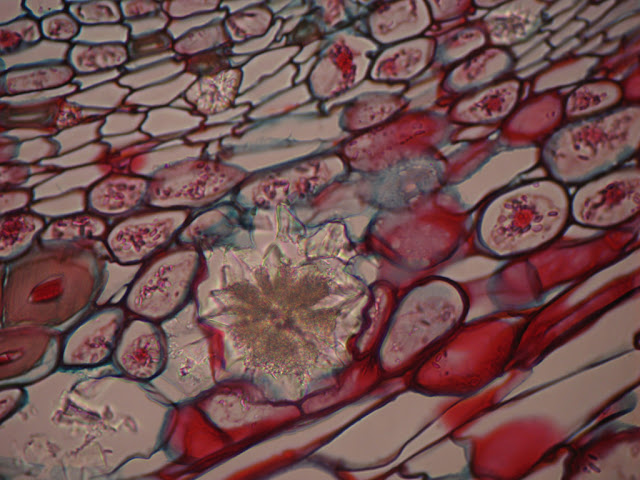
The chemical composition and morphology of solid material isolated from various Cactaceae species have been analyzed. All of the tested specimens deposited high-purity calcium oxalate crystals in their succulent modified stems. These deposits occurred most frequently as round-shaped druses that...
I wonder about some of the data about the Ca oxalate, it seems to be confused at times with oxalic acid, which is dangerous, however the calcium oxalate seems less so.
The chemical composition and morphology of solid material isolated from various Cactaceae species have been analyzed. All of the tested specimens deposited high-purity calcium oxalate crystals in their succulent modified stems. These deposits occurred most frequently as round-shaped druses that...
I wonder about some of the data about the Ca oxalate, it seems to be confused at times with oxalic acid, which is dangerous, however the calcium oxalate seems less so.
I think oxalic acid will spontaneously form (and precipitate) calcium oxalate in the presence of calcium when in solution (at least, I assume it would somewhere around a neutral pH. In highly acidic conditions perhaps not)--and from my reading of it, the DANGER of oxalic acid in consumption is that it will produce calcium oxalate in the kidneys.
It might be that at high pH in the stomach calcium oxalate will dissolve, oxalate may be absorbed into the bloodstream, and then be susceptible to reformation of crystal in the kidneys--but I'm just speculating about that. I don't know.
I honestly have never seen these before, and I have harvested and consumed a wide variety and copious amounts of cactus. I wonder if it has something to do with region/climate/growing conditions?
Any ideas why I have never seen these before - everyone seems to have had at least one cactus with them in from the previous posts, some in nearly everyone!
from various sources on the web (google the quotes to find them)
The crystals are generally salts and/or calcium oxalate crystals (kidney stone incarnates). People have bioassayed them before. Whatever they are, they're not active.
The chemical composition and morphology of solid material isolated from various Cactaceae species have been analyzed. All of the tested specimens deposited high-purity calcium oxalate crystals in their succulent modified stems. These deposits occurred ...
www.ncbi.nlm.nih.gov
The chemical composition and morphology of solid material isolated from various Cactaceae species have been analyzed. All of the tested specimens deposited high-purity calcium oxalate crystals in their succulent modified stems. These deposits occurred most frequently as round-shaped druses
Note that in that study every single specimen they checked had these types of crystals.
I have yet to see a plant without them, but they are larger and more prominent in some specimens, especially older ones. The plants accumulate calcium with age and something like 80% of their dry weight can be composed of these crystals in some cases! 2-5% is more common though.
If you look close at a slice of the plants these crystals should be visible to the naked eye.
People have ingested them without harm many many times. Peyote contains them for example, so do Nopales, which are cactus food items. They seem fairly harmless.
This article talks about poisoning from oxalate containing plants--be sure to click through all the pages. They do mention at one point that poisoning from "insoluble oxalates" is "self-limiting." I suppose what that means is that, even in the highly acidic stomach, only a small portion of the crystals dissolve to allow the oxalate ion to pass into the blood. Again, just guessing.
Still, there would be NO REASON to eat calcium oxalate crystals--and a good reason to avoid them: they're very bitter.
A quick glance at this one implies that oxalate poisoning might manifest as hypocalcemia--and kill you because your calcium levels get low!
Observations are reported on five cases of suicide or attempted suicide by poisoning with oxalic acid or ethylene glycol. Elevated oxalic acid levels were observed in the plasma, stomach contents, and a number of tissues. Raised oxalic acid levels in ...
This site uses cookies to help personalise content, tailor your experience and to keep you logged in if you register.
By continuing to use this site, you are consenting to our use of cookies.













![[:]](/data/avatars/s/58/58936.jpg?1707488068)