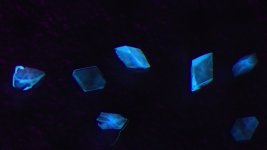
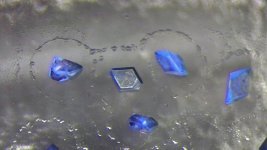
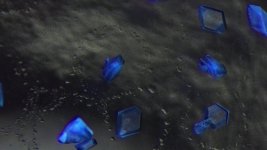
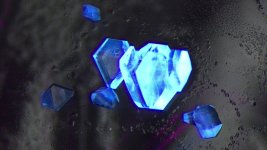
I've been searching for answers and sprinkled questions among different threads, gathering some theories. But I still haven't figured it out so I'm just going to start compiling my research here.
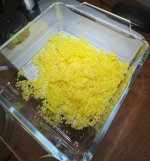
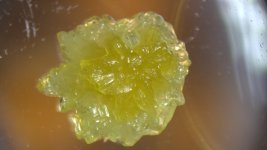
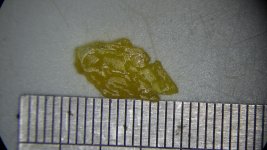
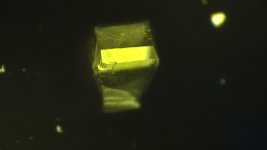
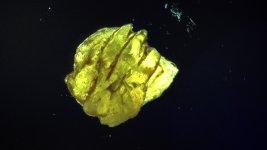
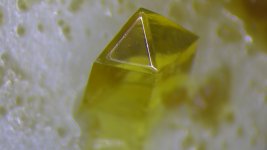
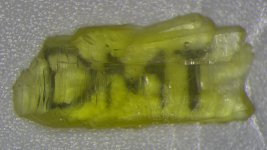
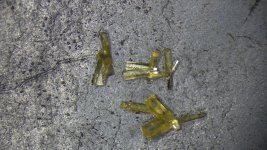
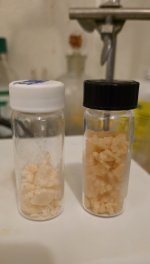
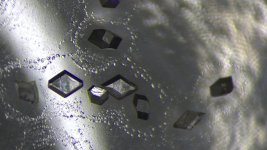
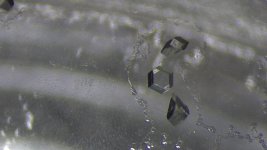
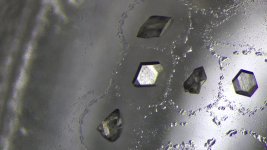
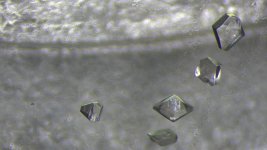
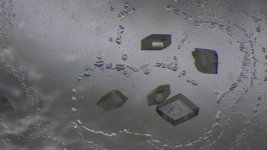
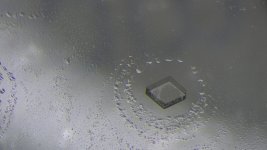
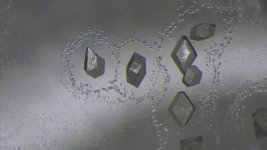
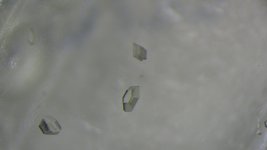
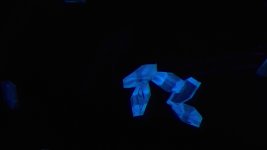
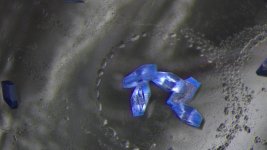
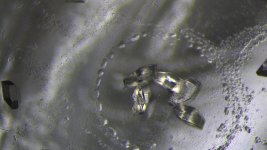
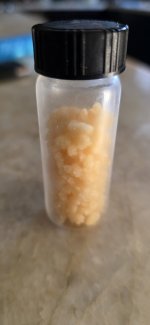
To summarize, I'm getting little prisms with nice morphology, but the color is yellow. Ever since the first pull on the bark the solvents have been yellow whenever the spice is dissolved. I really thought I escaped the color when converting to DMT-benzoate, because that salt was very white. But a water re-x of the benzoate powder still grew salt crystals with a yellow tint. And after converting back to freebase, the crystals grown are nicer and more transparent than ever, but still yellow.
View attachment VID_0071.mp4
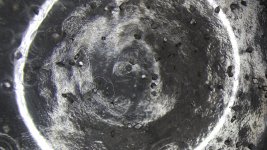
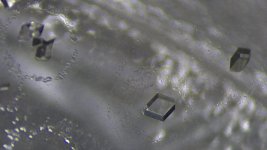
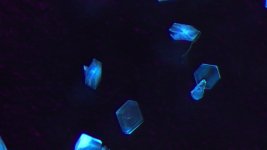
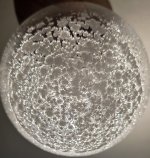
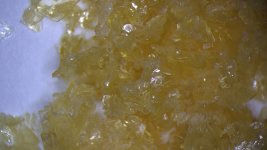
Included is a video example of one of the crystals. I was originally inspecting the geometry, but I also noticed that the color changes between yellow and colorless depending on what angle you're looking at the crystal. I posted this in a gemology community to ask them if this is pleochroism, and they seemed confident it was not. But it seems to fit the definition to me and no one explained their reasoning for why not.
Yet I have seen photos of DMT "diamonds" that seem unanimously colorless. So even if mine are pleochroic, that doesn't help me understand why mine are that way and others are completely colorless.
Ultimately, I'm trying to find a way to decolor it. Any suggestions?
Below is the process these have gone through so far.
I've targeted polymers during the acid phases of a couple mini A/B's. Both the saturated HCl and benzoic acid solutions were yellow though, and in the end hasn't removed any color. Non-polar solvent washes on the aqueous dmt salt solutions would turn the same yellow color. If allowed to rest for a day, the yellow color would fade, presumably back into the aqueous layer. I tried to separate the yellow with solvent washes but ran out of solvent before I could wash it out completely. It's inconclusive whether the solvent was pulling a yellow impurity or DMT itself.
NMT?
I targeted any potential NMT with a dry ice CO2 wash. I didn't see any goo precipitate though, nor did it affect the color of the solution. I may revisit this.
DMT-NO?
Apparently this is debunked, but N-Oxides are technically a potential culprit. I plan to try a zinc reduction just to see, but N-Oxide is supposedly water soluble, so it should have been well removed by now during the numerous washes and filtrations.
Polymorphs?
I did a melting point test and got 66-69 C. None of the other diamond growers have reported melting points; but in literature, other researchers reporting this melting point have reported colorless prisms. This seems to contradict some suggestions that there's a lower melting, colorless polymorph that slowly changes to the yellow, higher melting polymorph during storage or heating. Considering other people have gotten the higher melting polymorph without the color change. And I've seen pictures of yellow crystals that were not prismatic, but again no associated melting points reported. I'm not ruling out polymorphism but idk if there's enough data to conclude one way or another.
To summarize, I'm getting little prisms with nice morphology, but the color is yellow. Ever since the first pull on the bark the solvents have been yellow whenever the spice is dissolved. I really thought I escaped the color when converting to DMT-benzoate, because that salt was very white. But a water re-x of the benzoate powder still grew salt crystals with a yellow tint. And after converting back to freebase, the crystals grown are nicer and more transparent than ever, but still yellow.
View attachment VID_0071.mp4
Included is a video example of one of the crystals. I was originally inspecting the geometry, but I also noticed that the color changes between yellow and colorless depending on what angle you're looking at the crystal. I posted this in a gemology community to ask them if this is pleochroism, and they seemed confident it was not. But it seems to fit the definition to me and no one explained their reasoning for why not.
Yet I have seen photos of DMT "diamonds" that seem unanimously colorless. So even if mine are pleochroic, that doesn't help me understand why mine are that way and others are completely colorless.
Ultimately, I'm trying to find a way to decolor it. Any suggestions?
Below is the process these have gone through so far.
Polymers?I extracted at 60 celsius from MHRB, and got a yellow dusty waxy crude. Everything following was done at room temp.
I washed the solids with aqueous sodium carbonate solution a few times because I forgot to wash the naphtha pulls.
Then I dissolved the water-washed crude in a solution of HCl. I washed the aqueous dmt.hcl solution with naphtha a few times.
Freebased it again with NaOH solution and clouds of white precipitate settled into an orange oil above the salt water.
I pulled from the dmt oil / salt-water with hexane, and salted the DMT out of hexane with benzoic acid-saturated hexane, instantly crashing out insoluble DMT-benzoate. The hexane went back to pull more of the oil, where excess benzoic acid gets neutralized by excess NaOH.
After everything was pulled and converted to benzoate I vacuum filtered the solvent out the benzoate powder, and washed it with fresh hexane and naphtha a few times to pull off any stray freebase or benzoic acid residue.
Then I dissolved the benzoate salt in distilled water, and washed it with clean hexane and naphtha a few more times before freebasing it with NaOH again. I used hexane again to pull the freebase oil layer.
The combined hexane pulls were washed with dry ice, attempting to convert any NMT in solution to NMT-carbamate, which should have precipitated as a goo. No precipitation was observed, so I did not follow through decanting into another vessel. The solution sat for a day without precipitation. Then it was washed with aqueous NaOH solution once, clouding the hexane with presumably micro water drops. This sat for another day, and still had a minor haze.
The final solution flowed through 0.22 micron PTFE syringe filters, to block any micro water content, particles, spores, bacteria. The filtered hexane was crystal clear. In the crystal vessel, I hadn't even finished filtering the solvent before I could see sparkles smaller than dust forming.
Within 24 hours of just sitting there at room temp most of the growth had occurred, leaving 2mm sq flawless crystals. I got greedy and tried to slowly cool then freeze to grow them larger, and I think a few did grow, but most just got ruined by tiny growth nucleating off the gems.
I've targeted polymers during the acid phases of a couple mini A/B's. Both the saturated HCl and benzoic acid solutions were yellow though, and in the end hasn't removed any color. Non-polar solvent washes on the aqueous dmt salt solutions would turn the same yellow color. If allowed to rest for a day, the yellow color would fade, presumably back into the aqueous layer. I tried to separate the yellow with solvent washes but ran out of solvent before I could wash it out completely. It's inconclusive whether the solvent was pulling a yellow impurity or DMT itself.
NMT?
I targeted any potential NMT with a dry ice CO2 wash. I didn't see any goo precipitate though, nor did it affect the color of the solution. I may revisit this.
DMT-NO?
Apparently this is debunked, but N-Oxides are technically a potential culprit. I plan to try a zinc reduction just to see, but N-Oxide is supposedly water soluble, so it should have been well removed by now during the numerous washes and filtrations.
Polymorphs?
I did a melting point test and got 66-69 C. None of the other diamond growers have reported melting points; but in literature, other researchers reporting this melting point have reported colorless prisms. This seems to contradict some suggestions that there's a lower melting, colorless polymorph that slowly changes to the yellow, higher melting polymorph during storage or heating. Considering other people have gotten the higher melting polymorph without the color change. And I've seen pictures of yellow crystals that were not prismatic, but again no associated melting points reported. I'm not ruling out polymorphism but idk if there's enough data to conclude one way or another.