• Members of the previous forum can retrieve their temporary password here, (login and check your PM).

Working with wild spores - Panaeolus cyanescence

Migrated topic.

intosamadhi

Rising Star
Joined
May 5, 2008
Messages
121
Merits
42
Does anyone have any handy advice for working with spore prints made from wild mushrooms (ie non-sterile)? I am struggling to get the spores that I have collected to sporulate. I've gone through dozens of agar plates and all of them end up horribly contaminated with little to no signs of mycelium.

I've tried plain water agar, as I saw a video about using this as a way to get a small amount of mycelium to form without having bacteria overtake it too quickly, but that didn't work at all.

I've tried dropping spores on soaked and sterilized cardboard but nothing here either.

I'm using PDA for my plates. I sterilize everything with a pressure cooker and work in a still airbox trying to keep things as sterile as possible (which amounts to dousing everything with 70% ethyl alcohol). I've ordered a UV-C lamp which I will try on my next round of plates.

I managed to isolate what looked like healthy mycelium from one plate and have been growing that out and even made what looks like a healthy LC from it, but because I've only managed to do this once, I am a bit worried that it may not even be pan myc, and so would prefer not to rest all my efforts on one success.

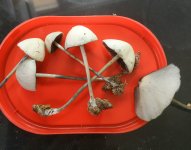
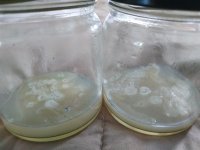
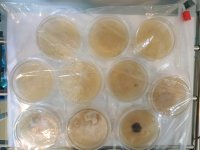
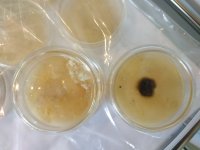
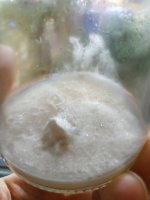
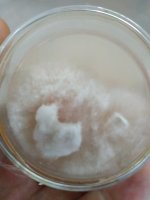
I've attached pictures of the specimens I made the prints from, some of the plates, and some of what I hope is healthy pan MYC. Any comments or tips welcome!
 

Attachments

  • pan-myc3.jpg
    pan-myc3.jpg
    342.7 KB · Views: 3
  • IMG_20210207_084853.jpg
    IMG_20210207_084853.jpg
    1.1 MB · Views: 3
  • agar3.jpg
    agar3.jpg
    273.7 KB · Views: 3
  • agar2.jpg
    agar2.jpg
    140.4 KB · Views: 3
  • agar1.jpg
    agar1.jpg
    123.8 KB · Views: 3
  • pan-myc1.jpg
    pan-myc1.jpg
    1.3 MB · Views: 2
  • pan-myc2.jpg
    pan-myc2.jpg
    1.1 MB · Views: 3
The healthy myc you have does very much look like Pan myc.

As it appears you have access to fresh mushrooms, consider cloning tissue from inside the carpophores.

You might want to look into using antibiotics in your agar in order to increase success rates with using spores.

There are methods involving adding hydrogen peroxide to the agar for decreasing contamination rates when transferring mycelium. H2O2 will kill spores so it cannot easily be used at the start of an agar run with spores.

What kind of technical set up do you have? Laminar flow hood? SAB/glovebox? What PC or autoclave?
 
downwardsfromzero said:
The healthy myc you have does very much look like Pan myc.

Well that's a relief! :d I've seen enough bacterial and mold growth now to know the difference, but because I've only gotten myc from one plate inoculated with spores and dozens of failures I keep doubting.

One thing I've noticed with all the plates that I've transferred the healthy mycelium onto is that the agar eventually starts turning dark after a couple of weeks. Is this just the agar drying out ?

downwardsfromzero said:
As it appears you have access to fresh mushrooms, consider cloning tissue from inside the carpophores.

Initially, this was my plan, but these little guys are so small I didn't see how I would be able to get any clean tissue from them. You reckon if I slice one of the caps with a sterile razor blade there'll be enough clean tissue in there to work with?

downwardsfromzero said:
You might want to look into using antibiotics in your agar in order to increase success rates with using spores.

Can you recommend anything that is easily available?

downwardsfromzero said:
There are methods involving adding hydrogen peroxide to the agar for decreasing contamination rates when transferring mycelium. H2O2 will kill spores so it cannot easily be used at the start of an agar run.

I looked into this, but since my transfer plates seem to remain healthy, it didn't seem so relevant for getting more spores to grow.

downwardsfromzero said:
What kind of technical set up do you have? Laminar flow hood? SAB/glovebox? What PC or autoclave?

Bear minimum at the moment. This is the first time I am growing and so have been building things up gradually. Just an SAB and PC. I've played around with the idea of building one of these cheapo flow hoods (ie strapping a HEPA filter to a box fan), but so far the SAB seems to be good enough. I'm prepared to keep investing in this as I start to see some results. Starting with Pan's is probably not the best move, but they are what's available around here.
 
It looks like you're doing pretty well with what you've managed to get through the process so far, tbh. I find it very cool that you have access to Pan. cyan.!

Useful article: https://www.researchgate.net/post/W...can-be-used-to-isolate-fungi-on-growth-medium
You'll see gentamycin and chloramphenicol recommended for bacteria, and cycloheximide for fungi. Unfortunately, cycloheximide is now recognised as being extremely toxic :?


You might just have been lucky but there's a chance you've selected for more vigorous and contam resistant genetics with the myc that you have.


One more thing - you should ditch those plates with obvious contams much more quickly. Dump them in a bleach bath for safety's sake, particularly the one with the big black blob.

Would you say the contamination appears at the inoculation sites or is there a chance that some of it is airborne?
 
Stash the agar with bacterial contam somewhere safe for couple of month and check up on them later. there is a good chance the bacteria will die out and mycelium will survive and will consume whatever is left of that contam and you will have nice fat blanket of myc to copy to another agar dish

Additionally, i see clean agar there (as much as the pictures allow the first, second and third pic).
cut little chunks of this agar and move it onto new plates. And repeat this after new plates have been colonized as many times as needed until the culture is clean.
(Use separate blades for each agar dish to avoid cross-contam)
 
intosamadhi said:
You reckon if I slice one of the caps with a sterile razor blade there'll be enough clean tissue in there to work with?
Even using a sterile razor blade, when you cut you will push contaminants from the surface into the interior tissue. Ideally, you can peel the stem open from the bottom (like string cheese) and scrape a tiny bit of tissue to transfer to agar. The sample can be smaller than a grain of rice.

As soon as you see mycelium growth on the agar, transfer tiny pieces from the edge of the growth to new agar plates (use a new sterile blade for each transfer). Wait for growth, and continue transferring to new plates until you have a clean culture. Don't dip the clone sample in peroxide or bleach as that will temporarily slow down the growth. The strategy is that healthy mycelium can initially outrun bacteria so you have a chance to get clean growth at the edge of the mycelium to transfer to new agar.

Good luck!
 
downwardsfromzero said:
It looks like you're doing pretty well with what you've managed to get through the process so far, tbh. I find it very cool that you have access to Pan. cyan.!
One of the benefits of living in Asia :d

downwardsfromzero said:
Useful article: https://www.researchgate.net/post/W...can-be-used-to-isolate-fungi-on-growth-medium
You'll see gentamycin and chloramphenicol recommended for bacteria, and cycloheximide for fungi. Unfortunately, cycloheximide is now recognised as being extremely toxic :?
All I can find locally for this is eye drops that contain chloramphenicol. I generally prefer doing no-pour-agar plates (ie sterilize the agar in the plates or jars in the PC rather than pouring into them after sterilization) because pouring inside my tiny SAB is a nightmare. Do you think I would need to add these drop after or could i just drop them in when I am prep'ing the agar?


downwardsfromzero said:
You might just have been lucky but there's a chance you've selected for more vigorous and contam resistant genetics with the myc that you have.
I hope so, because the plate that I pulled this from actually looked weird and bubbly when I first did the transfer and I thought it was a bust. But after a couple of days, the healthy stuff had spread across the plate, so I did a few more transfers from that and cleaned it up. This isolate which I am playing with has pretty vigorous growth, it colonizes the plates quickly and evenly, whereas the other transfers showed patchy and uneven growth, and some would just stall. Is that usual for pans?

downwardsfromzero said:
One more thing - you should ditch those plates with obvious contams much more quickly. Dump them in a bleach bath for safety's sake, particularly the one with the big black blob.
will do, this batch was a bit of a mess because I had just ordered these glass petri's but I couldn't get the damn parafilm to circle the plate and seal them properly, probably because they are tiny 60mm dishes and the parafilm kept slipping off the edge. So i got fed up and just dropped them in a zip lock. I will probably ditch them all.

downwardsfromzero said:
Would you say the contamination appears at the inoculation sites or is there a chance that some of it is airborne?
Definitely inoculation site. You can kind of see that in the pic of the jars above where there are rings of whiteish contam encircling the little black specs. Eventually, satellite colonies and all sorts of other nastiness appear if I leave them long enough, but the day after inoculation you can clearly see stuff spreading from each spore chunk.

I was also wondering if overdoing it with the spores also limits my chances of success, I scape loads onto the plates, sometimes just leaving them where they land and sometimes using an inoculation loop to smear them around. One would assume that more spores = greater chance of success, but in this case, because they are so dirty the more spores there are the more contam as well?

I was also wondering, since pan's love straw and manure, rather than starting with agar I could try to inoculate some sterilized manure or straw in small jars and then transfer from that if anything takes to clean it up?
 
intosamadhi said:
Do you think I would need to add these drop after or could i just drop them in when I am prep'ing the agar?
Found the answer in that article. Chloramphenicol can withstand autoclaving so I will just add it to the agar before. It says it should be used at 50mg/l concentration. So one of these little eye drop solutions (20mg) will only last for about 400ml of agar.
 
I eventually found a solution that doesn't involve anything fancy - manure based agar.

I read David Barlow's Copelandia tek when I first started experimenting with these. In there he advises the use of manure in the agar for this species, but in every forum I found people saying that this wasn't necessary or even risky, so I disregarded it. But after many failures using PDA, I gave it a try and every batch of agar I have done since has grown out usable myc.

My method now is to put 10g of cow manure in a jar with 500ml water, sterilize at 15psi for 2 hours and then combine the deep red liquid from the jar with agar to prepare my plates.

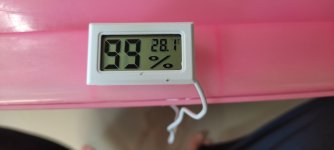
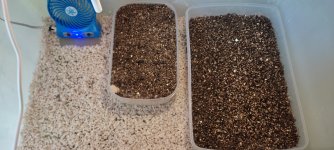
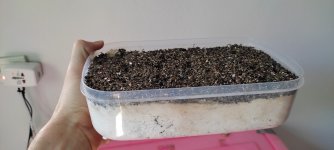
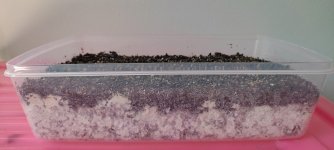
I now have several healthy cultures and have colonized several bulk substrates, experimenting with different mixtures. But, I am stuck getting these to pin. I have cased the substrate using a 50/50 verm & peat casing with calcium carbonate as a buffer. The first casing got completely overlaid so I scraped it and reapplied casing using more calcium carbonate and a little lime as well. The growing chamber has an led light on for approx 12 hours per day. The bottom is covered with damp perlite to keep the humidity high and I am spraying regularly. I also have a small USB fan running to provide FAE. The day temp's here are usually +85F, but at night I have AC going for about 8 hours which brings it down to about 75F. These little guys grow naturally here where the temperature varies similarly so I am hoping that this isn't going to be a problem. I've ordered some proper grow lights and a little ultrasonic humidifier to keep in the chamber too but I am just waiting for those to arrive. My hygrometer/thermometer says that the humidity is staying at 99% most of the time, but I have a feeling it isn't very accurate so I will be getting another one.

Any tips to get these things to pin would be greatly appreciated!
 

Attachments

  • IMG_20210726_094125.jpg
    IMG_20210726_094125.jpg
    53.2 KB · Views: 1
  • IMG_20210726_094141.jpg
    IMG_20210726_094141.jpg
    589.9 KB · Views: 0
  • IMG_20210726_094159.jpg
    IMG_20210726_094159.jpg
    315.4 KB · Views: 1
  • IMG_20210726_094332.jpg
    IMG_20210726_094332.jpg
    333.9 KB · Views: 1
intosamadhi said:
Does anyone have any handy advice for working with spore prints made from wild mushrooms (ie non-sterile)? I am struggling to get the spores that I have collected to sporulate. I've gone through dozens of agar plates and all of them end up horribly contaminated with little to no signs of mycelium.
In my opinion, especially when you're working with wild spores the best way is to use a small piece of spores, about 1-2mm at the tip of the scalpel.
Fill the syringe with boiling water and let it cool down. Throw these spores inside a syringe with cooled boiled water.
Just open the plunger of the syringe and throw the spores there, slightly mixing the spores in the water with a scalpel, and close the syringe. The spores should not be visible in the syringe. The water have to look almost clear. And it works great. The objective reason is fewer spores, fewer contaminants, respectively.
Agar is of course a good and professional thing, I still prefer to make a spore vial and inoculate the small grain sterilised in jar in the pressure cooker for 90 min, such as canary seeds or whole millet.
And inoculate jars with it.
I say what works great for myself. Of course, you can just inoculate agar with this syringe.
Syringe with low quantity of spores works the best for me.
 
Back
Top Bottom