Hi Nexians ! Has anyone ever tried 1-3 propanediol (trimethylene glycol) instead of propylene glycol for DMT e-cig juice ?
Peace
Peace


It's not PG (1,2 propanediol - propylene glycol), neither VG (glycerol). 1-3 propanediol (trimethylene glycol) is an organic compound which can be obtained by bio-fermentation of glycerol. It's less viscous than PG but I don't know about solubility and overall efficiency as PG substitute for DMT vape. That's the datas I'm looking for.So is that just VG / Vegetable Glycerine? As in DMT is not that dissolvable in it.
I'd remembered reading Vegetol in relation to VG, hence my comment. Happy to be wrong though.It's not PG (1,2 propanediol - propylene glycol), neither VG (glycerol). 1-3 propanediol (trimethylene glycol) is an organic compound which can be obtained by bio-fermentation of glycerol. It's less viscous than PG but I don't know about solubility and overall efficiency as PG substitute for DMT vape. That's the datas I'm looking for.

Link to the review is at the end of my previous postNice - so it has an established safety profile, does it? Please could you provide a link and some details here.
This does rather sound like a useful 'new' addition to the technological arsenal!

I'd have to see how easily obtainable the TG (1,3-PDO) is for me. In principle, anyone can determine a solubility level with a few pieces of relatively simple equipment.And now you are here, I was just wondering if a chemist like you could determine the solubility of DMT in this substrate, because I have the impression that it is better than in PG (which would allow for more concentrated juices), but at this stage it is only my impression, that needs to be confirmed (or not). I'm probably gonna vape it next week-end to see how it feels and works. I prepared a 1g DMT/1,3ml TG/1,2ml VG juice ready to go, which I'll try with this new promising sub-ohm tank.
OK, so toxicologically speaking we have a profile superior to that of PG:Link to the review is at the end of my previous post
It would be good to dig up the specifics of those references - the provision of a more explicit clarification of the safety profile is generally considered to be the responsibility of the person who first introduces the novel material to a space - or that's at least analogous to the rules we have here for discussing novel psychoactive substances.PDO is GRAS certified (“Generally Recognized As Safe”) by FDA<a data-track="click" data-track-action="reference anchor" data-track-label="link" data-test="citation-ref" title="US FDA GRAS Notification Program available at https://www.fda.gov/downloads/Food/IngredientsPackagingLabeling/GRAS/oticeInventory/ucm269352.pdf (2017)." href="Physical and chemical assessment of 1,3 Propanediol as a potential substitute of propylene glycol in refill liquid for electronic cigarettes - Scientific Reports">21</a>. In a recent inhalation toxicity study, PDO tested at 1800 mg/m3, PDO does not appear to pose a significant hazard via inhalation of either the gas phase or a gas/aerosol mixture<a data-track="click" data-track-action="reference anchor" data-track-label="link" data-test="citation-ref" title="Farsalinos, E. K. et al. Comparison of the Cytotoxic Potential of Cigarette Smoke and Electronic Cigarette Vapour Extract on Cultured Myocardial Cells. Int. J. Environ. Res. Public. Health 10 (2013)." href="Physical and chemical assessment of 1,3 Propanediol as a potential substitute of propylene glycol in refill liquid for electronic cigarettes - Scientific Reports">17</a>. In cosmetics, 1,3-propanediol is recognized and used as a non-irritant alternative to PG<a data-track="click" data-track-action="reference anchor" data-track-label="link" data-test="citation-ref" title="Scott, R. S., Frame, S. R., Ross, P. E., Loveless, S. E. & Kennedy, G. L. Inhalation Toxicity of 1,3-Propanediol in the Rat. Inhal. Toxicol. 17, 487–493 (2005)." href="Physical and chemical assessment of 1,3 Propanediol as a potential substitute of propylene glycol in refill liquid for electronic cigarettes - Scientific Reports">22</a>.
Ok, I somewhat naively thought that it could be determined simply based on the physico-chemical properties of 1,3-PDO.I'd have to see how easily obtainable the TG (1,3-PDO) is for me. In principle, anyone can determine a solubility level with a few pieces of relatively simple equipment.
Looking forward to hearing more of how the new juice works for you!
PDO is doubtless stable upon heating when EC are used in recommended conditions (250 °C).
PDO seems to have better thermal behavior showing less thermal decomposition by-products compared to PG and VG.
Sure. I guess if it's sold legally in France as PG substitute, safety profile is probably not bad but we definitely have to investigate deeper that aspect (if the PDO happens to be suitable for DMT e-cig juices from an efficiency standpoint).It would be good to dig up the specifics of those references - the provision of a more explicit clarification of the safety profile is generally considered to be the responsibility of the person who first introduces the novel material to a space - or that's at least analogous to the rules we have here for discussing novel psychoactive substances.
The paper with the physicochemical properties was worth a good skim at the very least, so I'll acknowledge the GRAS status again (while resisting the temptation to veer off on too cynical a tangent regarding thatOk, I somewhat naively thought that it could be determined simply based on the physico-chemical properties of 1,3-PDO.
For those wondering about safety profile, you included if you didn't have time to read the review, here is a quote from the conclusion :
After the tests I'm planning we'll now if it could be a serious substitute candidate to PG. PDO is quite easy to obtain, at least in France : I bought it from an online vape shop.
I'll keep the community informed of my future experiments with it.
 )
)Hello, moi c'est Cyryl et je débute. Tu me conseilles d'acheter quelle vapoteuse et quel mélange GP/VP dans lequel dissoudre mon gramme d'épice ?Hi Nexians ! Has anyone ever tried 1-3 propanediol (trimethylene glycol) instead of propylene glycol for DMT e-cig juice ?
Peace
Bitte mal auf EnglischHello, moi c'est Cyryl et je débute. Tu me conseilles d'acheter quelle vapoteuse et quel mélange GP/VP dans lequel dissoudre mon gramme d'épice ?
Salut Cyryl, je te suggère de créer un post dédié et j'y répondrai éventuellement. On va tâcher de garder ce thread centré sur le sujet indiqué dans le titre (le trimethylène glycol comme substitut au PG). Aussi, l'anglais est la langue préconisée sur ce forum, tu peux utiliser un traducteur en ligne si tu n'es pas à l'aise avec la langue de Shakespeare.Hello, moi c'est Cyryl et je débute. Tu me conseilles d'acheter quelle vapoteuse et quel mélange GP/VP dans lequel dissoudre mon gramme d'épice ?
Ok d'accord, thanxSalut Cyryl, je te suggère de créer un post dédié et j'y répondrai éventuellement. On va tâcher de garder ce thread centré sur le sujet indiqué dans le titre (le trimethylène glycol comme substitut au PG). Aussi, l'anglais est la langue préconisée sur ce forum, tu peux utiliser un traducteur en ligne si tu n'es pas à l'aise avec la langue de Shakespeare.
Dans tous les cas je t'invite à découvrir et explorer le forum, la question des e-cigs et autres y est déjà bien présente.

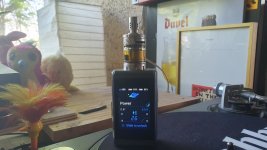
Positively poeticWell, I finally dipped my toes in the PDO
 as is the rest of your nicely-written account.
Glycerol feels warm in the mouth, perhaps it could be a mild chemoreceptor effect, since PDO is just glycerol minus the middle oxygen atom. And you did, of course, add VG to the mix as well.One thing I noticed is a kind of quite unusual heat feeling on the throat.