Thanks everyone!
Mailorderdeity: that sounds like a cool idea. The most important thing in making an object appear luminous is in how the light coming from that object interacts with surrounding objects and surfaces. If you look at my stuff in the member gallery you'll see that this is something I'm kind of fixated on. For many of these pieces I modeled references, either digitally or using good old fashioned clay, in order to have a realistic idea of how the light would really interact. This has made it possible for me to achieve similar effects without references as well. It's been a process of studying light.
Mr. P, glad you could be part of the unfolding of the creative potential here. It's a group experience for sure.
Art, any time you need a nudge out of a rut, try collaborating with someone. It's fun and takes you out of your comfort zone in a good way. Also, I'll say it again... You're way too freaking hard on yourself. Your contributions here are always refreshingly original.
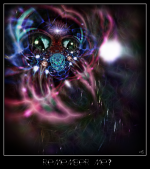
Orion- I build references only a small percentage of the time, usually when I'm looking to push myself up a notch and am ready to take on the extra work. This contributes to an overall understanding of light and shadow, and the more you do this kind of exercise, the more this kind of realistic rendering will become second nature. This painting was done with no reference and in fact no preparatory sketch. I had expected to have no painting time during the event (being one of its organizers) so I really just kind of closed my eyes and started stabbing away with the brush, plugging into some subject matter that is familiar to me. Having Alex Grey painting at the next easel over can be both inspiring and a little intimidating.
I would recommend that you try getting a little more set up digitally, so that at bare minimum you have Photoshop for compositing and such. In the meantime, picture this: pick up about 5 pounds of white plasticine (modeling clay that doesn't dry). Reconstruct the face in your sketch using plasticine (half the head would be fine, built on a slab of wood for support, using tin foil as filler). Set up some lights- possibly a cool and a warm- and move them around the model, find a dynamic combination. Photograph this and use the photo as reference when you paint. If you don't have access to a projector, you can have the reference printed at full size on archival canvas at super low contrast, stretch it, spray with acrylic matte medium, paint right over it. (I prefer projecting and tracing, but there are a lot of right answers to this).
By adding some new steps to your process you might be able to approach a familiar subject from a new angle.