• Members of the previous forum can retrieve their temporary password here, (login and check your PM).

Beta Substituted Tryptamines

Migrated topic.

AlbertChemist

Rising Star
Merits
50
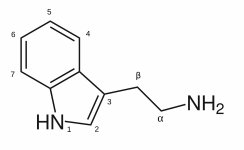
My question is about tryptamines which are substituted (have a group) at the beta position of the tryptamine molecule (see picture) below.

Does anyone have experience with consuming a tryptamine which has a beta substitution? If so what are the effects? For the chemists: Is it even chemically possible to create such a substitution?

I have looked through Tihkal and there is no mention of a beta substituted tryptamine. 6 and 7 substituted tryptamines seem to have little to no effect, which is why they aren't often seen, but all other positions when substituted can produce some interesting effects. But the beta position seems to be left out of the discussion entirely.

I'm very curious to hear your thoughts in any way shape or form!


Tryptamine - Wikipedia
 

Attachments

  • 1920px-Tryptamine_structuresvg.jpg
    1920px-Tryptamine_structuresvg.jpg
    58.6 KB · Views: 0
AlbertChemist said:
My question is about tryptamines which are substituted (have a group) at the beta position of the tryptamine molecule (see picture) below.

Does anyone have experience with consuming a tryptamine which has a beta substitution? If so what are the effects? For the chemists: Is it even chemically possible to create such a substitution?

I have looked through Tihkal and there is no mention of a beta substituted tryptamine. 6 and 7 substituted tryptamines seem to have little to no effect, which is why they aren't often seen, but all other positions when substituted can produce some interesting effects. But the beta position seems to be left out of the discussion entirely.

I'm very curious to hear your thoughts in any way shape or form!


Tryptamine - Wikipedia

Of course it is synthetically possible to create such a molecule.

Thought they remain largely unexplored since they are thought to mirror that of the beta-substituted phenethylamines.

Beta substitution largely seems to reduce activity or result in unpleasant or adverse physical effects without much psychedelic activity, explored in the BOx. BOD being the most worthwhile https://erowid.org/library/books_online/pihkal/pihkal014.shtml

beta-substitution does not increase potency by preventing MAO metabolism the way that alpha-methyl substitution does, at least typically.

The most remarkable exception however is in the case of the benzocyclobutenes (TCB-2) where potency is close that of LSD, with what is technically a beta-substituion.

so overall, beta-substitution is usually not good, but many exceptions exist. Much of it remains unexplored. A few things I'd like to try with it as well, i wonder how fluorine behaves in the beta-position. It should be small enough to mimic hydrogen, so to avoid losing activity through sterics.
 
Not sure if such analogy should be drawn between phens and trypts. In trypts, that beta carbon is 1 carbon further away from the aromatic ring than in phens. And to me subtitutions seem to work differently in phens X trypts.
Trypts are psychedelic when the N is subtitutes at least once, ideally twice.
Phens are psychedelic when N is not subtituted, and when it is they turn into stimulants.
 
skr_nexus said:
Not sure if such analogy should be drawn between phens and trypts. In trypts, that beta carbon is 1 carbon further away from the aromatic ring than in phens. And to me subtitutions seem to work differently in phens X trypts.
Trypts are psychedelic when the N is subtitutes at least once, ideally twice.
Phens are psychedelic when N is not subtituted, and when it is they turn into stimulants.

Obviously N-N- alkyl tryptamines are different from phenethylamines in general.
Tryptamines are only truly active when substituted twice at the amine, mono-alkylated tryptamines really aren't significant, and usually offer different activties. While in reverse, phenethylamines are only active as primary amines, and lose activity entirely at ht2a when N-methylated.

It's drawn this way because alpha-methyl tryptamines very much mirror the activity of the alpha-methyl phenethylamines

alpha methyl tryptamine, aMT, is an active psychedelic as a primary amine, and as well contributes significant MAOI and monoamine reuptake and releasing action that some of the phenethylamines show (in this case closer related to PMA and MDxx). On top of that aMT loses its serotonin agonism with N-alkylation, just like the phenethylamines do.

I don't make the rules, I agree its no reason to dismiss it entirely, I'm just offering an explanation why this remains unexplored. It just means chemists have better ideas they want to explore first.


In trypts, that beta carbon is 1 carbon further away from the aromatic ring than in phens.

you are thinking about this incorrectly.

You should treat the indole ring as an analogue as the phenyl ring, at least in this case. And this is how it substitutes in the receptor.

You shouldn't treat the C3 carbon of the indole as a 'beta' carbon analgoue of a phenethylamine. First of all it doesn't freely rotate, it just doesn't substitute. You have to think of these things dynamically. Two completely different species.
 
Beta substitution largely seems to reduce activity or result in unpleasant or adverse physical effects without much psychedelic activity, explored in the BOx. BOD being the most worthwhile Erowid Online Books : "PIHKAL" - #14 BOD


The most remarkable exception however is in the case of the benzocyclobutenes (TCB-2) where potency is close that of LSD, with what is technically a beta-substituion.


Wow thank you so much for this informative response! I'll be sure to read up on these topics more! Also please do share your experience if you ever get the chance to work with a tryptamine which has a fluoro group at the beta carbon.
 
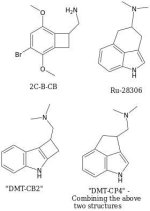
Interesting topic. The TCB's are indeed the exception when it comes to beta substitutions. This reminds me also of the conformationally restricted DMT analogue known as Ru-28306. A cross between this and the TCB type conformational restriction would give rise to a five-membered ring bridging between the pyrrole and benzene rings of the indole moiety.

Picture attached for your perusal. Extra bonus points go to whoever comes up with the correct IUPAC name for the "DMT-CP4" molecule!
 

Attachments

  • DMT-CB.jpg
    DMT-CB.jpg
    13.8 KB · Views: 0
Back
Top Bottom