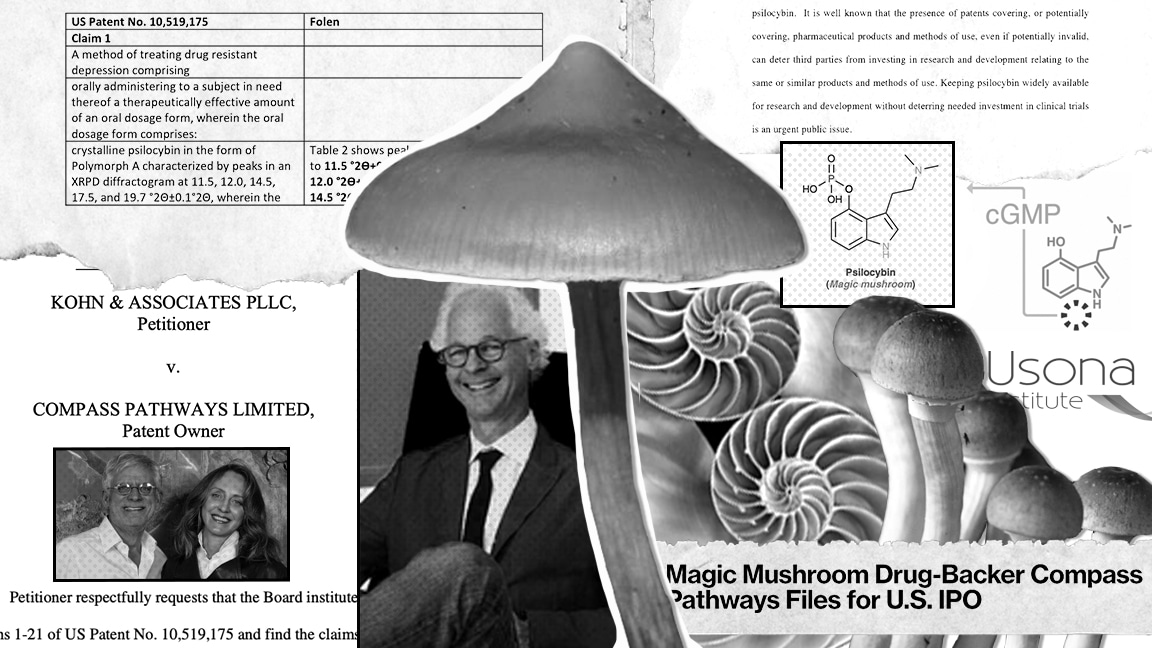
The legal wrangling over U.S. Patent No. 10,519,175 (the ’175 patent) began shortly after issuance. Kohn & Associates, PLLC filed a petition for Post Grant Review of the ’175 patent with the Patent Trial and Appeal Board (PTAB) at the United States Patent and Trademark Office (USPTO) on February 21, 2020 (Kohn & Associates, PLLC v. Compass Pathways Limited, Pet. for Post-Grant Review, PGR2020-00030, filed February 21, 2020). The petition identifies Kohn & Associates, PLLC as the real party in interest. The petitioner asserted that the claims in the ’175 patent are invalid and should never have been granted because they are obvious in view of articles in scientific literature that published before the priority date of the patent. Claim 1 of the ’175 patent reads:
A method of treating drug resistant depression comprising orally administering to a subject in need thereof a therapeutically effective amount of an oral dosage form, wherein, the oral dosage form comprises:
crystalline psilocybin in the form Polymorph A characterized by peaks in an XRPD diffractogram at 11.5, 12.0, 14.5, 17.5, and 19.7o2θ ± 0.1o2θ, wherein the crystalline psilocybin has a chemical purity of greater than 97% by HPLC, and no single impurity of greater than 1%; and silicified microcrystalline cellulose.
The PTAB has set a deadline of May 26, 2020 for the Patent Owner to file a preliminary response to the petition, but noted that the Patent Owner may elect to waive the preliminary response in order to expedite the proceedings. Under the USPTO rules, we can expect a decision by the PTAB to either institute the review process or reject the petition within six months. We know from the cannabis industry that the PTAB treats disputes relating to claims covering cannabis no differently than claims to any other technology. So, we can expect that whatever the PTAB decides, the Schedule I status of psilocybin is unlikely to factor into that decision.