Interestingly enough - Hyperion never came on my radars.
Really enjoyed the first book, but then - it just went downhill. Kinda feels like the author had the story well thought and figured out - but somewhere around beginning of the Fall of Hyperion - the storyline notes book got lost to a house fire and he had to wrap it all up with something else... Too many logical incongruences - even for a brain freshly massaged by psychedelics.
Have the next two books of the series and no taste to open it... Yes, I'm totally spoiled.
If I had to throw in my .02cents to the list - these two should be on it:
Heinlein - Stranger in a strange land
Nathalie Henneberg - The Plaigue
don't believe - the latter is available in audio format in English, however - being originally written in French - it can also be found in other languages
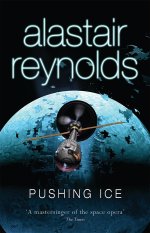
Last night I finished reading Pushing Ice by Alastair Reynolds and I have mixed feelings about it. I think it could have easily been in the top 3 Reynolds' works ever, but it has a few glaring issues that might be hard to look past for some people.
First off, it's pretty long - about 450 pages. One of the things that stood out to me as uncharacteristic of Reynolds' work is the pacing. Usually his plots are driven forward in a carefully calculated and well-paced manner, but in this one it feels like he missed the mark big time.
The central power struggle around which the whole book revolves seems to drag on for an unnecessarily long time, going into excessive details that bring almost no value to the plot itself. Some critics have (fairly) called this book the closest Reynolds has come to writing pure drivel, and while I love his work with all my heart, I have to agree. Some sections dragged on way past their welcome while contributing nothing.
Which is extra unfortunate, because this dilutes the absolute masterpiece that the rest of the novel is. The ideas Reynolds explores are nothing short of breathtaking. If he had focused less on the petty power struggle and more on the central idea of this book, I would easily classify it as perhaps the best first contact novel ever written.
Spanning over a vast stretch of time, littered with arcane and bizarre alien technology, and brimming with major plot twists, Pushing Ice is a journey that, when stripped of the unnecessary filler an fluff I mentioned above, is a thrilling sequence of events that get crazier and crazier. Just when you go through one major twist and you think to yourself "there's no way it gets crazier than this," it proceeds to get crazier than this, and then some. This keeps going all the way to the end, culminating in a peak of weirdness and a haunting sense of longing for more, while also getting closure on a few loose ends.
So who is this book for? If you are someone that doesn't mind a slightly choppy pacing that goes through large swaths of character development via interpersonal conflict and a power struggle, while also being someone that craves incomprehensible alien technology and a damned good first contact story, then this is a book you will probably thoroughly enjoy.
Now I will share a few of the things that rubbed me the wrong way about Pushing Ice, as well as a few things that I found utterly fascinating. Fair warning, the following section contains major book spoilers!
There are a few things I found kind of corny and a bit unexpected from Reynolds:
The absolute Deus Ex Machina that was Chromie - I get that humanity was incredibly advanced by the time her consciousness was encoded into the cube, but to have her pop out and suddenly be able to read the blueprint file for a completely alien artifact - the Endcap Key - is just ridiculous. I understand she would've been able to read forge vat blueprint files since it was human tech, but to be able to spot the errors in the alien tech and to even correct them was just a convenient plot device that made no logical sense.
Another awfully convenient thing that happens is the cube ending up orbiting around Janus inside the Structure. Throughout the novel it's made abundantly clear that the Structure is basically an enclosed environment that can be entered only by some obscure means that resemble teleportation (or blowing up a hole in its walls, of course). The cube is not made part of the story until way into Janus being inside the Structure. So how did it end up there, and why is it conveniently orbiting the very structure that holds its end goal - Bella?
Since the cube's only purpose was to find Bella, why was it designed in a way that completely obscures its purpose to people that are not Bella? Why put the Vitruvian man on the side instead of Bella's face? Why risk the cube ending up in the right place, but never reaching Bella because nobody thinks to have her specifically touch it? Could it be that Reynolds just needed the 20+ years it sits idle as a plot device? From where I stand, it seems like the only reasonable explanation, and that's just weak and utterly unexpected by Reynolds.
And the thing I found the most fascinating is, of course, The Structure. The idea that some hyper-advanced and now potentially extinct species created a "zoo" where spacefaring species are carried in on pseudo-moons like Janus and made to co-exist in this utterly massive tangle is incredible to me. When the existence of the "Nexus" (hehe) is revealed, and the concept of a society of over 30 species existing in this section of the Structure is revealed, and then it is put in the context of the unimaginable size of the whole structure, you realize there are probably a few orders of magnitude more species existing in the whole thing, forming rivalries, political structures, waging wars, cohabiting, and doing whatever it is that creatures do when locked in the same room. Really sets your mind going.
And then you get the hint that there is some apex predator lurking outside the Structure - potentially the thing that is to be blamed for the missing Spicans - poses a few more questions that are just begging for a sequel.
Overall, I would rate this novel a 5/5 on ideas, but a 2/5 on pacing and character development. Still, with the things that are revealed in the last third of the book, I think this is one of the most sequel-worthy novels Reynolds has ever written, and I do sincerely hope we get a sequel at some point. The Structure NEEDS to be explored further, the potential there is practically limitless.
Considering this book is now 20 years old, I believe if we were to get a sequel, the pacing and characters would be significantly better because Reynolds has improved dramatically over the years.
If you got this far, you're a real sci-fi enthusiast, and I applaud your patience and thank you for your time.
A few days ago I finished reading A Memory Called Empire, the first book in the Teixcalaan Series, written by AnnaLinden Weller (under pen name Arkady Martine). It is her debut space opera, and one I thoroughly enjoyed. I'm not one to particularly enjoy politics-heavy science fiction, which this book definitely is, but even so, I found it surprisingly easy to read, and the pages kept turning as I frequently lost track of time. This is perhaps reinforced by the fact that both books in this series won the Hugo, with the second winning the Locus as well. It's not often you see someone enter this saturated market and immediately find success like that.
She's got a couple dozen short stories under her belt, but I have to say, the prose quality in this book caught me by surprise. It reads like someone that has been writing long-form for a very long time. It is complex, funny, layered, quite clever, and an absolute joy to read. Despite the novel not having any grand, super dramatic ending, it does leave a very big open door for the sequel, which I am reading right now.
All that is to say - if you're a fan of deep plots with rich character- and world-building, thickly layered with complex politics, you will probably enjoy this book quite a lot.
Another vote for Hyperion (the first one) from me. It really is excellent.
I read a mixture of genres and have not delved deeply into sci-fi in particular. However I can also vouch for Iain M. Banks. Consider Phlebas or The Player of Games are good jumping-off points.
Ian Banks' non-sci-fi work (published without the 'M') is also very good, although off-topic for this thread of course.
Been a few days since I finished reading A Desolation Called Peace, the second and currently last book in the Teixcalaan Series by Arkady Martine. I'm left with rather mixed feelings for a few reasons. First, the good.
The core of this novel is first contact with an alien species, and the main conflict revolves around communication and the challenge of linguistics. While it had its questionable moments, the pacing of the plot (when it got to that point) was just right, and the aliens are equal parts fascinating and terrifying. I particularly liked how the conflict is resolved and what choices were made regarding that.
However, all of that is made less enjoyable by the rather poor character development that takes place in the book, and the time it takes to expo-dump and explore micro-narratives that expose how certain characters feel, yet doesn't drive the plot even an inch forward. The dynamics between the main characters are boring and childish, the conflict between them is superficial and unsatisfying, and the there is a particular scene that takes place, which the reader will be consistently reminded of throughout the rest of the book for no reason whatsoever, to the point where it got kind of annoying.
Furthermore, the book leaves WAY too many questions unanswered. I understand what Martine is doing - she wants to leave the door wide open for a third book in the series, perhaps hoping some obscenely rich media network is going to come knocking at her door like what happened to Andy Weir - but still, leaving that many loose ends results in the reader being left, for a lack of a more suitable term, blue-balled
I really wish she had put more effort in developing the main characters and finding interesting ways to answer some of the questions that were left dangling, but it is what it is. Still, considering this is her second novel ever, I think she did a pretty good job and am looking forward to her next books. The world she has built so far has great potential to hold a plethora of interesting stories.
The core of this novel is first contact with an alien species, and the main conflict revolves around communication and the challenge of linguistics. While it had its questionable moments, the pacing of the plot (when it got to that point) was just right, and the aliens are equal parts fascinating and terrifying. I particularly liked how the conflict is resolved and what choices were made regarding that.
I was thinking about just this theme recently. Sci-fi books tend to focus on linguistics and how difficult it'd be to communicate. What about a more basic level? Our very biology may differ. We may have a different set of senses, or their spectrum may be much wider. For all we know, alien biology could be built on a totally different chemistry than ours. We still don't know if we as humans see the same picture. We kind of agree through words, but it's a limited set of descriptions. What about a larger neural system and a much higher intelligence than ours? How would we start a communication with an ant?
What I'm trying to say here is that alien life could be so alien that we can't even recognize it. Communication would be the last of our problems when the picture we see is completely different. Even logic and reasoning could evolve in a different direction. How can we find something in common with such a creature?
Further, even our own assumptions about humans are biased. We're not just bodies, but a culture too. You'd not connect to a person who was brought up isolated outside society. We can even question if he would be truly human. So, given a different culture based on a fundamentally alien set of basic beliefs, we'd get a human who is unrecognizable by our standards. Do you follow where I'm leading? What kind of mind could create the pyramids, for example? We try to recreate them based on our model of reality. The humans who built them could just as well be aliens to us, even if our biological bodies are the same.
I feel world systems like this planet are isolated by design. Space travel is actually low-tech, and the real juice is in inner exploration. At some point, the distinction between inner and outer melts away. Sorry for my rant. In no way am I trying to diss sci-fi. It's just that I see the same pattern in every book. Where is something so new that blows my mind wide open?
What I'm trying to say here is that alien life could be so alien that we can't even recognize it. Communication would be the last of our problems when the picture we see is completely different. Even logic and reasoning could evolve in a different direction. How can we find something in common with such a creature?
It depends what your expectations for that "common" point are. When you look at a deep-sea mollusc, it might as well be an alien - the only common things we have with it is that we're mostly made out of carbon arranged in various ways, we eat, and at some point we die. But that's already plenty to "connect" on. You may not connect with it verbally, or bidirectionally. But you can find common ground in the very fact that it IS life and it's doing the same thing you are - surviving. It's just doing it in a different way, in a different environment.
We're not just bodies, but a culture too. You'd not connect to a person who was brought up isolated outside society. We can even question if he would be truly human.
It is true that culture is just as much a part of humanity as biology, but I'm not sure I would argue the humanity of someone that was brought up "in the wild". Connecting with someone like that could still take place, just on a much more rudimentary level. You don't need to raise someone in society to have them enjoy food, or comfort, or even music, even if they've never heard it before. Just like in the previous example, you can connect with that person on the level of just humanity, and that might be enough.
Well, it really depends how you define "tech". It's mathematically true that if you compare humanity to the largest thing we can guess exists (the Universe itself), and the smallest thing we guess exists (Planck length), we are many orders of magnitude closer to the size of the Universe than we are to Planck length. Without making too many assumptions in a row, it would be rather logical, given what we currently know, to assume that exploring inwards might indeed lead to much more revelation than exploring outwards. And yet, I feel like both have equal value in upholding "the balance".
Sorry for my rant. In no way am I trying to diss sci-fi. It's just that I see the same pattern in every book. Where is something so new that blows my mind wide open?
No worries brother, I always enjoy talking about stuff with you, since you have such a unique perspective on many topics. I think there's plenty of sci-fi that can blow your mind, certainly much more than you have the time to read, but a good start would be Alastair Reynolds, especially his House of Suns novel which I've yapped about on the forum far too much already
As a side note, I haven't read the book it's based on, but the recent sci-fi movie 'project hail mary' was quite enjoyable for me and this alien communication theme was central
As a side note, I haven't read the book it's based on, but the recent sci-fi movie 'project hail mary' was quite enjoyable for me and this alien communication theme was central
That was why I mentioned Andy Weir in my post above. I still haven't read anything of his beyond The Egg, and I've watched The Martian, but Project Hail Mary is definitely on my list, though I don't have expectations that go too far, considering how spoiled I feel with all the amazing sci-fi I've had the opportunity to read.
No worries brother, I always enjoy talking about stuff with you, since you have such a unique perspective on many topics. I think there's plenty of sci-fi that can blow your mind, certainly much more than you have the time to read, but a good start would be Alastair Reynolds, especially his House of Suns novel which I've yapped about on the forum far too much already
Thanks for putting up with me and answering so coherently. I'll give that book a try. The last one that made me think about what being human means was "The Left Hand of Darkness" by Ursula K. Le Guin. It's not about aliens per se, but somehow it caught me off guard.
I shared my rant because a few days ago, before falling asleep, a thought came about how we could connect with a life form so different from us that there is no apparent common ground. Somehow it blew my mind the same way as if you try to really imagine how far it's to the sun. Just sit and imagine how long it would take to go there. It actually blows my mind and I see my limits.
I love this thread. It reminds me to read more. Back in the day, I read so many books on a tiny Palm Pilot, and now when everything is so easy, I don't read as much.
It's kind of sad.
Thanks for putting up with me and answering so coherently. I'll give that book a try. The last one that made me think about what being human means was "The Left Hand of Darkness" by Ursula K. Le Guin. It's not about aliens per se, but somehow it caught me off guard.
I shared my rant because a few days ago, before falling asleep, a thought came about how we could connect with a life form so different from us that there is no apparent common ground. Somehow it blew my mind the same way as if you try to really imagine how far it's to the sun. Just sit and imagine how long it would take to go there. It actually blows my mind and I see my limits.
I love this thread. It reminds me to read more. Back in the day, I read so many books on a tiny Palm Pilot, and now when everything is so easy, I don't read as much.
It's kind of sad.
Do it, read more. It's so good. House of Suns is perhaps his best standalone novel. Really cool ideas in there, even though they don't revolve around linguistics and communication.
I just finished reading Solaris by legendary polish science-fiction author Stanisław Lem, whose work I've been sleeping on for far too long. I'm probably quite late to the party, but better late than never. By recommendation from my brother, I picked this one up, and to say it shook me to my core would be an understatement. I'll try to keep my ramblings spoiler-free as much as I can.
Despite the fact that I read an English translation, the prose and the visceral symbolism in this book were an absolute joy to experience. Over the decades, a lot of sci-fi that involves first contact has been written. The aliens have taken many different shapes, and humanity's interaction with them has always fallen into more or less several categories - conflict, peaceful coexistence, or some kind of mutually-beneficial deal, with some novels dipping into immoral exploitation of either side.
Solaris, on the other hand, collides humanity with such an incomprehensibly weird lifeform that it defies all explanation. It is about as "alien" as an alien can get. Lem calls it a "defective god" in the novel for a very good reason. The psychological torture comes from the realization that this thing is not only unknown, but may also be unknowable. It is so unutterably different and bizarre that it goes against everything a human being can conceive of. Neither science nor religion can chip away at the mystery that surrounds it.
Even though the entire novel's plot develops in the insides of a small station on the planet, Lem masterfully weaves the story such that it feels enormous, bigger than the mind can capture, precisely because the nature of that which we are up against cannot be reasoned about, cannot be understood, is paradoxical, and completely unpredictable.
There are few things in the universe that humans are more afraid of than the truly unknowable. Most of us just don't realize that. And yet, in this ambiguous space filled with questions and uncertainty, a certain place of liberating comfort can be found by everyone, as long as one is willing to leave behind humanity's preconceived notion of what "life" is, what consciousness is, and what constitutes sentience.
Solaris is a masterpiece of the exploration of human psychology and of what profound alienness truly means. I could not recommend it enough. The ending was slightly disappointing, but the concepts it explores are worth it IMO.
It's a pity I don't know Polish because I'm certain the book would be even better in original. I loved it so much that I've got 4 more of his most popular books on my Kindle, ready to go. I'm doing a Lem deep-dive, and I'm so ready for it.
This book feels like an answer to my previous post about an absolutely alien intelligence.
Maybe I was subconsciously thinking about Solaris back then.
Lem is a gem
This book feels like an answer to my previous post about an absolutely alien intelligence.
Maybe I was subconsciously thinking about Solaris back then.
Lem is a gem
I didn't connect these two dots, but you're 100% right hahaha what a funny little coincidence Even though I found the story conclusion quite unsatisfactory, the concept hooked me very well. I'll see what else Lem has to offer.
This book feels like an answer to my previous post about an absolutely alien intelligence.
Maybe I was subconsciously thinking about Solaris back then.
Lem is a gem
Inability to understand alien intelligence is one of the main themes of Lem's book. 'His master's voice' is another example.
'Roadside picnic' from brothers Strugacky is also similar.
I'm looking forward to that one for sure, but I will go through The Invincible and The Cyberiad first, as I'm going through them in chronological order for whatever reason
Not to mention it spawned the international phenomenon of Stalker media - games, LARP events, movies and a plethora of art. I need to re-read it, it's been nearly two decades since I read it. Thanks for reminding me.
Not to mention it spawned the international phenomenon of Stalker media - games, LARP events, movies and a plethora of art. I need to re-read it, it's been nearly two decades since I read it. Thanks for reminding me.
Oh yeah, the Stalker world is huge. In my country there was a regular LARP event themed entirely around that world and I participated in one of those events back in 2016, it was exceptionally cool. It took place in an old abandoned military complex with a huge flooded basement, there were over 200 people playing, a portion of whom were in the mutant faction and had some very unsettling costumes and noise-makers. You can check some photos from that specific event (as well as all others, selectable on the left) here - Stalker LARP Bulgaria - Спиралата на времето (2016)
Glad you liked Solaris! And IMO it's far from the best work by Lem, despite being one of the most famous. I can highly recommend Memories Found in a Bathtub, despite it not being fully sci-fi. Also, "Cyberiad" and "Robot Fables" are strange, philosophical, and hilarious all at once. And many more are excellent.
This site uses cookies to help personalise content, tailor your experience and to keep you logged in if you register.
By continuing to use this site, you are consenting to our use of cookies.














 Even though I found the story conclusion quite unsatisfactory, the concept hooked me very well. I'll see what else Lem has to offer.