• Members of the previous forum can retrieve their temporary password here, (login and check your PM).

Can DMT HCl be black?

eolo

Esteemed member
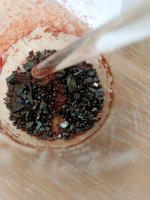
So, I wanted to create DMT HCl so I dissolved my DMT with <= 37% HCl. I used some heat to evaporate most of the water (not to the point of boiling) and just let it sit for a couple days to fully dry. The end result is the picture I attached, a orange-black, glass like substance, that is hard with sharp edges.

I'm curious to know if this ever happened to any of you or if anyone knows what went wrong here. Is it possible that DMT salt can create polymorphs just like freebase does with heat? The mixture got dark really really quick when I mixed it with the acid, it wasn't something that got dark over time.
 

Attachments
  • IMG_20250828_084834.jpg
    IMG_20250828_084834.jpg
    3.4 MB · Views: 16
Last edited:
Well, it's quite surprising to see that you've (apparently) succeeded in producing solid DMT.HCl at all. Normally, it's said to be far too hygroscopic/deliquescent for crystals to survive for very long while exposed to the atmosphere.

It looks like you have a certain amount of polymerisation and decomposition from the prolonged heating in contact with the air, but the persistence of the crystalline structure suggests that this is largely aesthetic. A tiny amount of a highly coloured substance can have a dramatic effect on the appearance.

Then again, you say the colour appeared practically immediately on addition of the acid. This suggests to me that a chemical reaction with something in either the acid or the DMT has occurred.

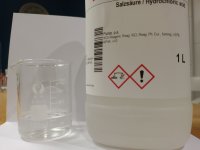
What does your acid look like? I have a sneaking suspicion that it may be at fault. A picture of some of the HCl in a clear glass beaker, photographed against a white background under neutral lighting, would be very helpful here.
 
Well, it's quite surprising to see that you've (apparently) succeeded in producing solid DMT.HCl at all. Normally, it's said to be far too hygroscopic/deliquescent for crystals to survive for very long while exposed to the atmosphere.

It looks like you have a certain amount of polymerisation and decomposition from the prolonged heating in contact with the air, but the persistence of the crystalline structure suggests that this is largely aesthetic. A tiny amount of a highly coloured substance can have a dramatic effect on the appearance.

Then again, you say the colour appeared practically immediately on addition of the acid. This suggests to me that a chemical reaction with something in either the acid or the DMT has occurred.

What does your acid look like? I have a sneaking suspicion that it may be at fault. A picture of some of the HCl in a clear glass beaker, photographed against a white background under neutral lighting, would be very helpful here.
I have to say I live in a very dry climate, maybe that's why it crystalized 🤷‍♂️

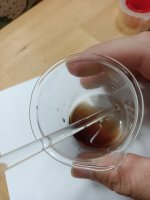
I have to correct myself. When I mixed the freebase DMT (extracted from mimosa) the mixture got a really dark brown color. But right after adding heat, it got completely black (I'm attaching a picture of a bit of DMT + HCl I just mixed to show the color)

I'm also attaching a picture of the acid, it looks just like water tho. It also said in the container that the boiling point of the acid is 42°C, so even tho it was boiling, I guess it didn't get as hot as I first thought.

Thanks for your quick response, and sorry for my delay, I got a really buddy day at work today.
 

Attachments

  • IMG_20250829_004329.jpg
    IMG_20250829_004329.jpg
    2.3 MB · Views: 13
  • IMG_20250829_003726.jpg
    IMG_20250829_003726.jpg
    2.2 MB · Views: 13
What colour was the DMT before adding the acid? In the picture where you've added the acid, it looks like you might have some contamination from the bark soup. A picture of the freebase would be helpful if you happen to have one.

Either way, you should be able to run your coloured product through another miniature extraction, since you've effectively already done the acid part of a mini A/B.

Another option would be to dissolve it in distilled water and add a pinch of activated carbon to clean up the colour.

Thinking about this a bit more, if you've added concentrated acid directly onto solid freebase DMT there's a likelihood that the strongly exothermic reaction in the highly acidic environment may have caused some side reactions to produce the highly coloured byproducts.

Next time, dilute the acid first, and maybe even dissolve the DMT in something like heptane or another reasonably inert, fully water-immiscible non-polar solvent in order to prevent discoloration through scorching.

When you added the HCl to the DMT, how exactly did you go about this?
 
What colour was the DMT before adding the acid? In the picture where you've added the acid, it looks like you might have some contamination from the bark soup. A picture of the freebase would be helpful if you happen to have one.

Either way, you should be able to run your coloured product through another miniature extraction, since you've effectively already done the acid part of a mini A/B.

Another option would be to dissolve it in distilled water and add a pinch of activated carbon to clean up the colour.

Thinking about this a bit more, if you've added concentrated acid directly onto solid freebase DMT there's a likelihood that the strongly exothermic reaction in the highly acidic environment may have caused some side reactions to produce the highly coloured byproducts.

Next time, dilute the acid first, and maybe even dissolve the DMT in something like heptane or another reasonably inert, fully water-immiscible non-polar solvent in order to prevent discoloration through scorching.

When you added the HCl to the DMT, how exactly did you go about this?
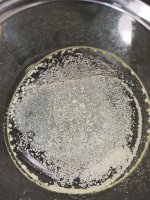
I'll link a picture of one of the batches. When I extract it I do at least one water bath, no amount of bark mixture should end up in the mixture.

I did add the concentrated acid directly onto the solid freebase DMT. First time I did dissolve the DMT in acetone before dropping the HCl, and second time (the one I did to show you) I didn't even dissolve it first. So it might be what you say and some side reaction has occurred and destroyed a percentage of the DMT.

Next time I know what to do, thanks a lot.
 

Attachments

  • IMG_20250830_013853.jpg
    IMG_20250830_013853.jpg
    4.4 MB · Views: 6
First time I did dissolve the DMT in acetone before dropping the HCl
Bit of a footnote now, but that could also get messy because acetone reacts with concentrated HCl to produce species which can then react with DMT. This is why I'd suggest a more inert solvent like heptane or toluene, even if they're water-immiscible. Ethanol would probably be OK with dilute HCl, though.
 
Back
Top Bottom