• Members of the previous forum can retrieve their temporary password here, (login and check your PM).

Circulating Freeze Precip

Icon

Titanium Teammate
Donator
Concept:

One container being warmed, a second container being cooled or left at room temp. They're connected somehow and filled with solvent. In the hot container, an excessive amount of dmt is added. The solution reaches saturation.

It might work better if the entire setup is cooled at this point and some crystals form (everywhere at random) but specifically in the cold container. Or a seed could be added.

As long as the hot container (40c) is kept saturated with excess DMT, and the dissolved DMT has a cooler area (0c) to settle in, wouldn't equilibrium slowly move the pile of crystals from the hot container to the cold container?

Could possibly even be the same container if the temperature gradient was strong enough. One half on a heat sink, other on a hot plate. An insulated divider or something that minimizes the thermal exchange of the two areas while still inviting the solute over. But, maybe at rest, that system would just reach some kind of equilibrium that prevents the transfer of molecules?

So I was thinking of adding circulation between two separate containers to better control their temperatures and force a continuous exchange. I feel like this has to be a thing already and I just haven't come across the name or technique yet.

Another variation I'm imagining is like a cold soxhlet; where warm solvent (40c?) drips through a mass of crystals, leeching them and flushing into a cooling chamber, which is slowly being pumped back through a heater to drop again.

Whether one divided chamber, or two chamber, or soxhlet - the point would be to keep the local solution in the cold area fed with DMT - to grow fatties.

Thoughts?
 
There are a few diagrams of this type of apparatus buried somewhere in my paper notes, so thanks nor articulating the idea, whereas I merely discounted it as impractical.

Complete saturation of the warm solution would also be potentially problematic. With temperatures lower than 0°C in the precipitation vessel, maximum saturation when warm is unnecessary and risks leading to oligomer/polymer formation, discoloration and goo.

I don't know if you've previous experience of fluid circulation systems, but there's nearly always a risk of leakage so you'd have to have secondary containment in place.

The orthodox thinking regarding production of large crystals is to use slow evaporation of solvent at a steady temperature. Another way of increasing crytal size is through temperature cycling, known as Ostwald ripening.

I'd love too see a system based on thermal gradient and solvent circulation in operation, though, just to see how well it might work, however unparsimonious it might be.
 
I feel like this has to be a thing already and I just haven't come across the name or technique yet.
I was so close lol. Had all the terms but I finally found an example of this proposed by someone 40 years ago.

There are a few diagrams of this type of apparatus buried somewhere in my paper notes, so thanks nor articulating the idea, whereas I merely discounted it as impractical.

Complete saturation of the warm solution would also be potentially problematic. With temperatures lower than 0°C in the precipitation vessel, maximum saturation when warm is unnecessary and risks leading to oligomer/polymer formation, discoloration and goo.
Their design takes into consideration the problem with complete saturation that you brought up.

Growth from Solutions
(d) Temperature gradient techniques
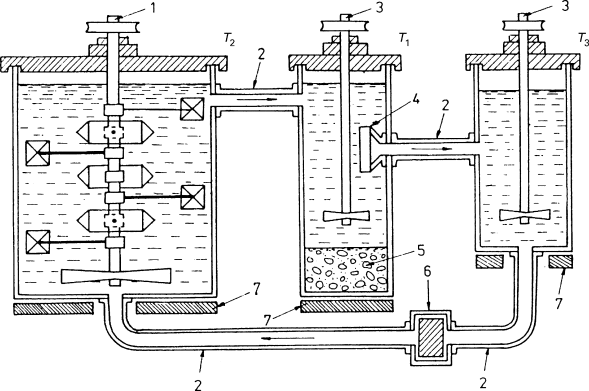
In temperature gradient techniques, the desired supersaturation for growth is achieved by forming two regions of different temperatures T1 and T2. In one of the regions at a higher temperature, T1, the substance is dissolved, while in the other region of temperature T2 crystal growth takes place on a mounted seed. The material transport is ensured by natural, thermal, or forced convection. Accordingly, the apparatus designs for the three types are different. Large crystals are obtained in crystallizers based on forced convection.

In crystallizers based on forced convection, the solution is pumped usually between two separate chambers kept at different temperatures. However, an additional tank at a temperature T3>T1 may be inserted between the nutrient tank at temperature T1 and the growth tank at temperature T2 as in the three-tank system of Walker and Kohman (Fig. 4). The additional tank serves as a reservoir of a subsaturated solution, which is pumped to the growth tank and again back to the nutrient tank to be reheated and resaturated. The additional tank also reduces the occurrence of parasitic nucleation in the connecting pipe between the nutrient and growth tanks.

3-s2.0-B0080431526006550-gr4.gif

Figure 4. Three-tank crystallizer of Walker–Kohman: (1) stirrer with limbs for mounting crystals, (2) connecting pipes, (3) stirrers, (4) filter, (5) nutrient, (6) pump, (7) supports. Arrows in the connecting pipes indicate the direction of circulation of solution (reproduced by permission of Springer Verlag from ‘Modern Crystallography III: Crystal Growth’, 1984).
 
Last edited:
I was so close lol. Had all the terms but I finally found an example of this proposed by someone 40 years ago.


Their design takes into consideration the problem with complete saturation that you brought up.


3-s2.0-B0080431526006550-gr4.gif

Figure 4. Three-tank crystallizer of Walker–Kohman: (1) stirrer with limbs for mounting crystals, (2) connecting pipes, (3) stirrers, (4) filter, (5) nutrient, (6) pump, (7) supports. Arrows in the connecting pipes indicate the direction of circulation of solution (reproduced by permission of Springer Verlag from ‘Modern Crystallography III: Crystal Growth’, 1984).
Fantastic - there's nothing new under the sun as the saying goes! That Walker-Kohmann design looks like a properly-drawn version of the one in my notes, except for the goal of growing the crystals on those little stalks, as opposed to my aim of precipitating loads of DMT as part of a continuous extraction process, now that I recall 😁
 
I'm a little confused about that part of the drawing, whether those stalks are branched stirring paddles or where the seed crystals go. Maybe the elongated hexagons straddling the axle are the crystals.

Seems like it would definitely need a seed though or the system could do a full circulation and reach saturation. It would still take some finessing to ensure the seeds keep up with the circulation. I guess the slowest circulation possible that still keeps heat and solutes moving in one direction.

You could probably modify this to work with bark extraction. If the lye soup is kept gently stirred and a layer of solvent is on top, could slowly pull from that as your source. The returning solvent could maybe be introduced from the bottom so it has to pass through the liquid. I actually haven't done too many wet bark extractions. In a wet A/B does DMT float to the surface? In STB is it more stuck to the bark or does it move to the surface too?

That would make the ultimate timelapse. A whole root in a lye vessel, and the crystal chamber next to it slowly growing from the root solution.

Anyway I'm going to keep working on this and come up with some kind of build to try. I have a pretty good idea of how I could do it but I'm searching for a few glass containers with hose barbs on the bottom that have a ~3" wide lid to accommodate the stirrer. It would be so much easier to make something by drilling a hole in a glass jar and adding a barb, but idk what I could use to seal it that's solvent proof. Maybe instead of a barb I could plug the hole with a nitrile plug and stick a needle through it.

My secret weapon is a peristaltic pump and tygon tubing. I've only seen it name dropped a couple times, but I'm loving it.
 
Last edited:
That's an ambitious plan! Maybe not something to attempt building out of glass jars on the first attempt. The more joints there are, the more chance there is of leakage.

Dip tubes might prove to be a better option, but ideally one would get into laboratory glassblowing (I wish I had!) Another item to bear in mind is the 'flange flask'. These are wider-mouthed laboratory vessels with a ground glass flange and corresponding lids which can have multiple standard taper socket joints as ports in the top. Very handy, if rather expensive - unless you get lucky and buy a used one off somebody who has no idea what it is ;)

For the NPS extraction component, I've considered using a liquid-liquid countercurrent column which I've outlined here, as a rough plan for making one by modifying a Liebig condenser (glassblowing required), although the OP in that thread went on to try something using plastic tubing, afaics.
 
That's a clever idea. In your drawing, only the base soup pump is labeled peristaltic. Is it implied that the NPS pump is also peristaltic or is there another type that could work?

I was originally thinking dip tubes too, but after seeing the Walker-Kohman design and doing some reading, it seems like stirring is important - something I was going to neglect entirely. I got a little worried dip tubes could get in the way.

I came across "bulkhead fitting" last night. It'll just have to be square jars so there's a flat plane for the washer to compress evenly for a watertight seal. I suppose it doesn't have to be glass, could be HDPE containers. I'm already putting a lot of faith in Tygon, PTFE, PP, SS, Buna-N. Compatibility with hexane is good for all of those. I think PP is the most questionable as temperatures rise.

The few pieces of lab glass I could find that might be suitable were ridiculously expensive so here's hoping DIY works.
 
That's a clever idea. In your drawing, only the base soup pump is labeled peristaltic. Is it implied that the NPS pump is also peristaltic or is there another type that could work?

I was originally thinking dip tubes too, but after seeing the Walker-Kohman design and doing some reading, it seems like stirring is important - something I was going to neglect entirely. I got a little worried dip tubes could get in the way.

I came across "bulkhead fitting" last night. It'll just have to be square jars so there's a flat plane for the washer to compress evenly for a watertight seal. I suppose it doesn't have to be glass, could be HDPE containers. I'm already putting a lot of faith in Tygon, PTFE, PP, SS, Buna-N. Compatibility with hexane is good for all of those. I think PP is the most questionable as temperatures rise.

The few pieces of lab glass I could find that might be suitable were ridiculously expensive so here's hoping DIY works.
Please consider using an alternative solvent than hexane. Neurotoxicity is no joke.

Another pump? Dual Tesla-valve rocking pump? Hydraulic ram? :ROFLMAO: Peristaltic was chosen for the viscosity and aggressive nature of the base soup. Tbh, considering it was somebody else's project, I wasn't that bothered about specifying what to pump the naphtha with. Standard rotary vane/centrifugal would also work, if you've a spark free motor.
 
Would heptane be more acceptable? I have both, was just thinking lower solubility is better. I use a full-face respirator with organic vapor cartridges, strong ventilation ducted to within inches of the vessels, and try not to be near exposed solvent anyway, drawing and transferring it with the peristaltic pump. A side quest with these different fittings and materials is to not expose the solvent to open air at all when handling it.

Or are you more concerned about solvent contaminating the product?
 
Last edited:
Back
Top Bottom